
A complete issue · 16 pages · 1883
Judge — January 6, 1883
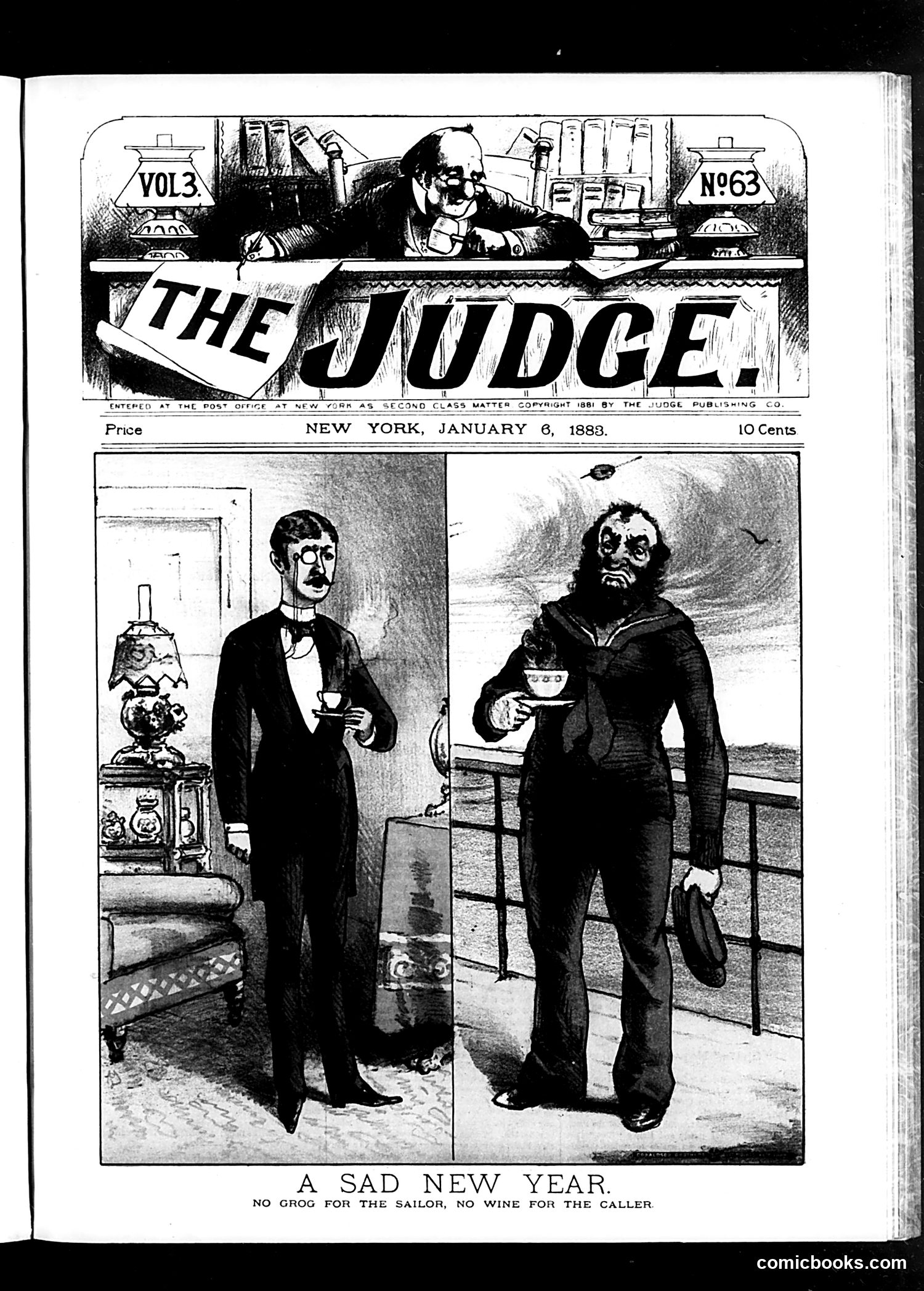
This cartoon depicts two contrasting figures on New Year's Day 1883. The left shows a well-dressed gentleman indoors with an ornate lamp, holding what appears to be tea or coffee. The right shows a disheveled, bearded sailor or working-class man outdoors, also holding a cup. The caption reads: "NO GROG FOR THE SAILOR, NO WINE FOR THE CALLER" This satirizes likely temperance or prohibition-related policies enacted around New Year's 1883. The cartoon suggests that both social classes—wealthy and working poor—were denied their traditional alcoholic beverages (wine for the genteel caller; grog for the sailor), presenting this as a shared "sad" consequence. The juxtaposition critiques how such restrictions affected everyone across class lines.
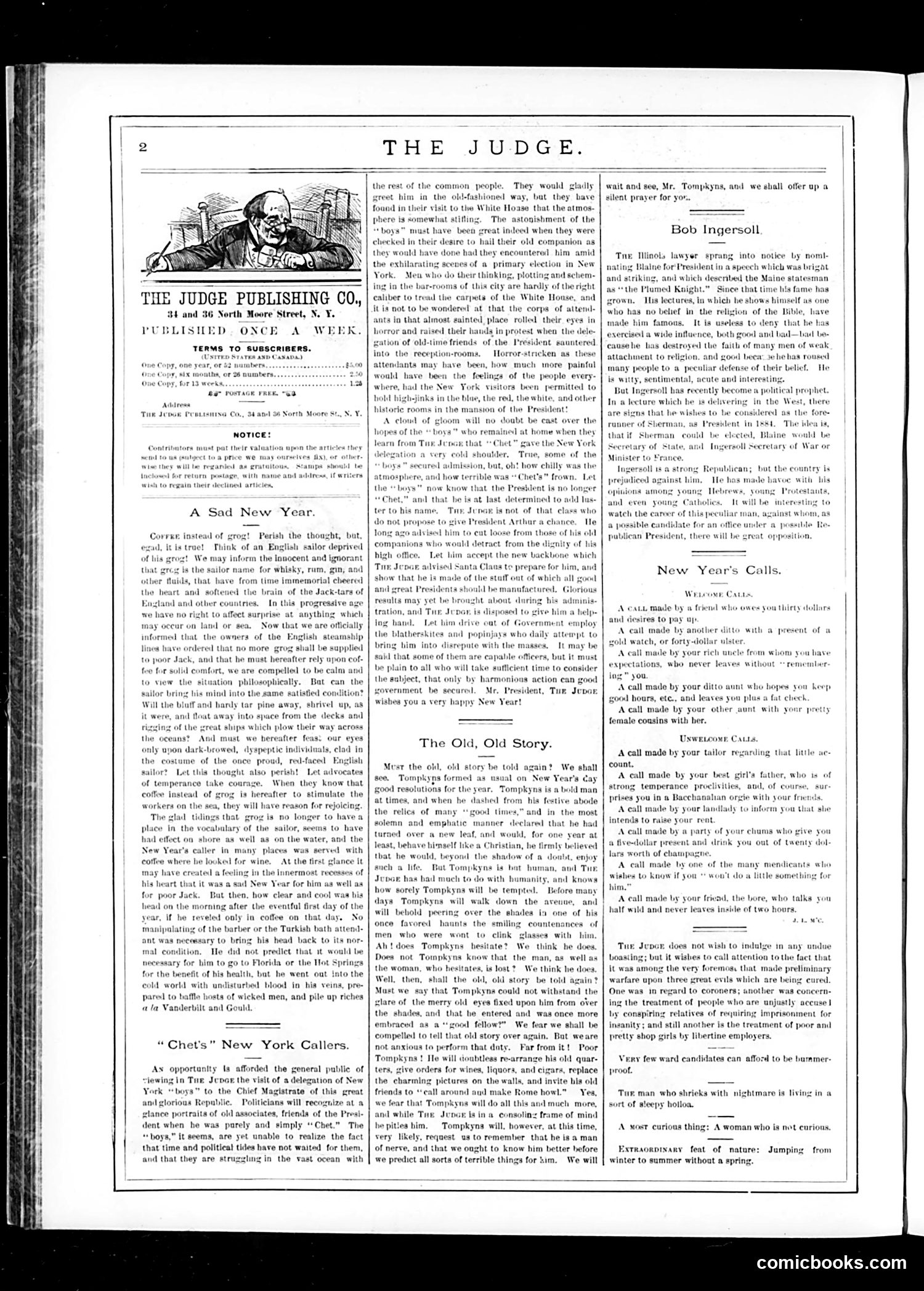
This page from Judge magazine contains satirical commentary on early-1900s American politics and social issues: **Main Cartoon/Content:** The prominent illustration depicts a figure labeled "THE JUDGE PUBLISHING CO." as a stern authority figure, introducing the magazine's editorial voice. **Key Articles:** 1. **"A Sad New Year"** satirizes Prohibition-era temperance movements, mocking the elimination of alcohol ("grog") from sailors' rations. The author laments that English sailors—historically associated with rum consumption—must now drink coffee instead, treating this as cultural tragedy. 2. **"Chet's New York Callers"** ridicules President Chester Arthur's old political associates visiting the White House. The satire suggests these uncouth "boys" from Arthur's past embarrass refined White House staff with their crude manners and appearance, highlighting tensions between old political cronies and refined governance. Both pieces reflect Judge's conservative, elitist perspective—opposing temperance reform while mocking working-class politicians who don't fit genteel standards.
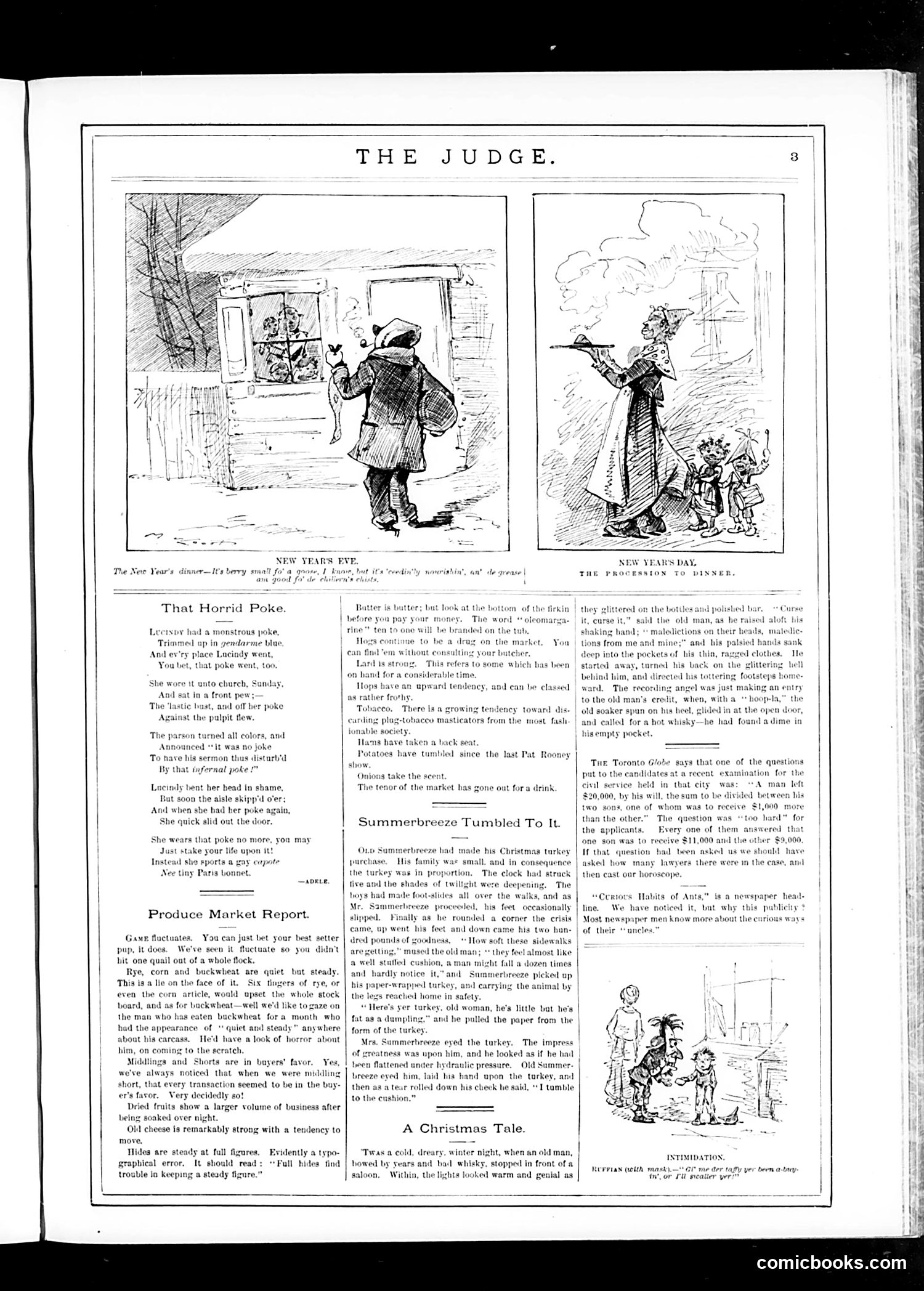
This page from *Judge* magazine contains several satirical pieces aimed at Victorian-era social customs and contemporary issues: **"That Horrid Poke"** mocks the exaggerated fashion of large bustles ("pokes"), using a character named Lacindy whose oversized garment creates public disruption—flying up in church, hitting the pulpit. The joke targets the absurdity of women's fashions prioritizing appearance over practicality. **"Produce Market Report"** appears to be financial satire, likely poking fun at agricultural market volatility and unreliable reporting through deliberately contradictory statements about commodity prices. **"Summerbreeze Tumbled To It"** is a humorous anecdote about an elderly man slipping while carrying his Christmas turkey home, with the gentle punchline that despite his mishap, the turkey remains intact—a mild, sentimental comedy. **"A Christmas Tale"** (bottom) begins a story about an old man entering a warm saloon, likely setting up social commentary about poverty or charity. The illustrations support these verbal narratives with period-appropriate sketches showing fashionable dress and domestic scenes.
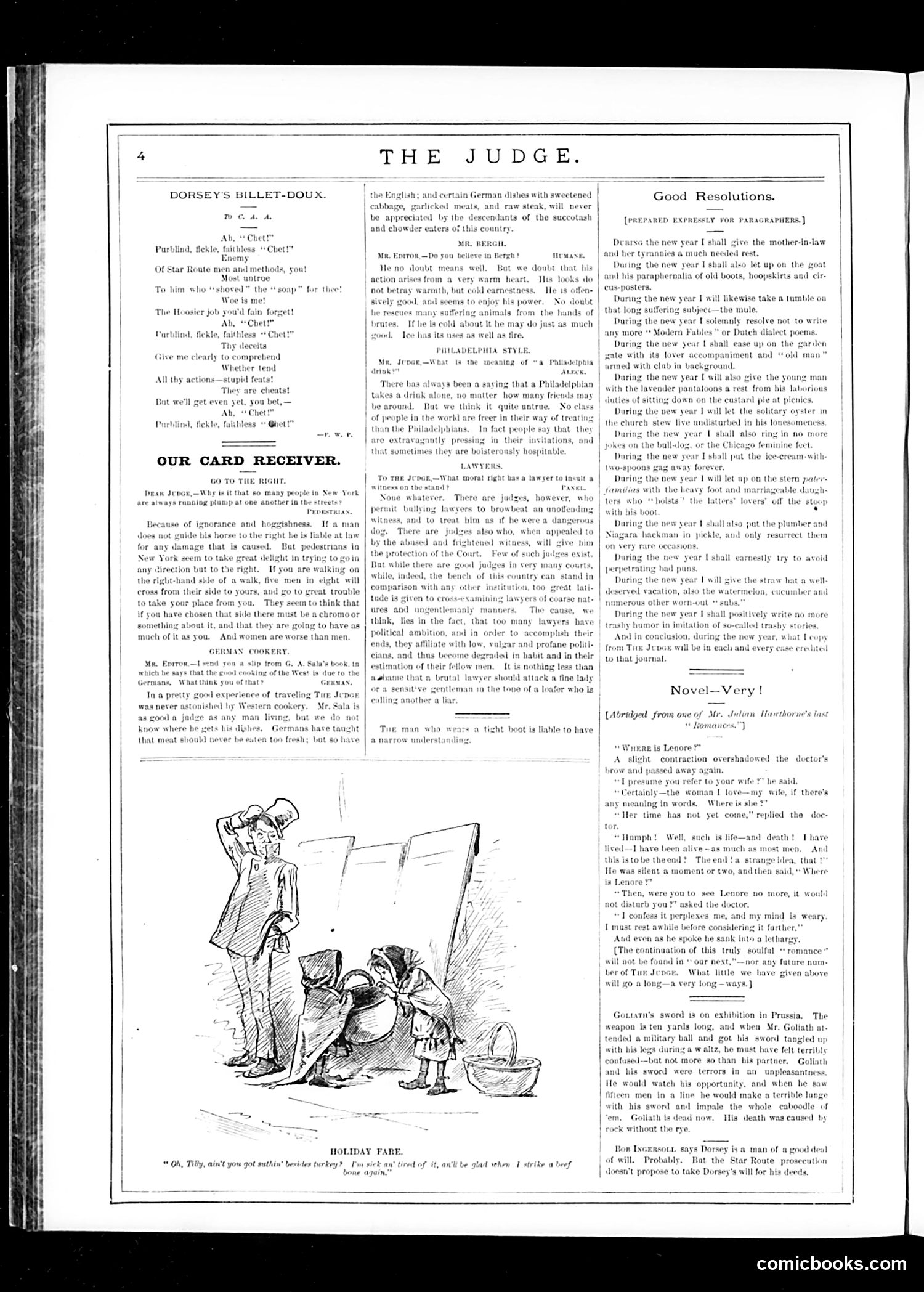
This page from *Judge* magazine contains satirical commentary on contemporary issues circa the 1880s-1890s: **"Dorsey's Billet-Doux"** mocks a political figure (likely Dorsey, a Star Route scandal figure) through mock-romantic verse. **"Our Card Receiver"** satirizes lawyers' behavior—specifically their perceived arrogance, dishonesty, and hostility toward clients and the public. The joke criticizes how lawyers insult people with impunity and behave unethically. **"German Cookery"** humorously contrasts American and German eating habits, stereotyping German cuisine as heavy and challenging for American palates. **"Holiday Fare"** (the illustration) shows someone eagerly anticipating holiday food, with the caption making a joke about bread or provisions. **"Good Resolutions"** presents tongue-in-cheek New Year's pledges about tolerating annoying people and things. The overall tone is satirical commentary on urban American life, professional ethics, and social pretensions of the era.
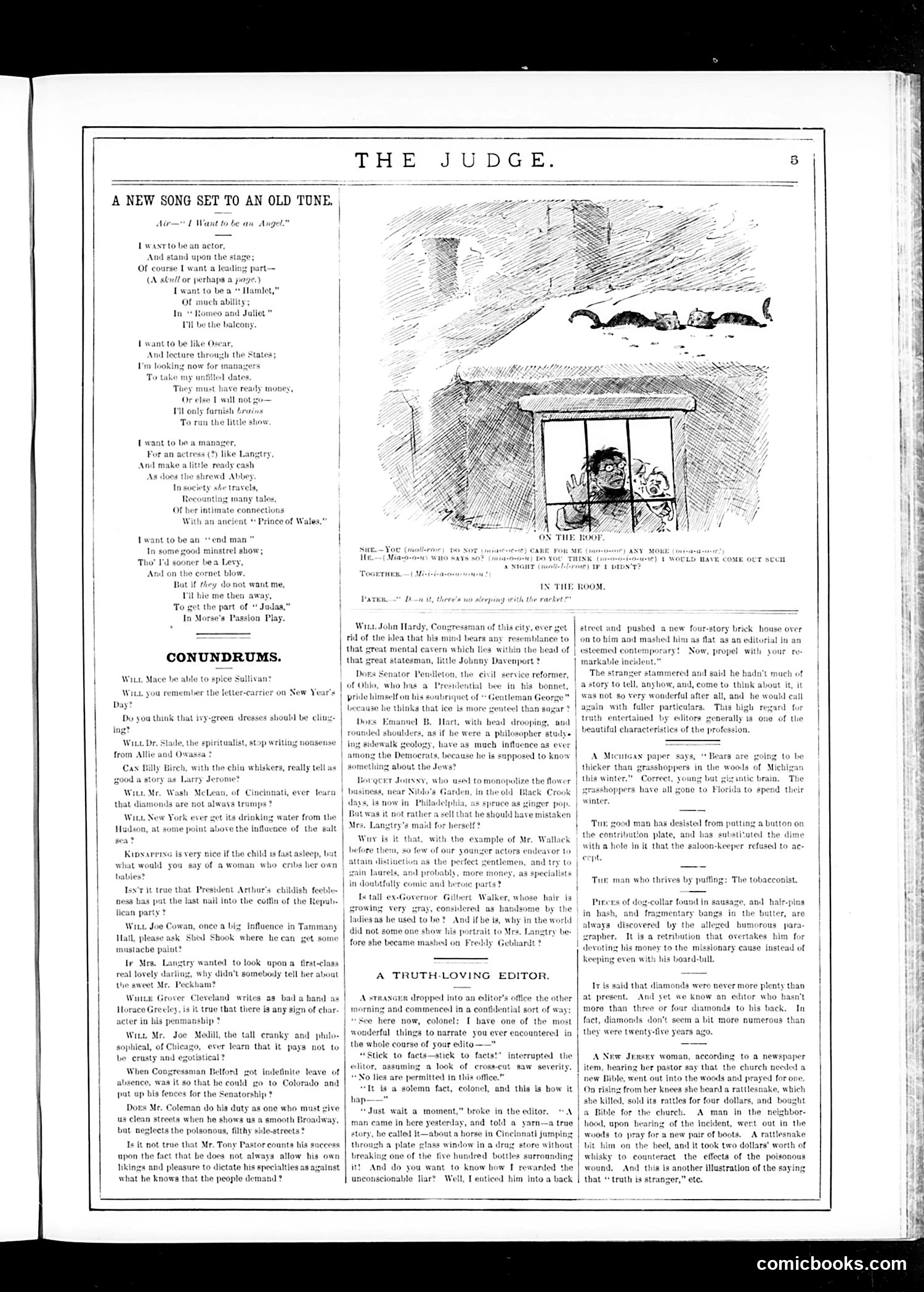
This page combines theatrical ambition satire with political commentary. The main song parodies actors desperately seeking famous roles—from Hamlet to minstrel shows—satirizing theatrical pretension and desperation for employment. The specific reference to "Prince of Wales" likely mocks actress Lillie Langtry, who was famously associated with the Prince. The "Conundrums" section uses absurdist humor to mock contemporary figures: Congressman John Hardy (depicted as mentally inferior), spiritualist Dr. Slade (fraudulent), and various minor celebrities. The rooftop illustration appears to show domestic chaos or marital discord. A "Truth-Loving Editor" anecdote ridicules an editor's fabricated sob story about an injured horse, satirizing journalistic dishonesty and sentimentality. Overall, the page targets theatrical pretenders, corrupt politicians, fraudulent spiritualists, and dishonest editors—typical Judge targets combining entertainment industry and political mockery.
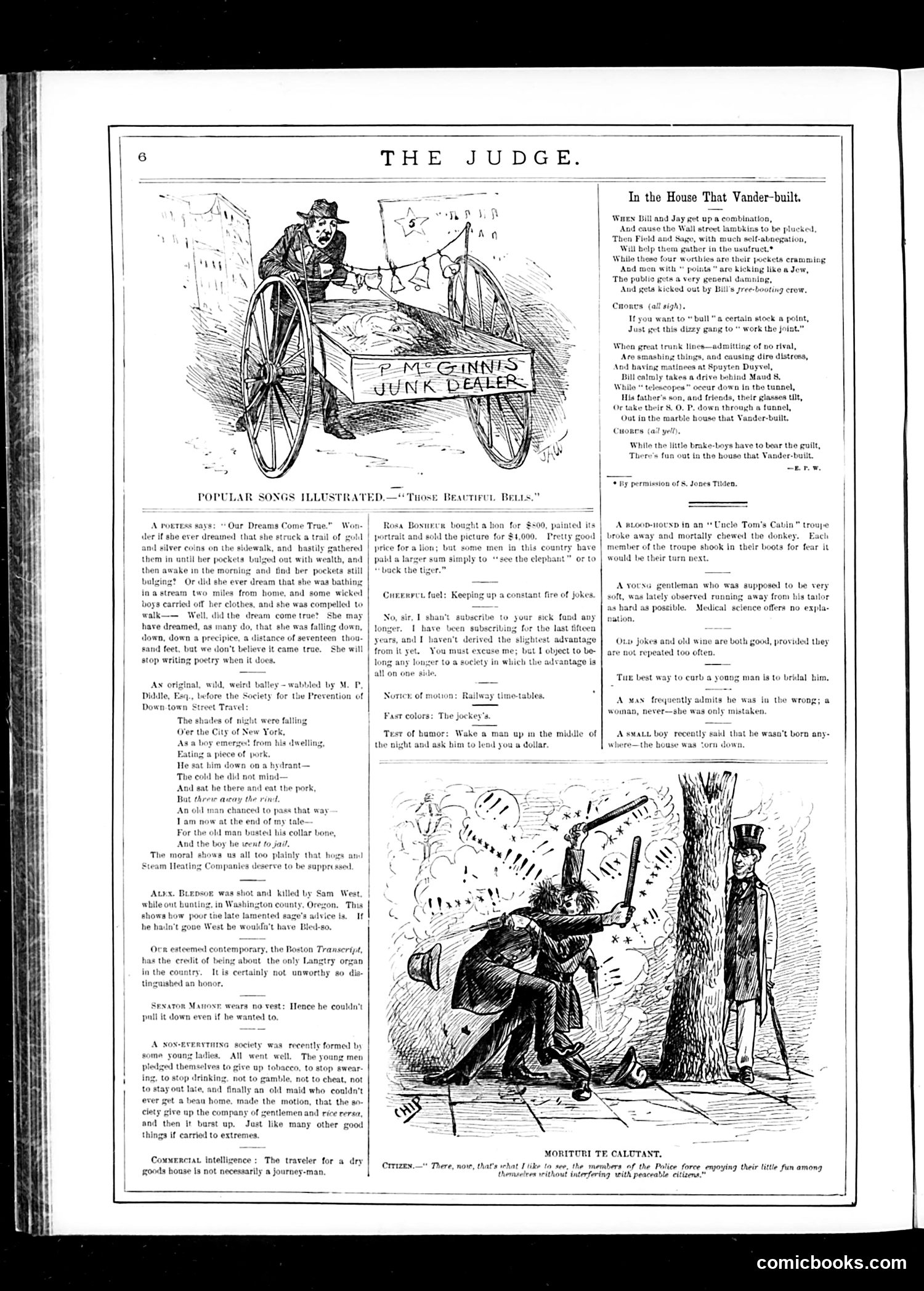
This page from *Judge* magazine contains several satirical pieces typical of late 19th-century American humor. The main cartoon depicts **P. McGinnis, Junk Dealer** with a horse-drawn cart, likely mocking petty business or urban commerce. The text includes social commentary: jokes about women's poetry, a senator (appears to be **Senator Mattox**) wearing no vest, and references to **Vanderbilt** wealth and railroad dealings—likely satirizing wealthy industrialists' market manipulation during the Gilded Age. A "no-everything society" sketch mocks extremist reform movements. The final illustration labeled "Morituri Te Salutant" shows what appears to be police officers, with sardonic commentary about law enforcement "enjoying their little fun" among civilians—suggesting corruption or abuse of authority. The humor relies on gentle mockery of contemporary business practices, class pretensions, and social reformism rather than sharp political critique.
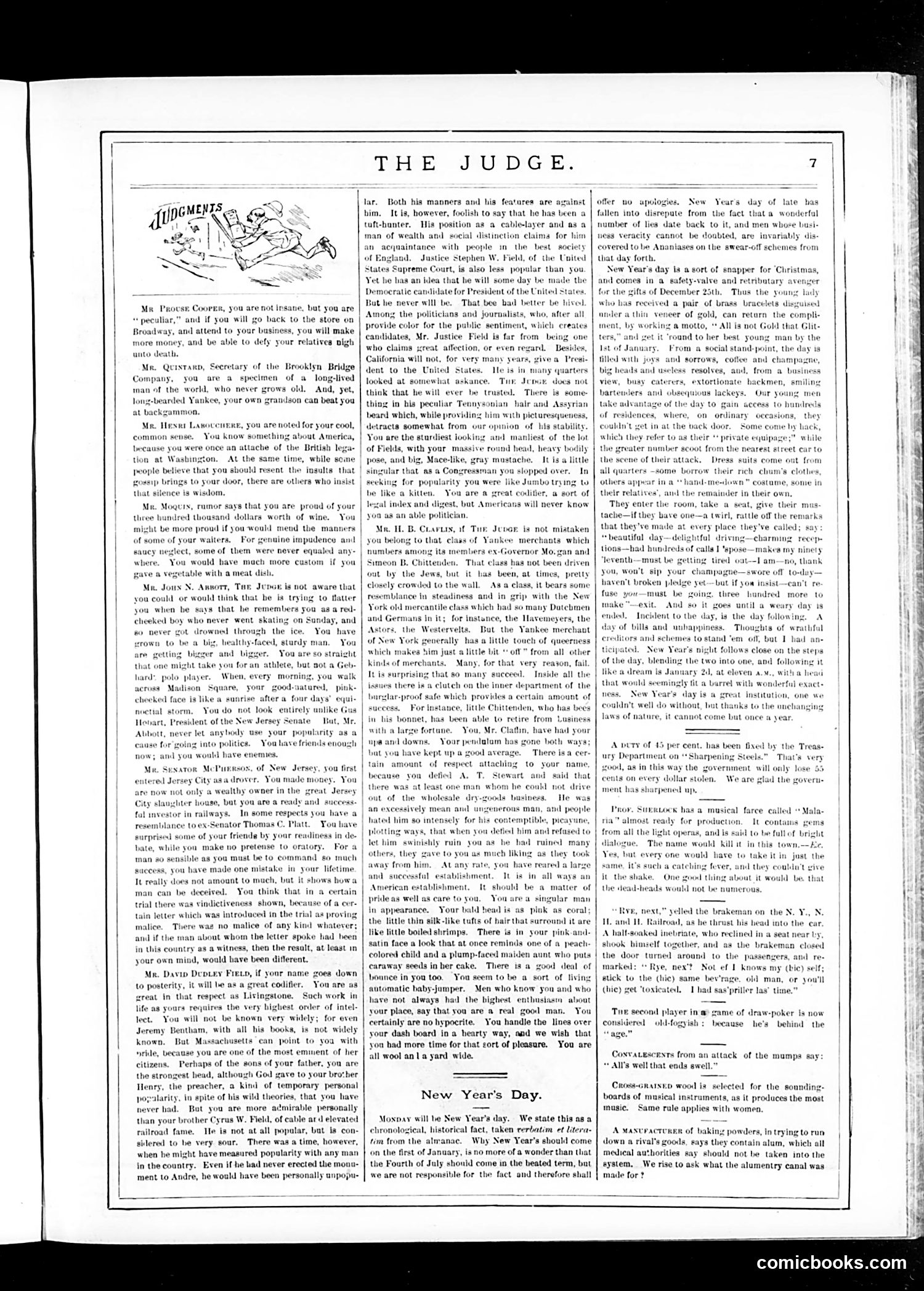
This page from Judge magazine consists primarily of **personal character attacks** on prominent American figures of the era, written as open letters. The main targets appear to be wealthy industrialists and politicians, including figures associated with major infrastructure projects (the Brooklyn Bridge is mentioned). The satire mocks these men for their business practices, personal vanity, and lack of genuine popularity despite their wealth and prominence. One letter addresses a "Senator" involved in Jersey City slaughtering operations, criticizing his moral character. Another targets Justice Stephen W. Field, suggesting despite his wealth and position, he lacks real respect and will never become President. The humor relies on **harsh personal critique** rather than visual comedy—attacking their appearance (beards, mustaches), their social pretensions, and the gap between their self-regard and actual public esteem. This reflects Judge's aggressive style of muckraking satire targeting the Gilded Age wealthy and politically connected.
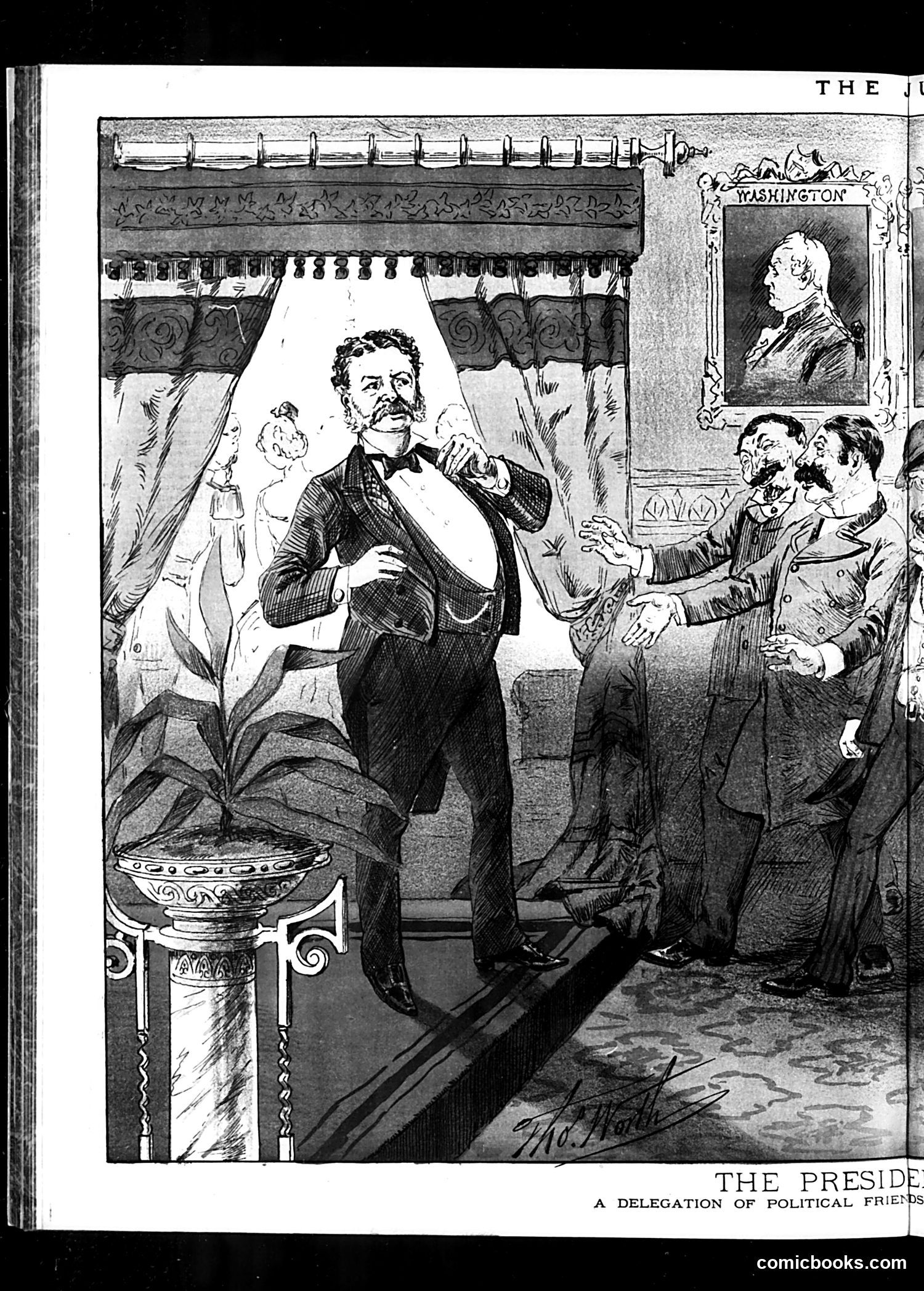
This cartoon depicts "The President" receiving "A Delegation of Political Friends" in what appears to be an ornate White House interior. The central figure—a well-dressed man with a distinctive mustache—stands while three visitors approach him. A portrait labeled "Washington" hangs on the wall, invoking the nation's founding ideals. The satire criticizes the practice of political patronage and favor-seeking. The "delegation of political friends" represents individuals seeking appointments, contracts, or other benefits from the President in exchange for political support—a common practice in Gilded Age politics. The cartoon mocks how presidential audiences became opportunities for political operatives to cash in on their connections rather than discuss matters of state principle. The formal setting contrasts ironically with the transactional nature of the meeting, suggesting corruption masquerading as official business.
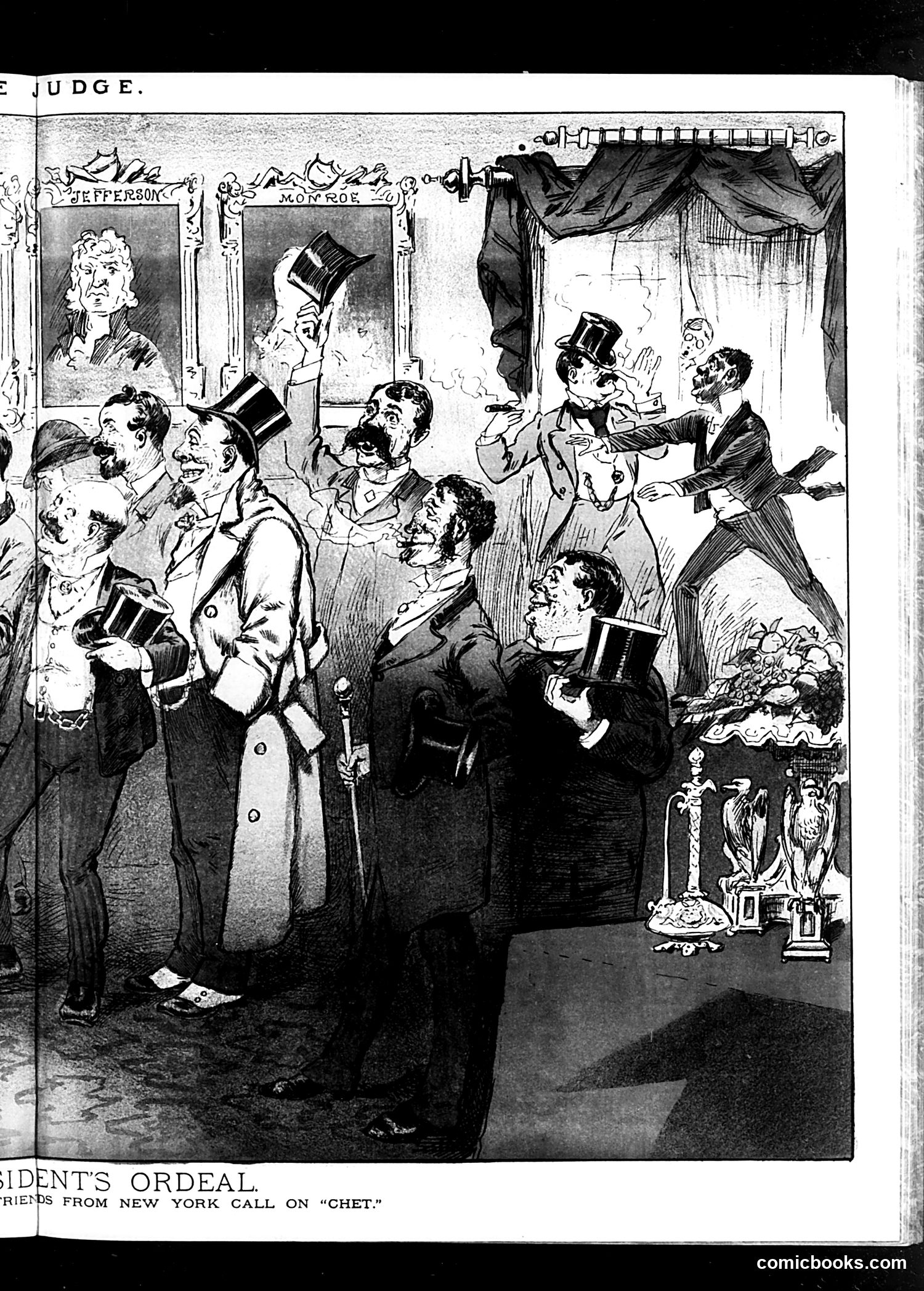
This Judge magazine cartoon satirizes a visit by New York political figures to "Chet" (likely Chester Arthur, based on the portraits of Jefferson and Monroe visible on the wall). The cartoon depicts well-dressed gentlemen in top hats, some appearing anxious or uncomfortable, gathered in what appears to be an official setting with ceremonial objects displayed. The satire likely comments on the awkwardness or tension surrounding these political "friends from New York" making a formal call on a prominent figure. The exaggerated facial expressions and body language suggest discomfort or insincerity in their interactions. Without the complete text visible, the specific political scandal or event being mocked remains unclear, though the scene implies commentary on patronage politics or diplomatic formality of the Gilded Age era.
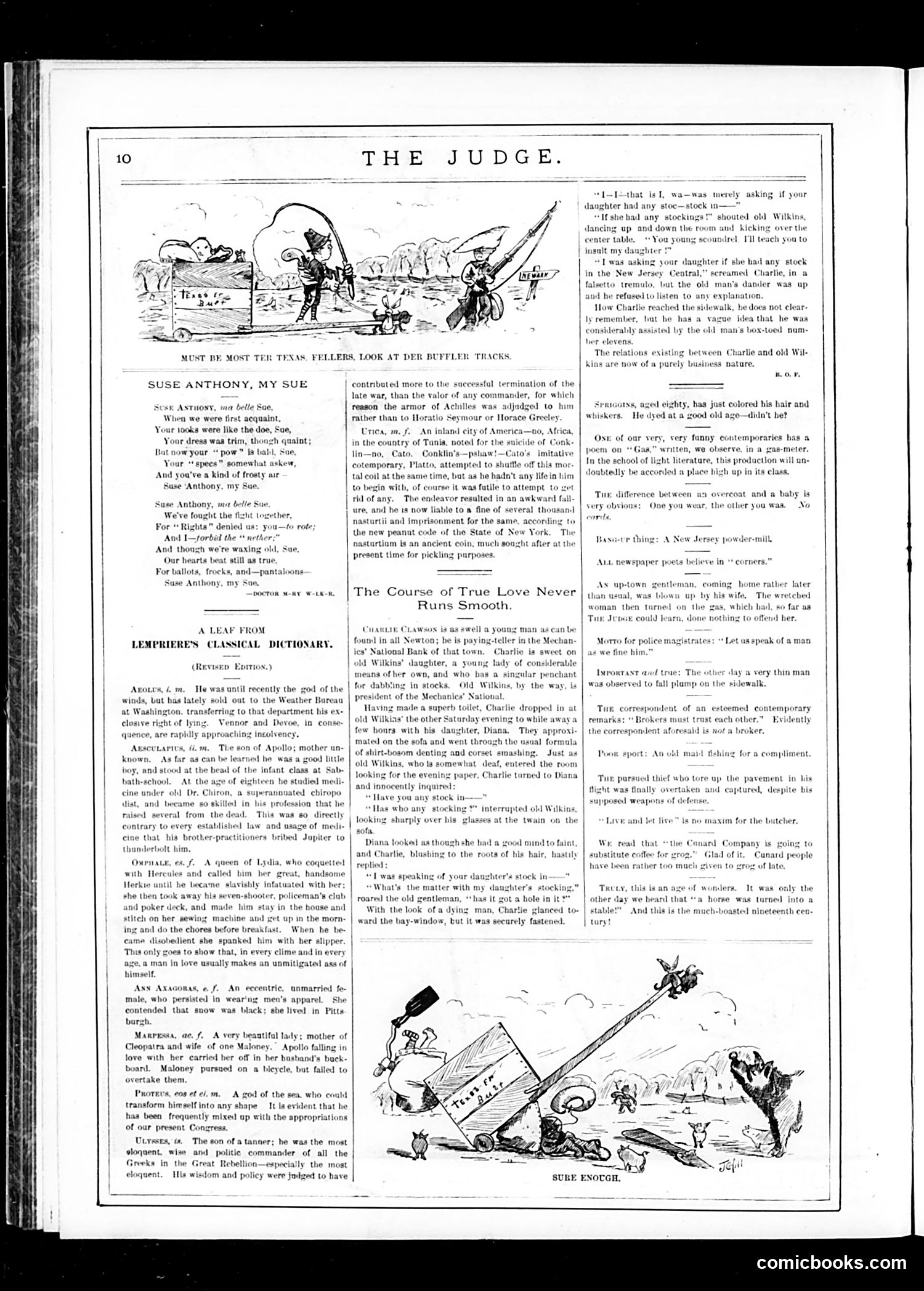
This page from Judge contains several satirical pieces targeting 1870s-80s social pretensions and contemporary figures: **Main cartoons:** The top illustration depicts a mishap involving Texas buffalo tracks and frontier life, mocking rural characters. **"Suse Anthony, My Sue"** is a poem mocking Susan B. Anthony (prominent women's rights activist), portraying her as aging and vain—"coloring his hair and whiskers." The satire ridicules her activism through mockery of her appearance. **"The Course of True Love Never Runs Smooth"** narrates young Charlie's misadventure: he asks a girl about stock investments, her father (old Wilkins) misunderstands it as an insulting reference to her stockings, and violently ejects Charlie. The satire mocks both the miscommunication and the father's violent overreaction. **Dictionary entries** parody classical references with absurd American contemporary substitutes. The page demonstrates Judge's characteristic approach: mixing political/social satire with crude personal attacks on prominent figures, particularly women activists, using misunderstandings and violence for comedic effect.
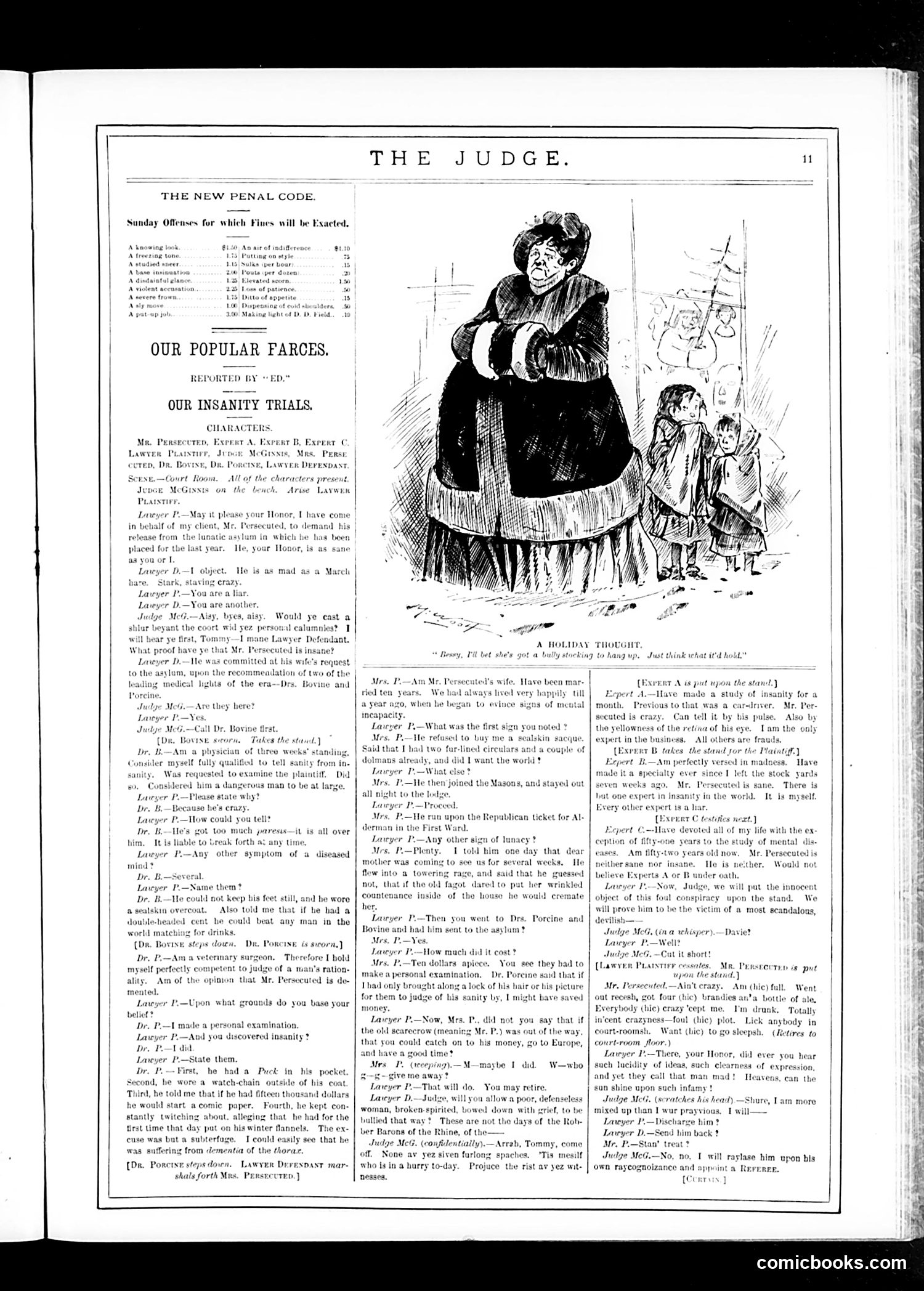
This page satirizes the American legal system's handling of insanity defenses, specifically mocking expert psychiatric testimony. The central cartoon depicts a grotesquely obese woman—Mrs. Persecuted—at the center of a courtroom farce. The text presents a mock trial where multiple "experts" (labeled A, B, C) offer contradictory diagnoses about a man's sanity. The satire targets several absurdities: physicians with minimal training (Dr. Bovine has "three weeks' standing") pronounce definitive judgments; experts contradict each other openly; and the trial devolves into name-calling between lawyers. The humor derives from the system's obvious incompetence—no real expertise exists, yet courts rely on these "experts." Judge McGlynn's Irish-accented interjections add comedic incompetence to the bench itself. The final irony: the allegedly insane man appears perfectly rational, while the entire legal proceeding is demonstrably absurd. This reflects late 19th/early 20th-century anxiety about pseudoscientific psychiatry gaining courtroom authority.
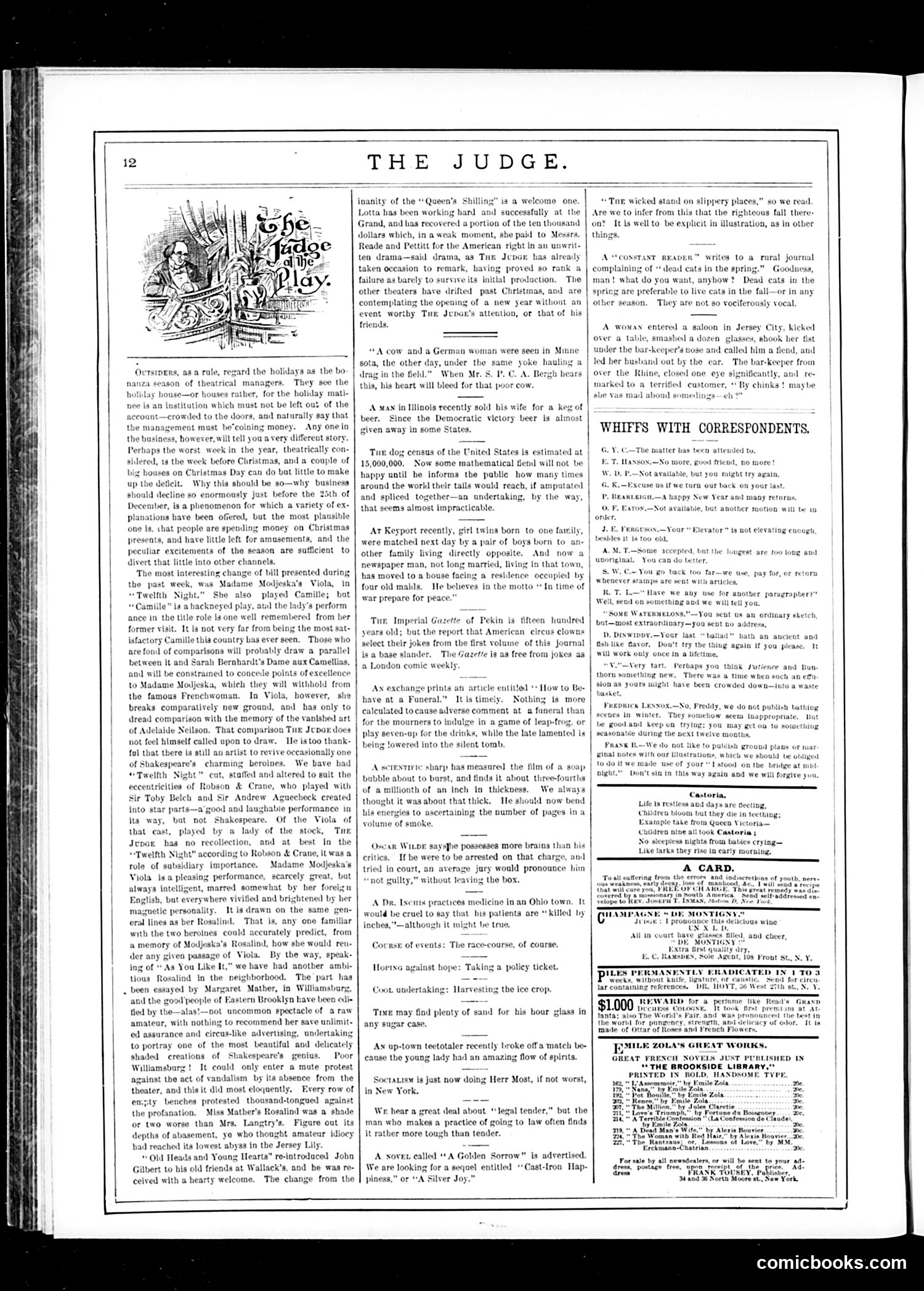
This page presents a theater criticism column reviewing recent Broadway productions. The main subjects discussed include: **Helena Modjeska's performances** in *Camille* and *Viola* - praised as satisfactory, though the critic notes her slight foreign accent and argues her interpretations closely parallel her previous roles (Rosalind). **Margaret Mather's amateur *Rosalind*** in Williamsburg - harshly mocked as incompetent vandalism of Shakespeare, worse even than Lily Langtry's notorious amateur performances. The empty theater seats are presented as "thousand-tongued" protest. **John Gilbert's return** in *Old Heads and Young Hearts* at Wallack's - welcomed warmly by audiences. The column also discusses the theatrical paradox that Christmas week—seemingly promising for theaters—actually underperforms because audiences spend holiday money on shopping rather than entertainment. The satire targets both pretentious amateurs attempting serious roles and public taste during holidays.
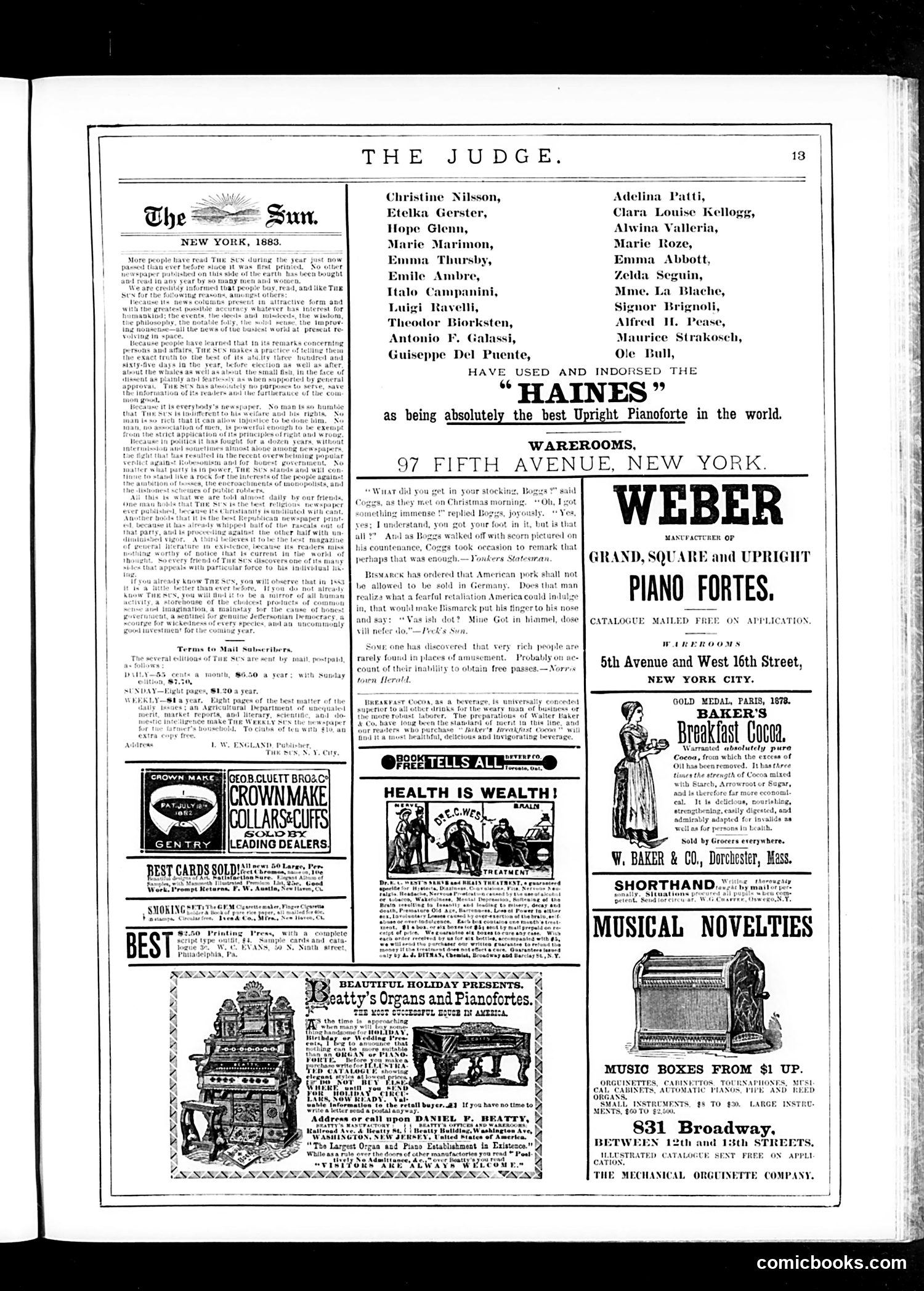
This page is primarily **advertising**, not satire or political commentary. It showcases luxury goods targeting wealthy consumers in the Gilded Age. The central advertisement features **famous opera singers and musicians** (Christine Nilsson, Adelina Patti, Italo Campanini, etc.) endorsing Haines pianos as "absolutely the best Upright Pianoforte in the world." This celebrity endorsement strategy was novel and prestigious—these were internationally renowned performers, lending credibility to the product. Additional ads promote: - **Weber piano fortes** (competitor) - **Baker's Breakfast Cocoa** (luxury imported product, Gold Medal Paris 1878) - **Musical novelties** like music boxes and mechanical organs The implicit message: owning these instruments and products signals refined taste, cultural sophistication, and wealth—essential status markers for the American upper class during this era of industrial prosperity. The page reflects 1880s consumer culture where imported European goods and association with high culture conveyed social standing.
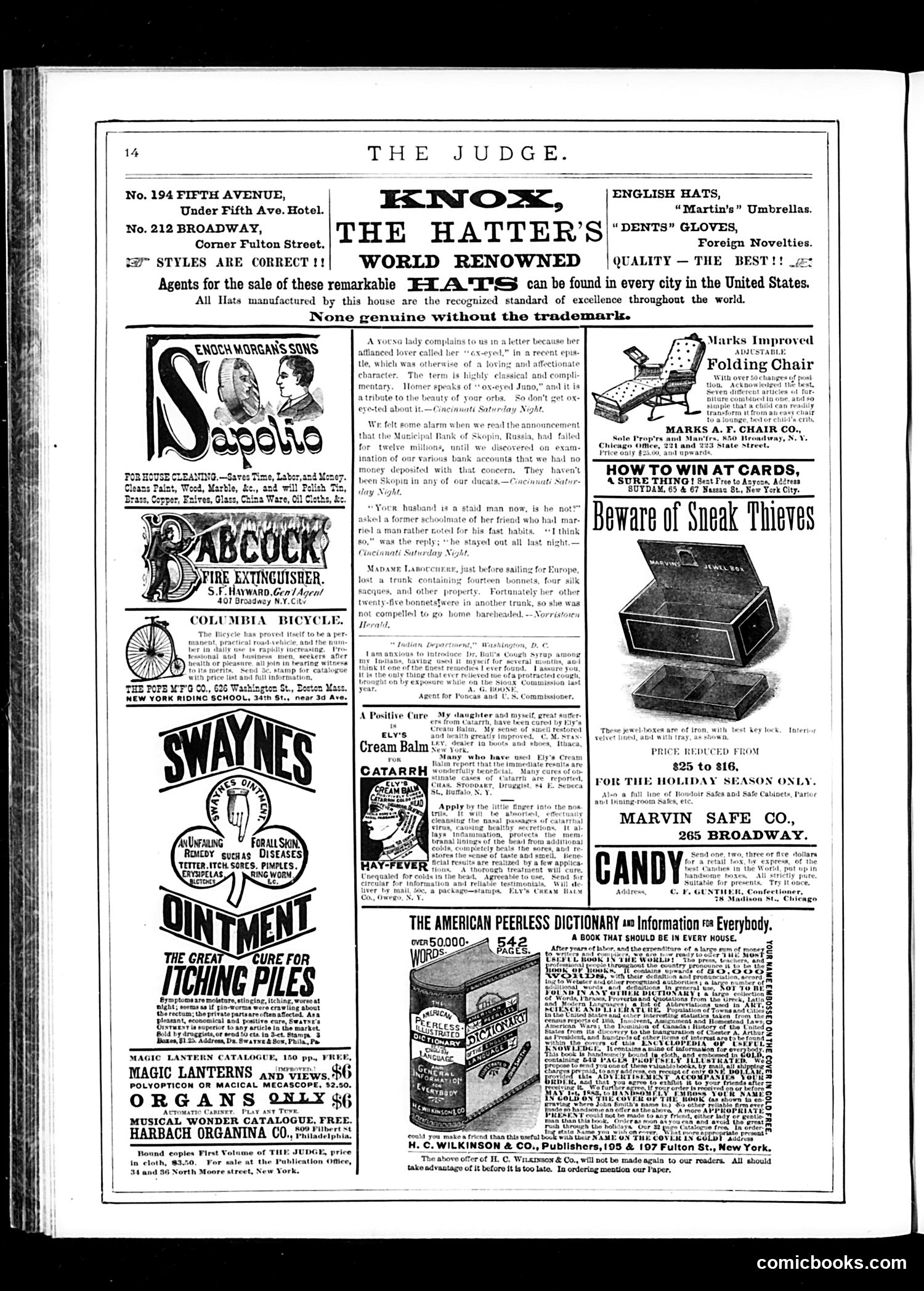
This page is primarily **advertising**, not editorial content or cartoons. It's page 14 of Judge magazine featuring commercial advertisements from the era. The main content includes ads for: - **Knox Hats** (prominently featured) — marketed as "world renowned" with branches at Fifth Avenue and Broadway - **Swayne's Ointment** — promoted as a cure for itching piles - Various other products: bicycles, fire extinguishers, safes, organs, dictionaries, and "how to win at cards" guides The small editorial snippets interspersed among ads appear to be humorous letters from readers about domestic situations (a wife calling her husband "ox-eyed," complaints about bank accounts), typical of Judge's satirical format. There are no identifiable political cartoons or caricatures on this page. The content reflects late 19th-century American consumer culture and the magazine's mixed advertising-editorial format rather than its satirical purpose.
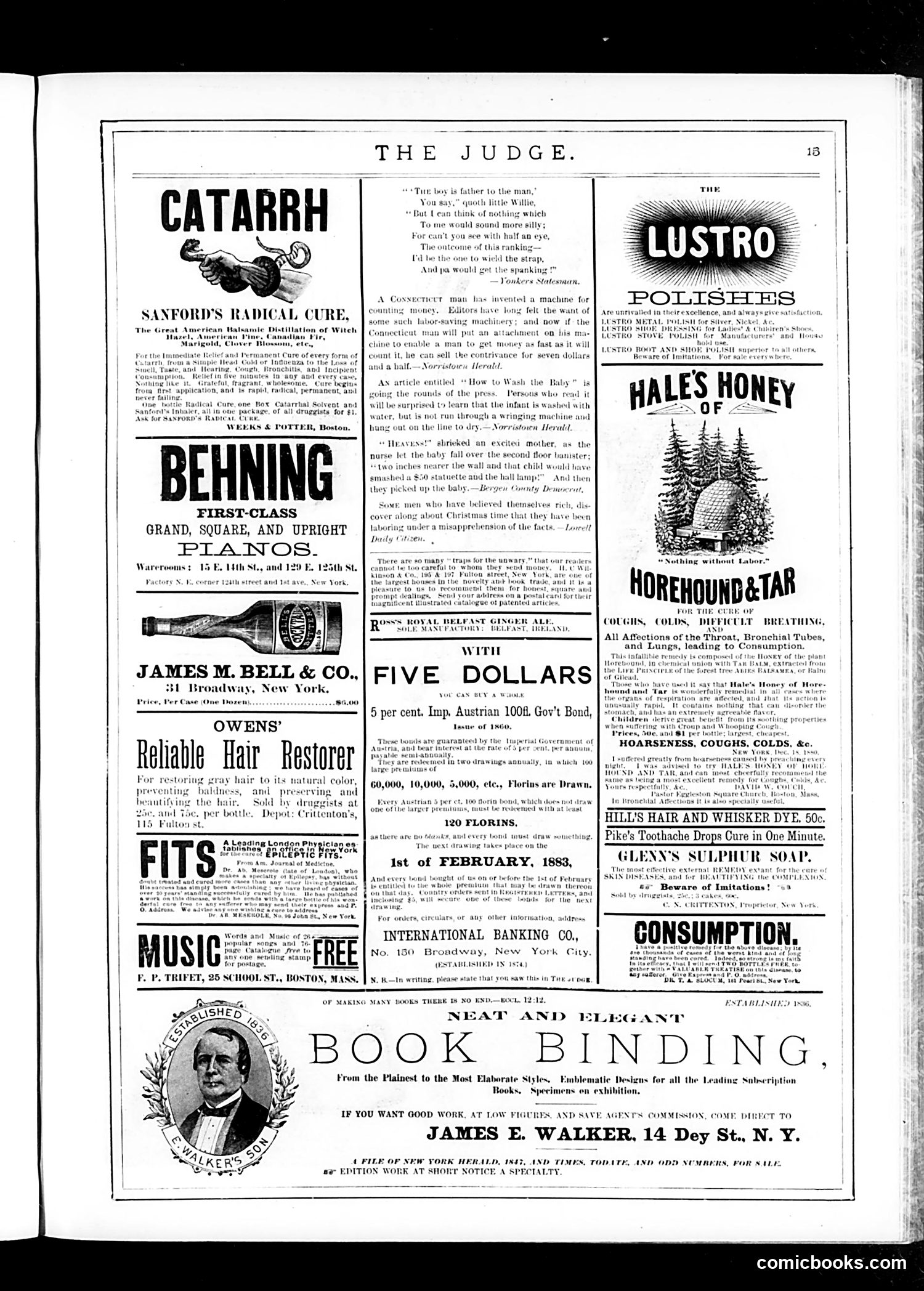
This is primarily an **advertising page** from Judge magazine, not a satirical cartoon section. The page contains numerous patent medicine and product advertisements typical of 1880s American publications. The small **text-based humor** appears in the middle column, featuring brief anecdotes rather than visual cartoons: - A joke about a boy's mischief ("The boy is father to the man") - A humorous story about a baby nearly falling over a banister, narrowly missing a $30 statuette - A quip about men discovering at Christmas they aren't as wealthy as they believed These brief jokes reflect **common satirical themes** of the era: childhood mischief, domestic mishaps, and financial delusion. The advertisements showcase **patent medicines and services** typical of the period: hair restorers, cough remedies (Hale's Honey of Horehound), hair dyes, pianos, and book binding services. Many such "remedies" were unregulated and of dubious efficacy—a subject Judge frequently mocked in actual editorial cartoons. No specific political figures or dated events are referenced on this page.
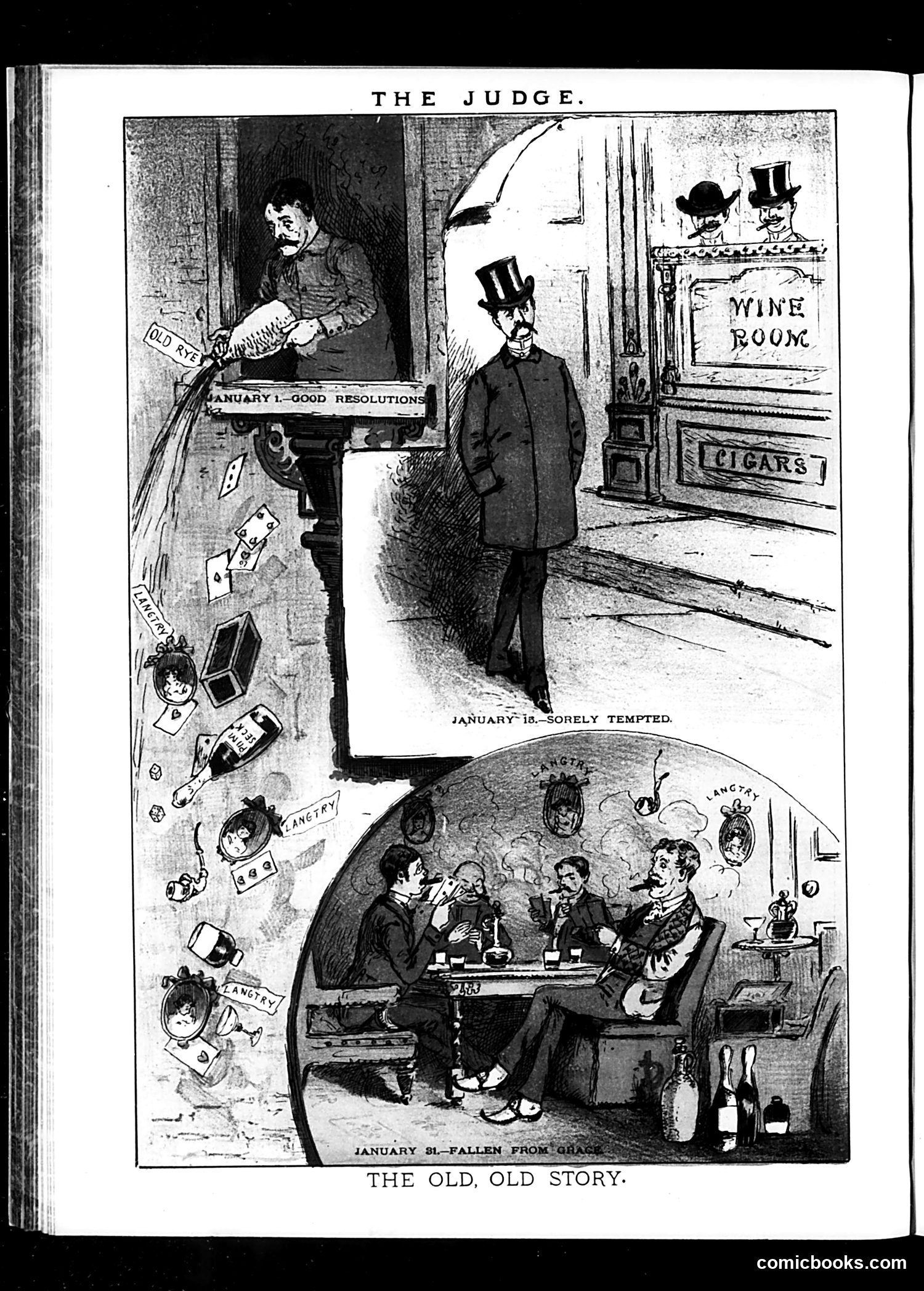
This satirical page shows "The Old, Old Story" — a recurring January theme about broken New Year's resolutions. The top panel (January 1: "Good Resolutions") depicts a man making earnest pledges, surrounded by symbolic items suggesting reform: abstinence from alcohol and tobacco. The middle panel (January 18: "Sorely Tempted") shows him passing a wine room and cigar shop, resisting temptation. The bottom panel (January 31: "Fallen From Grace") reveals the inevitable outcome: the man now sits gambling and drinking with companions in what appears to be a bar, having abandoned all his resolutions. The satire mocks the predictable failure of January resolutions and human weakness regarding self-improvement — a timeless joke that remains relevant today. The cartoon format effectively contrasts idealistic intentions with inevitable reality.