
Pulp Fiction, 1878 · page 9 of 24
Beadle's New York Dime Library, Vol. III, No. 34 — page 9: what you’re looking at
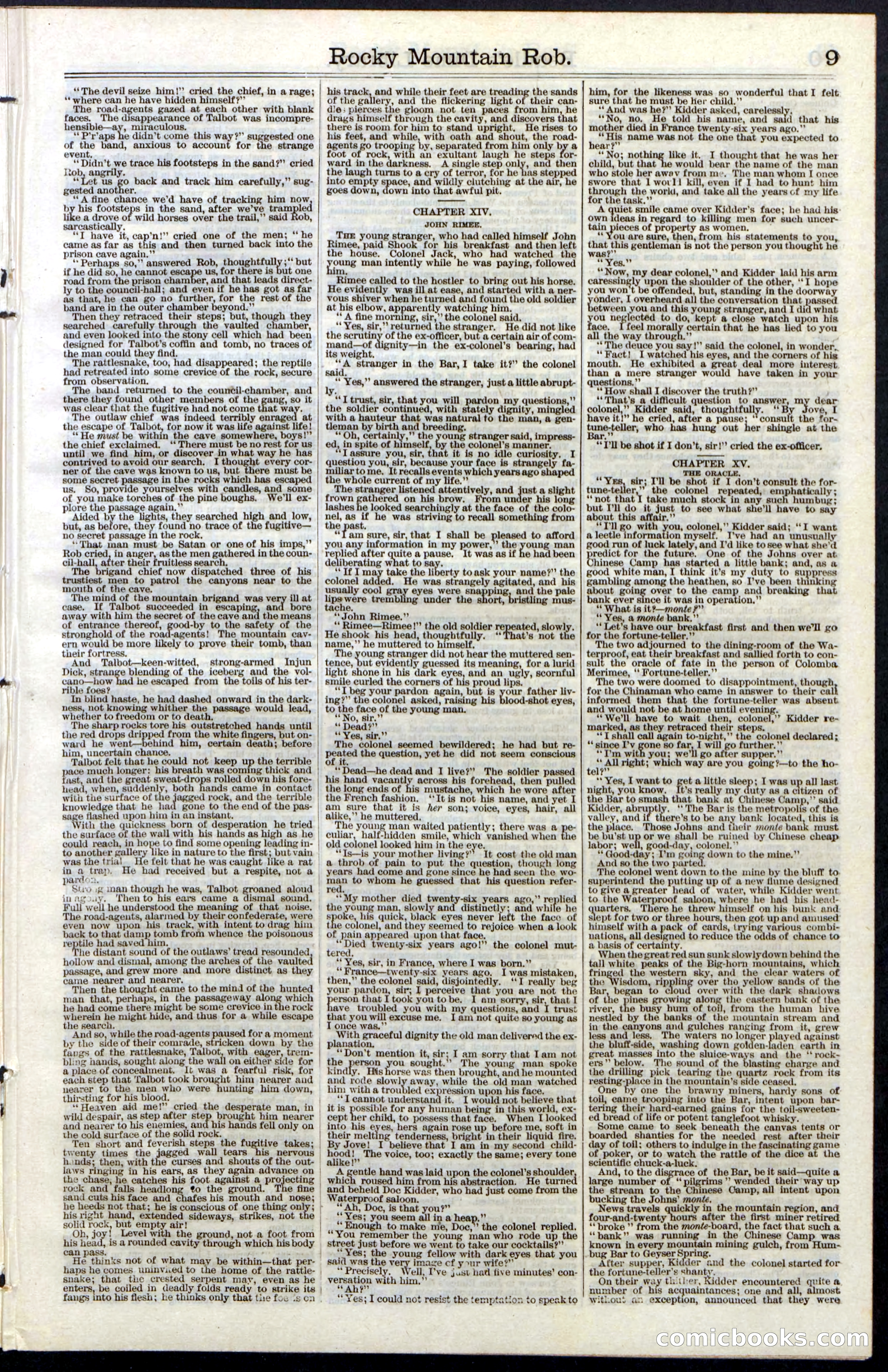
A restored page from Pulp Fiction, 1878. Page through the whole issue in the reader above.
📄 Transcribed text from this page (OCR, searchable)
Machine-transcribed from the original scan — historical spelling and the odd misread are preserved.
‘* The devil seize him!" cried the chief, in a rage; ‘* where can he have hidden himself?” The road-agents gazed at each other with blank faces. The disappearance of Talbot was incompre- hensible—ay, miraculous. “ P’r’aps he didn’t come this way?” suggested one of the band, anxious to account for the strange event, ‘Didn't we trace his footsteps in the sand?” cried Rob, angrily. “Let us go back and track him carefully,” sug- gested another. ‘‘A fine chance we'd have of tracking him now by his footsteps in the sand, after we’ve tram led like a drove of wild horses over the trail,’ said Rob, sarcastically. ba *T have it, Gey ssa cried one of the men; “ he came as far as this and then turned back into the prison cave again,” - ‘Perhaps so,” answered Rob, thoughtfully ;** but if he did so, he cannot escape us, for there is but one road from the prison chamber, and that leads direct- ly to the council-hall; and even if he has got as far as that, he can go no further, for the rest of the band are in the outer chamber beyond.” Then they retraced their steps; but, though they searched carefully through the vaulted chamber, and even looked into the stony cell which had been designed for Talbot's coffin and tomb, no traces of the man could they find. The rattlesnake, too, had disappeared; the reptile had retreated into some crevice of the rock, secure from observation. The band returned to the council-chamber, and | there they found other members of the gang, so it | was clear that the fugitive had not come that way. The outlaw chief was indeed terribly en at the escape of Talbot, for now it was life against life! ‘* He must be within the cave somewhere, boys!” the chief exclaimed, ‘‘ There must be no rest for us until we find him, or discover in what way he has contrived to avoid our search, I mone every cor- ner of the cave was known to us, but there must be some secret in the rocks which has escaped us. So, provide yourselves with candles, and some of you make torehes of the pine boughs. We'll ex- plore the passage again.’ Aided by the lights, they searched high and low, but, as before, they found no trace of the fugitive— no secret passage in the rock, . i ‘That man must be Satan or one of his imps, Rob cried, in anger, as the men gathered in the coun- cil-hall, after their fruitless search. The brigand chief now dispatched three of his trustiest men to patrol the canyons near to the mouth of the cave, The mind of the mountain brigand was very ill at case. If Talbot succeeded in escaping, and bore away with him the secret of the cave and the means of entrance per eaie BOOP rey to the safety of the stronghold of the road-agents! The mountain cav- ern would be more likely to prove their tomb, than their fortress. And Talbot—keen-witted, strong-armed Injun Dick, strange blending of the iceberg and the vol- CAR re fe he escaped from the toils of his ter- ble foes? In blind haste, he had dashed onward in the dark- | ness, not knowing whither the would lead whether to Gone or to death ; The sharp rocks tore his outstretched hands until the red drops dripped from the white fingers, but on- ward he went—behind him, certain death; before him, uncertain chance, Talbot felt that he could not keep up the terrible yace much longer: his breath was co ck and Fast and the great sweat-drops rolled down his fore- head, when, suddenly, both hands came in contact with the surface of the jeaged rock, and the terrible | knowledge that he had gone to the end of the pas- sage flashed upon him in an instant. Vith the quickness born of desperation he tried | the surface of the wall with his hands as high as he could reach, in hope to find some opening leading in- | ike in nature to the first; but vain | to another galler was the trial He felt that he was caught like a rat in a trap. pardon, Siro @ inan though he was, Talbot iu ns ar anon to his os came a We sound, Full well he understood the meaning o noise, The road-agents, alarmed by their confederate, were even now upon his track, with intent to drag him back to that damp tomb from whence the poisonous reptile had saved him. he distant sound of the outlaws’ tread resounded hollow and dismal, among the arches of the vaulted passage, and grew more and more distinct as they came nearer and nearer, Then the thought came to the mind of the hunted man that, perhaps, in the passageway along which he had come there might be some crevice in the rock wherein he might hide, and thus for a while escape the search. And so, while the road-agents paused for a moment by the side of their comrade, stricken down by the fangs of the rattlesnake, Talbot, with eager, trem- bling hands, sought along the wall on either side for a place of concealment. It was a fearful risk, for each step that Talbot took brought him nearer aud uearer to the men who were hunting him down, thirsting for his blood. ‘* Heaven aid me!” cried the d wild despair, as step after step brought him nearer and nearer to his enemies, and his hands fell only on the cold surface of the solid rock. Ten short and feverish steps the tive takes; twenty times the jagged wall tears nervous hands; then, with the curses and shouts of the out- ed aloud tach He had received but a respite, not a man to whom he guessed that his question refer- ' T once was.”’ rate man, in > _ Rocky | Mountain Rob. his track, and while their feet are treading the sands of the gallery, and the flickering light of their can- die; pierces the gloom not ten paces from him, he drags himself through the cavity, and discovers that there is room for him to stand upright, He rises to his feet, and while, with oath and shout, the road- agents go oe by, separated from him only by a foot of rock, with an exultant laugh he steps for- ward in the darkness. A single step only, and then the laugh turns to a cry of terror, for he has mepred into empty apace, and wildly clutching at the air, he goes down, down into that awful pit. CHAPTER XIV, JOHN RIMEE, THE young stranger, who had called himself John Rimee, paid Shook for his breakfast and then left the house. Colonel Jack, who had watched the young man intently while he was paying, followed m, Rimee called to the hostler to bring out his horse. He evidently was ill at ease, and s with a ner- vous shiver when he turned and found the old soldier at his elbow, apparently watching him. ‘* A fine mo g, sir,” the colonel said, ‘Yes, sir,” returned the stranger. He did not like the scrutiny of the ex-officer, but a certain air of com- mand—of dignity—in the ex-colonel’s bearing, had its weight, uf stranger in the Bar,I take it?” the colonel said, , ‘ Yes,” answered the stranger, just a little abrupt- ly. “*T trust, sir, that you will on my questions," the soldier continued, with stately dignity, mingled with a hauteur that was natural to the man, a gen- Capen by birth ob h st ree ’ ,”’ the you ranger ress- ed, in spite of he men mself, by the colonel’s manner. I assure you, sir, that it is no idle curiosity, I question you, sir, because your face is strangely fa- miliar tome, It recalls events which years ago shaped the whole current of my life.” The stranger listened attentively, and just a slight frown pernceen on his brow. From under his long lashes he looked searchingly at the face of the colo- = as e he was striving to recall something from e past. “Tam sure, sir, that I shall be pleased to afford you any information in my power,” the yous man replied after quite a pause, It was as if he had been deliberating what to “5 } it may take the liberty toask your name?” the mas ad ed. He was strangely senate cm usually cool gray eyes were s and the lips were trembling under the abort. bristling mus- 2. ‘‘John Rimee.”’ ‘“*Rimee—Rimee!"’ the old soldier repeated, slowly. He shook his head, pg es ph ’ *s not the name,’’ he muttered to himself. The young stranger did not hear the muttered sen- | tence, but evidently guessed its meaning, for a lurid light shone in his dark eyes, and an ugly, scornful smile curled the corners of his proud 9 ‘ “IT beg your pardon again, but is your father liv- ing?’ the colonel asked, raising his blood-shot eyes, to the face of the young man, “ Yes, sir ” The colonel seemed bewildered; he had but re- i the question, yet he did not seem conscious Oo * **Dead—he dead and I live?” The soldier passed his hand vacantly across his forehead, then pulled the long ends of his mustache, which he wore after the French fashion. ‘It is not his name, and yet I am sure that it is her son; voice, eyes, hair, all alike,’ he muttered, The young man waited patiently; there was a pe- culiar, half-hidden smile, which vanished when the old colonel looked him in the eye. ‘“‘Is—is your mother living?’ It cost the old man a throb of pain to put the question, though long years had come and gone since he had seen the wo- red, ‘*My mother died twenty-six years ago,” replied the young man, slowly and distinctly; and while he SPOR, his quick, black eyes never eft the face of the colonel, and they seemed to rejoice when a look of pain appeared upon that face. F aes twenty-six years ago!” the colonel mut- ered, ‘* Yes, sir, in France, where I was born.” i ce—twenty-six years ago. I was mistaken, then,” the colonel said, disjointedly. ‘I r beg your pardon, sir; I perceive that you are not the persen that I took you tobe, I am sorry, sir, that I 1ave troubled you with my questions, and I trust that you will excuse me. I am not quite so young as With graceful dignity the old man delivered the ex- planation, “Don't mention it, sir; I am sorry that Lam not the person you sought.” The young man spoke kindly. His horse was then brought, and he mounted and rode slowly away, while the old man watched him with a troubled expEoenen upon his face, ‘I cannot understand it. I would not believe that it is possible for any human being in this world, ex- cept her child, to possess that face. When I looked into his oyek, hers again rose up before me, soft in their melting tenderness, bright in their liquid fire. _ By Jove! I believe that I am in my second child hood! The voice, too; exactly the same; every tone alike!’ 9 him, for the likeness was so wonderful that I felt sure that he must be Ker child.” ‘* And was he?’’ Kidder asked, carelessly, “No, no. He told his name, and d that his mother died in France twenty-six years ago." “His name was not the one that you expected to hear?” ‘No; nothing like it. I thought that he was her child, but that he would bear the name of the man who stole her awav from me, The man whom I once swore that 1 wovl! kill, even if 1 had to hunt him through the world, and take all the years of my life for the task.” A ae smile came over Kidder’s face; he had his own ideas in regard to killing men for such uncer- tain Nee of property as women. “You are sure, then, from his statements to you, tap gs gentleman is not the person you thought he was ” “ Yes.”’ “Now, my dear colonel,’ and Kidder laid his arm caressingly upon the shoulder of the other, ‘I hope you wont be offended, but, standing in the doorway yonder, I overheard all the conversation that passed etween you and this young stranger, and I did what you neglected to do, kept a close watch upon his ace. I feel parelly certain that he has lied to you all the way through.” ; ‘The deuce you say!” said the colonel, in wonder, ‘Fact! I watched his eyes, and the corners of hig mouth. He exhibited a great deal more interest than a mere stranger would have taken in your questions,’’ “ How shall I discover the truth?” ‘*That’s a difficult question to answer, my dear colonel,” Kidder said, thoughtfully. By Jove, I have it!” he cried, after a pause; “consult the for- tune-teller, who has hung out her shingle at the “Tl be shot if I don’t, sir!” cried the ex-officer. CHAPTER XV, THE ORACLE. “Yrs, sir; I'll be shot if I don’t consult the for- tune-teller,”’ the colonel repeated, emphatically ; ‘not that I take much stock in any such humbug; but Tll do At aah to see what she'll have to say about this “Till go with you, colonel,’’ Kidder said; ‘I want a leetle information myself. I've had an unusually good run of luck lately, and I'd like to see what she'd oredict for the future. One of the Johns over at hinese Camp has started a little bank; and, as a good white man, I think it’s my duty to suppress gambling among the heathen, so I’ve n th ing about going over to the camp and breaking tha k ever since it was in operation,” ** What is it?—monte ?” ** Yes, a monte bank,”’ ‘* Let's have our breakfast first and then we'll go for the fortune-teller.”’ The two adjourned to the dining-room of the Wa- terproof, eat their breakfast and sallied forth to con- sult the oracle of fate in the person of Colomba Merimee, “ ortune-teller.”’ The two were doomed to disappointment, though for the Chinaman who came in answer to their ca informed them that the fortune-teller was absent. and would not be at home until evening. ‘*We'll have to wait then, colonel,’ Kidder re- marked, as they retraced their steps. “*T shall call again to-night,’’ the colonel declared; ‘since I'v gone so far, I wel go further." ‘I'm with you; we'll go r supper, d 3 All right; which way are you going?—to the ho- e +B * Yes, I want to get a little lee I was up all last night, you know, It’s really my duty as a citizen of the Bar to smash that bank at Chinese Camp,”’ said Kidder, abruptly, ‘“ The Bar is the metropolis of the valley, and if there’s to be any bank located, this is the place. Those Johns and their monte bank must be bu'st up or we shall be ruined by Chinese cheap labor; well, good-day, colonel.” * Good-day; I'm going down to the mine.” And so the two parted. The colonel went down to the mine by the bluff to. superintend the putting up of a new flume designed to hg agreater head of water, while Kidder went to the Waterproof saloon, where he had his head- qpernere. There he threw himself on his bunk and slept for two or three hours, then got up and amused himself with a pack of cards, orto various combi- nations, all designed to reduce the odds of chance to a basis of certainty. When the great red sun sunk slowlydown behind the tall white peaks of the Big-horn mountains, which Teng ed the western sky, and the clear waters of the Wisdom, rippling over tho yellow sands of the Bar, began to cloud over with the dark shadows of the pines growing along the eastern bank of the river, the busy hum of toil, from the human hive nestled by the banks of the mountain stream and in the canyons and gulches ranging from it, grew less and less. The waters no longer played against the bluff-side, washing down golden-laden earth in great masses into the sluice-ways and the ‘ rock- ers’ below. The sound of the blasting charge and the drilling pick tearing the quartz rock from its resting-place in the mountain’s side ceased, One by one the brawny miners, hardy sons of toil, came trooping into the Bar, intent upon bar- tering their hard-earned gains for the toil-sweeten- ed bread of life or potent tanglefoot whisky. Some came to seek beneath the canvas tents or boarded shanties for the needed rest after their day of toil; others to indulge in the fascinating game of poker, or to watch the rattle of the dice at the scientific chuck-a-luck. laws ringing in his ears, as they a, advance on, A gout'e hand was laid upon the colonel’s shoulder And, to the di ce of the Bar, be it said—quite a the chase, he catches his foot against a projecting | which roused him from abstraction. He turned large number o agieoe ” wended their way up rock and falls headlong to the ground. The fine and beheld Doc Kidder, who had just come from the | the stream to the Camp, all intent upon sand cuts his face and chafes his mouth and nose; Waterproof saloon. bucking the Johns’ monte. he heeds not that; he is conscious of one thing only; » ‘Ah, Doe, is that you?” News travels quickly in the mountain region, and his right extended sideways, strikes, not the | ‘Yes; you seem ail a heap.’ four-and-twenty hours the first miner retired ’ ‘Enough to make me, Doc,” the colonel replied. Oh, joy! Leve the ground, not a foot from ‘You remember the yo man who rode up the his head, is a rounded cavity through which hisbody | street just before we went to take our cocktails?” can pass. fino -.. “Yes; the young fellow with dark eyes that you He thinks not of what may be within—that per- said was the sety image cf yur wife?” ’ haps he comes uninviced to the home of the rattle- “Precisely, Well, I’ve jasv hati five minutes’ con- J snake; that the crested serpent may, even as he th bim,”’ enters, be coiled in deadly folds ready to strike its fangs into his flesh; he thinks only that the fou ‘son | Yes; I could not resist the temptation to speak to solid rock, but peta an Big A ‘broke ” from the monte-board, the fact that such a 1 wi “bank” was in the Chinese Camp was known in every moun mining gulch, from Hum- -bug Bar to Geyser Pprang. After supper, Kidder and the colonel started for the fortune-teller’s shanty, On their way thither, Ridder encountered quite a number of his acquaintances; one and all, almost without an exception, announced that they were versation ee Ah ? 4 m <S Eomicboo (ECO) a ee