
Pulp Fiction, 1878 · page 8 of 24
Beadle's New York Dime Library, Vol. III, No. 34 — page 8: what you’re looking at
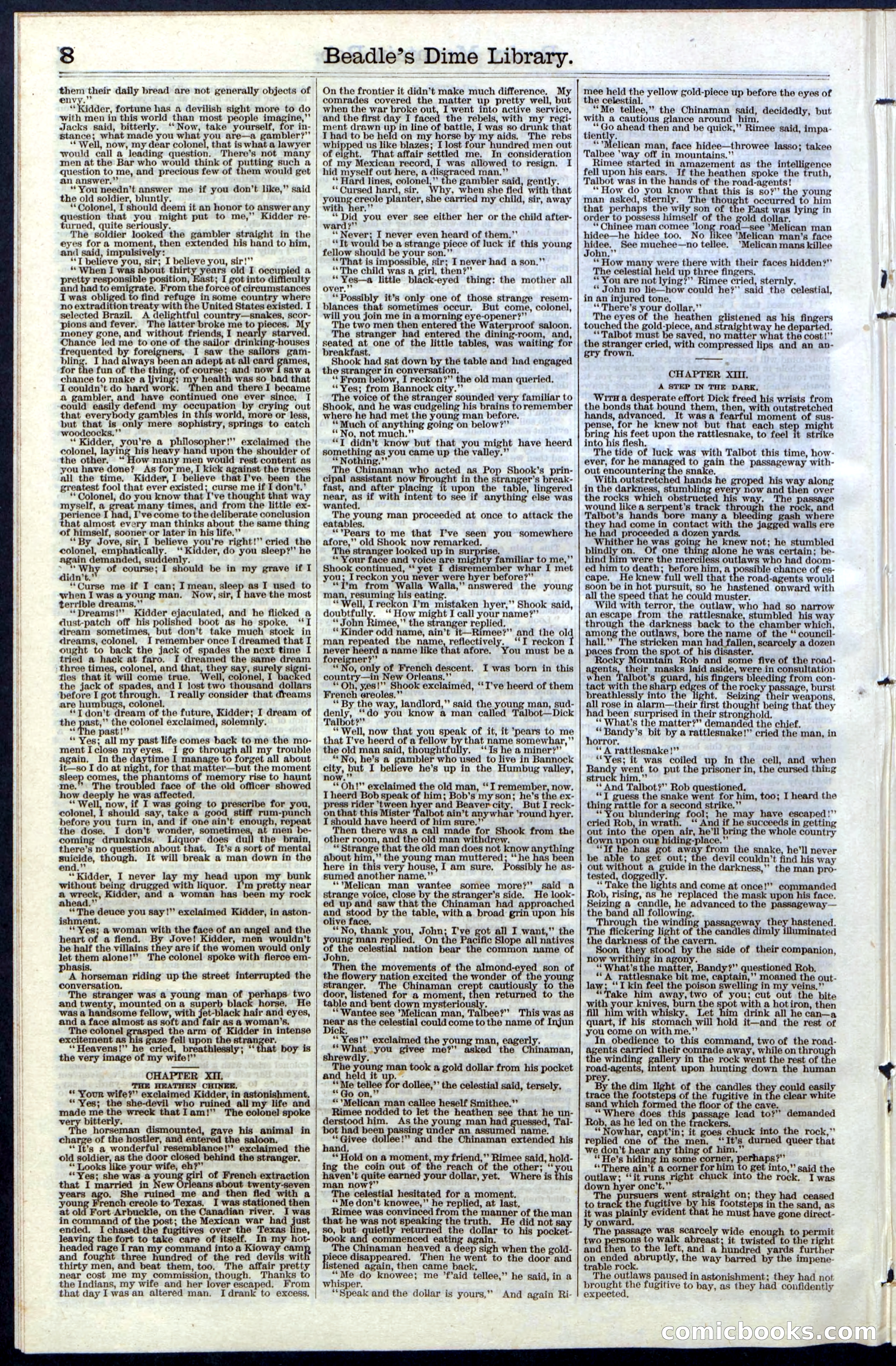
A restored page from Pulp Fiction, 1878. Page through the whole issue in the reader above.
📄 Transcribed text from this page (OCR, searchable)
Machine-transcribed from the original scan — historical spelling and the odd misread are preserved.
—_—- =e - ee a i oh Ome _—_ ES them their daily bread are not generally objects of envy.” “Kidder, fortune has a devilish sight more to do with men in this world than most people imagine,” Jacks said, bitterly. ‘“‘ Now, take yourself, for in- stance; what made you what gr are—a gambler?” - Well, now, my dear colonel, that is what a lawyer would call a | question. There's not many men at the Bar who would think of Pome | such a question to me, and precious few of them would get an answer.”’ “You needn't answer me if you don’t like,” said the old soldier, ee **Colonel, I should deem it an honor to answer any question that you might put to me,” Kidder re- turned, quite seriously. The soldier looked the gambler straight in the eyes fora moment, then extended his hand to him, and said, impulsively: “T believe you, sir; I believe you, sir!" “ basen I st hon ped a ne old ~ Kaen ty ee Ha retty responsible on, ; I gotin y rnd had to emt te. From the force of circumstances I was re find refuge in some country where no extradition treaty with the United States existed. I selected Brazil. A delightful country—snakes, scor- pions and fever. The latter broke me to pieces. M money gone, and without friends, I nearly starved. Chance led me to one of the sailor drinking-houses frequented by fo ers, I saw the sailors gam- bling. I had always been an adept at all card es, for the fun of the thing, of course; and now I saw a chance to make a Ying; sy Ag was so bad that I couldn’t do hard work. en and there I became a gambler, and have continued one ever since, I could y defend my occupation by crying out that everybody gambles in this world, more or less, but that is only mere sophistry, springs to catch woodcocks."’ “Kidder, you're a philosopher!’ exclaimed the colonel, lay his heavy hand upon the shoulder of the other. “How many men would rest content as you have done? As for me, I kick against the traces all the time. Kidder, I believe thatI’ve been the greatest fool that ever existed; curse me if I don't.’ **Colonel, do you know that I've thought that way myself, a t many times, and from the little ex- perience I had, I’ve come to the deliberate conclusion that almost every man thinks about the same thing of himself, sooner or later in his life.” “By Jove, sir, I believe you're right!"’ cried the colonel, emphat en? “Kidder, do you sleep?” he again demanded, suddenly. phx y of course; I should be in my grave if I didn’t.’ **Curse me if I can; I mean, slee as I used to when I was a young man. Now, sir, I have the most terrible dreams.” . “Dreams!"’ Kidder ejaculated, and he flicked a dust-patch off his polished boot as he spoke, “I dream sometimes, but don't take much stock in dreams, colonel. I remember once I dreamed that I ought to back the jack of spades the next time I tried a hack at faro. I dreamed the same dream ‘three times, colonel, and that, they say, signi- ties that it will come true. Well’ colonel, Y backed the jack of —_—- and I lost two thousand dollars before I got t rough. I really consider that dreams are humbugs, colonel. ‘*T don't dream of the future, Kidder; I dream of the past," the colonel exclaimed, solemnly. “The past!” “ Yes; all my past life comes back to me the mo- ment Iclose my eyes. I go through all my trouble again. In the daytime I man to forget all about it—so I do at night, for that matter—but the moment sleep comes, the phantoms of memory rise to haunt me.”’ The troubled face of the old officer showed how deeply he was affected. si a now, if I was going to preseribe for you, colonel, I should say, e a good stiff rum-punch before you turn in, and if one ain't et, ae repeat the dose. I don’t wonder, sometim men be- coming drunkards. Liquor does dull the brain there’s no question about that. It’s a sort of mental oor though, It will break a man down in the end.” “Kidder, I never lay my head a my bunk without being drugged with liquor. I’m pretty near rte bh om der, and a woman has been my rock ; " oh gern you say!” exclaimed Kidder, in aston- shment. ‘* Yes; a woman with the face of an angel and the heart of a fiend. By Jove! Kidder, men wouldn't be half the villains they are if the women would only ve ~ en alone!"’ The colonel spoke with flerce em- as an horseman riding up the street interrupted the ocrne string f perhaps two e r was a yo man 0 r and twenty, mounted on an b blak nowes, He was a handsome fellow, with jet-black hair and eyes, and a face almost as soft and fair as a woman's. “rn ae 5 Ra 7 oe in intense excitement as his gaze n the er. ‘*Heavens!”’ he cried, breathlessly; “that boy is the very image of my wife!” CHAPTER XII. THE HEATHEN CHINEE. “* Your wife?” exclaimed Kidder, in astonishment. she-devil w “Yes; the ho ruined all my life and made me the wreck thatI am!" The colonel spoke sp i * e horseman dismoun ve his animal in charge of the hostler, snd ketinGa bine saloon. ‘It’s a wonderful resemblance!"’ exclaimed the old soldier, as the door closed behind the “ Looks like your wife, eh?” ““Yes; she was a you 1 of French extraction that I married in New about twenty-seven . She ruined me and then fled with a ended. I chased the fugitives over the Texas line, weit = the fort to take care of itself. In my hot headed rage I ran my command into a Saye Bes | and fought three hundred of the red de wi thirty men, and beat them, too. The affair pretty near cost me my commission, though. Thanks to the Indians, my wife and her lover escaped. From that day Iwas an altered man. I drank to excess. —— St Pa ~~. _Sieecehedinne, Llormty. On the frontier it didn’t make much difference. My comrades covered the matter up pretty well, but when the war broke out, I went into active service, and the first day I faced the rebels, with my regi- ment drawn up in line of battle, I was so drunk that I had to be held on my horse by my aids. The rebs whipped us like blazes; I lost four hundred men out of eight. That affair settled me. In consideration of my Mexican record, I was allowed to resign. I hid myself out here, a ened man.” ‘** Hard lines, colonel,” the gambler said, gently. ‘Cursed hard, sir, Why, when she fied with that et ase ba planter, she carried my child, sir, away with her.” “Did you ever see either her or the child after- ward?" ‘* Never; I never even heard of them.” “Tt would be a strange piece of luck if this young fellow should be your son.” “That is impossible, sir; I never had a son.” “The child was a girl, then?” *Yes—a little black-eyed thing: the mother all over.” “Possibly it’s only one of those strange resem- blances that sometimes occur. But come, colonel, will you join me in a morning eye-opener?” The two men then entered the Waterproof saloon. The stranger had entered the dining-room, and, seated at one of the little tables, was waiting for breakfast. Shook had sat down by the table and had engaged the stranger in conversation. ‘* From below, I reckon?” the old man queried. ‘Yes; from Bannock city." The voice of the stranger sounded very familiar to Shook, and he was cudgeling his brains to remember where he had met the young man before. “Much of anything going on below?” ** No, not much.” “IT didn’t know but that you might have heerd something as you came up the valley.” “* Nothing.”’ The Chinaman who acted as Pop Shook’s prin- cipal assistant now Brought in the stranger's break- fast, and after placing it upon the table, lingered pe! th if with intent to see if anything else was wanted. The young man proceeded at once to attack the eatables. "Pears to me that I’ve seen you somewhere afore,"’ old Shook now remarked. The stranger looked up in surprise. * Your face and voice are mighty familiar to me," Shook continued, *‘ yet I disremember whar I met you; Ireckon you never were hyer before?” “I'm from’ Walla Walla,” answered the young man, resuming his eating. “Well, Ireckon I’m mistaken hyer,”’ Shook said, as ih “How might I call your name?” “John Rimee,”’ the stranger replied. “Kinder odd name, ain’t it— ee?” and the ol man repeated the name, reflectively. ‘‘I reckon ee co a name like that afore. You must be a oO er?’ “No, only of French descent. I was born in this country—in New Orleans.”’ | **Oh, y.es!"” Shook exclaimed, ‘‘ I’ve heerd of them French ereoles.” ‘“* By the way, landlord,” said the young man, sud- Se ae do you know a man called Talbot—Dick ‘a ” “Well, now that you speak of it, it pears to me that I've heerd of a fellow by that name somewhar,” the old man said, thoughtfully. ‘Is he a miner?” “No, he’s a bler who used to live in Bannock city, but I believe he’s up in the Humbug valley, now.” ** Oh!" exclaimed the old man, “I remember, now. T heerd Bob speak of him; Bob’s my son; he’s the ex- press rider ‘tween hyer and Beavercity, But I reck- on that this Mister albot ain’t anywhar ‘round hyer. I should have heerd of him sure.’ Then there was a call made for Shook from the other room, and the old man withdrew. “Strange that the old man does not know anything about him,” the young man muttered; “he has been here in this very house, I am sure, Possibly he as- sumed another name.” *'"Melican man wantee somee more?’’ said a strange voice, close by the stranger's side. He look- ed up and saw that the Chinaman had approached and stood by the table, with a broad grin upon his olive face. **No, thank yon John; I’ve got all I want,"’ the young man replied. On the Pacific Slope all natives = = celestial nation bear the common name of ohn. Then the movements of the soit son of the flowery nation excited the wonder of the yours stranger. The Chinaman crept cautio the door, ed for a moment, then returned to the table and bent down se pe scodncy 1s 6 ‘“Wantee see "Melican man, Talbee?”” This was as x? as the celestial could come to the name of Injun Cc . ** Yes!"’ exclaimed the young ma erly. recat givee me?” tind “thee Chinaman, The oung man took a old dollar from his pocket anc hold it ys ae . = ng or dollee,”’ the celestial said, tersely, “*Melican man callee heself Smithee.”’ Rimee nodded to let the heathen see that he un- derstood him. As the young man had bot had been g under an assumed name. **Givee dollee!” and the Chinaman extended his hand, **Hold on a moment, my friend,’’ Rimee said, hold- ing the coin out of the reach of the others’ ou haven’t quite your dollar, yet. Where is this man now?” The celestial hesitated for a moment. ‘**Me don’t knowee,”’ he replied, at last, Rimee was convinced from the manner of the man that he was not pores the truth. He did not sa 80, carat return lar to his poukst- book commenced os again. The Chinaman heaved a deep sigh when the gold- pe: disappeared. Then he went to the door and ned again, then came back, *““Me do knowee; me ’f'aid tellee,”’ he said, in a whisper. ‘Speak and the dollar is yours,” And again Ri- - a om ~~ re oe ek mee held the yellow gold-piece up before the eyes of the celestial. 4 , R z “Me tellee,” the Chinaman said, decidedly, but with a cautious glance around him. ‘Go ahead then and be quick,” Rimee said, impa- bra *“*Melican man, face hidee—throwee lasso; takee Talbee ’way off in mountains.” Rimee started in amazement as the br ony. ng fell upon his ears. If the heathen spoke the truth, Talbot was in the hands of the road-agents! ‘“How do you know that this is so?’ the young man asked, sternly. The thought occurred to him that perhaps the wily son of the East was lying in order to possess himself of the gold dollar. *“ Chinee man comee ‘long road—see ’Melican man hidee—he hidee too. No likee "Melican man’s face mn See muchee—no tellee. *‘Melican mans killee oO no ‘* How many were there with their faces hidden?" The celestial held up three fingers. “You are not lying?’ Rimee cried, sternly. ** John no lie—how could he?” said the celestial, in an injured tone, ‘“‘ There's your dollar,” The be fr of the heathen glistened as his fingers touched the gold-piece, and ightway he de ed. **Talbot must be saved, no matter what the cost!" the stranger cried, with compressed lips and an an- gry frown. CHAPTER XIII. A STEP IN THE DARK, Wirn a desperate effort Dick freed his wrists from the bonds that bound them, then, with outstretched hands, advanced, It wasa fearful moment of sus- ae mo for he knew not but that each step might yay his feet upon the rattlesnake, to feel it strike 1 into his flesh. The tide of luck was with Talbot this time, how- ever, for he ma to Feng the passageway with- out encounterin e snake. With outstretched hands he his way alon in the darkness, stumbling evened a and then ed the rocks which obstructed his way. The passage wound like a serpent’s track through the rock, and Talbot’s hands many a b & gash where they had come in contact with the jagged walls ere he Pp ed a dozen Whither he was going he knew not; he stumbled blindly on, Of one t alone he was certain; be- hind him were the merciless outlaws who had doom- ed him to death; before him, a ble chance of es- cape. He knew full well that the road-agents would soon be in hot pursuit, so he hastened onward with all the speed that he could muster. Wild with terror, the outlaw, who had so narrow an escape from the rattl e, stumbled his way through the darkness back to the chamber which, among the outlaws, bore the name of the “ council- hall.” The stricken man had fallen, scarcely a dozen paces from the spot of his disaster. Rocky Mountain Rob and some five of the road- nts, their masks laid aside, were in consultation when Talbot's guard, his ae bl g from con- tact with the sha es of the rocky passage, burst breathlessly into the light, pe their weapons, all rose in alarm—their first thought being that they had been surprised in their stronghold, ** What's the matter?” demanded the chief. “Bandy’s bit by a rattlesnake!” cried the man, in horror. *A rattlesnake!”’ ‘“Yes; it was coiled up in the cell, and when mandy went to put the prisoner in, the cursed thing struck him,” ‘** And Talbot?"’ Rob questioned. **T guess the snake went for him, too; I heard the thing rattle for a second strike.” “You Rigid 4 fool; he may have escaped!”’ cried Rob, in wra’ ** And if he succeeds in getting out into the open air, he'll bring the whole country down upon our hiding- us “Tf he has pe away from the snake, he'll never be able to get out; the devil couldn't find his way out without a guide in the darkness,” the man pro- = e the and come at once!’’ commanded Rob, rising, ashe replaced the mask upon his face. Seizing a candle, he advanced to the passageway— the band all aye Through the winding wa they astened. The flickering light of the candles dimly illuminated the darkness of the cavern. Soon they stood by the side of their companion, now writhin paring ‘* What's the ter, Bandy?”’ questioned Rob. “A rattlesnake bit me, captain,’’ moaned the out- law; ‘‘I kin feel the poison swelling in my veins.” “Take him away, two of you; cut out the bite with your knives, burn the spot with a hot iron, then fill him with w . Let rink all he can—a quart, if his stomach will hold it—and the rest of you come on with me.” In obedience to this command, two of the road- 7 er carried their comrade away, while on through e winding — the rock went the rest of the road-agents, intent upon hunting down the human prey. By the dim light of the candles they could easily trace the footsteps of the fugitive in clear white sand which formed the floor of the cave. “Where does this e lead to?’ demanded Rob, as he led on the ers, “Nowhar, capt’in; it goes chuck into the rock,” replied one of the men, ‘It’s durned queer that we don't hear any thing of him.” ‘He's ui in some corner, pagar ie hat ‘There ain’t a corner for him wed the outlaw; ‘it runs right chuck into the rock. I was down hyer onc’t,’ | The pursuers went straight on; they had ceased to the fugitive by his footste i fawantees it was plainly evident that he must have gone direct- ly onward. The passage was scarcely wide eno to permit two persons to walk abreast: it Brim: oF the right and then to the left, and a hundred yards further on ended abruptly, the way barred by the impene- The outlaws paused in astonishment; they had not onesie the fugitive to bay, as they had confidently ex ad, Micboo (E(0) SALE (0)