
Pulp Fiction, 1878 · page 10 of 24
Beadle's New York Dime Library, Vol. III, No. 34 — page 10: what you’re looking at
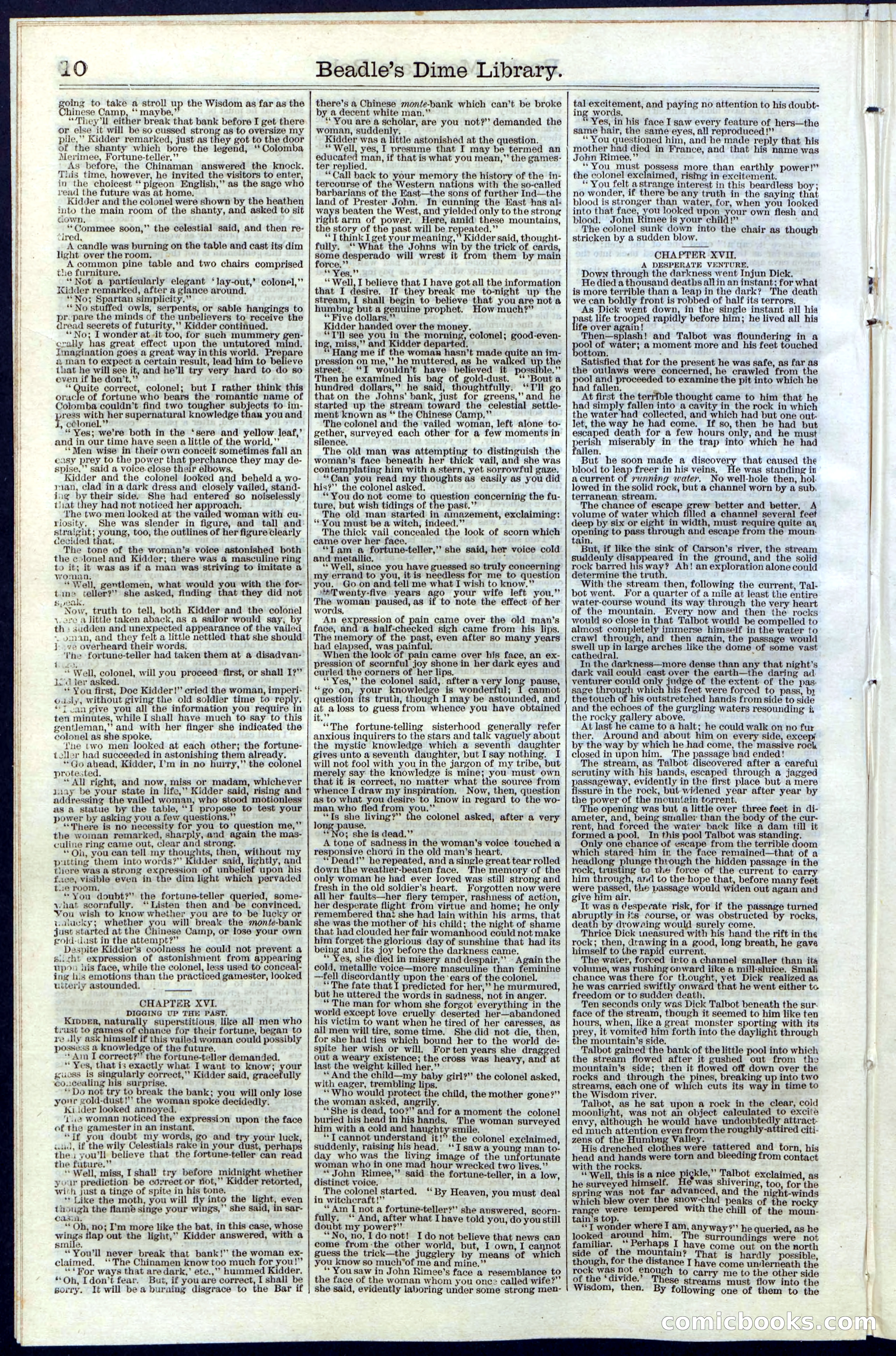
A restored page from Pulp Fiction, 1878. Page through the whole issue in the reader above.
📄 Transcribed text from this page (OCR, searchable)
Machine-transcribed from the original scan — historical spelling and the odd misread are preserved.
aS oing to take a stroll up the Wisdom as far as the hinese Camp, ‘* maybe,’ “They’ll either break that bank before I get there or else it will be so cussed strong as to oversize my pile,”’ Kidder remarked, just as they got to the door of the shanty which bore the legend, ‘* Colomba Merimee, Fortune-teller.”’ As before, the Chinaman answered the knock. This time, however, he invited the visitors to enter, in the choicest “ pigeon English,” as the sage who vead the future was at home, Kidder and the colonel were shown by the heathen into the main room of the shanty, and asked to sit qjown, 4 Se Secamei soon,”’ the celestial said, and then re- ired, A candle was burning on the table and cast its dim light overtheroom. A common pine table and two chairs comprised the furniture, “Not a particularly elegant ‘lay-out,’ colonel,” Kidder remarked, after a glance around. ‘*No; Spartan simplicity.” ‘*No stuffed owls, serpents, or sable hangings to pr. pare the minds of the unbelievers to receive the dread secrets of futurity,’’ Kidder continued. “No; I wonder at-it too, for such mummery gen- crally has great effect upon the untutored d, Imagination goes a great way inthis world. Prepare 2 man to expect a certain result, lead him to believe that he will see it, and he'll try very hard to do so even if he don’t,” “Quite correct, colonel; but I rather think this oracle of fortune who bears the romantic name of Colomba couldn't find two tougher subjects to im- ress with her supernatural knowledge than you and 4 célonel.” “Yes; we’re both in the ‘sere and yellow leaf,’ and in our time have seen alittle of the world,”’ ‘*Men wise in their own conceit sometimes fall an easy prey to the power that perchance they may de- spise,"’ said a voice. close their elbows. Kidder and the colonel looked and beheld a wo- man, clad in a dark dress and closely vailed, stand- iig by their side. She had entered so noiselessly iat they had not noticed her approach. _The two men looked at the vailed woman with cu- riosity. She was slender in figure, and tall and straight; young, too, the outlines of her figure Clearly cecided that, The tone of the woman’s voice astonished both the colonel and Kidder; there was a masculine ring to it; it was as if a man was striving to imitate a woman, ‘Well, gentlemen, what would you with the for- Cane teller?’ she asked, finding that they did not S$ yeas. “Now, truth to tell, both Kidder and the colonel \. ere a little taken aback, as a sailor would say, b th» sudden and unexpected appearance of the vailed ~ ginan, and they felt a little nettled that she should }. ve overheard their words. The fortune-teller had taken them at a disadvan- 1, £33) ** Well, colonel, will you proceed’ first, or shall I?” 1.4 ler asked. : ‘* You first, Doe Kidder!” cried the woman, imperi- ously, without giving the old soldier time to reply. “Tl can give you all the information you require in ten minutes, while I shall have much to say to this gentleman,’ and with her finger she indicated the colonel as she spoke. ‘{‘ne two men looked at each other; the fortune- tcller had succeeded in astonishing them already. M cote Kidder, ’'m in no hurry,” the colonel protested, “All right, and now, miss or madam, whichever laay be your state in life,” Kidder said, and addressing the vailed woman, who stood motionless as a statue by the table, oy propose to test your power by asking you a few questions.” “There is no necessity for you to question me,” the woman remarked, sharply, and again the mas- culine ring came out, clear and strong, ‘Oh, you can tell my ee then, without my putting them into words?” Kidder said lightly, and tiere was a strong expression of unbelief upon his face, visible even in the dim light which pervaded tue room, * You doubt?” the fortune-teller queried, some- what seornfully. ‘Listen then and convinced. Vou wish to know whether you are to be lucky or ualucky; whether you will break the monte-bank just started at the Chinese Camp, or lose your own fold-dast in the attempt?” Despite Kidder’s coolness he could not prevent a g..cht expression of astonishment from appearin up. his face, while the colonel, less used to conceal- ing his emotions than the practiced gamester, looked utterly astounded. CHAPTER XVI. DIGGING UP THE PAST. KIDDER, cy dy superstitious, like all men who trust to games of chance for their fortune, began to re lly ask himself if this vailed woman could possibly POssess a knowledge of the future. **Ain I correct?” the fortune-teller demanded. “ Yes, that is exactly what I want to know; your iguoss is ra agai correct,’’ Kidder said, pracelully co.cealing his surprise. **Do not try to break the bank; you will only lose yonr gold-dust!”" the woman spoke decidedly. Ki ider looked annoyed. ‘1.2 woman noticed the expression upon the face of the Senge pot ‘s an — , “If you doubt my words, go and t our luck aud, if the wily Celestials rake in your tune, perhaps the. you'll believe that the fortune-teller can read the future.” ‘Well, miss, I shall try before midnight whether your prediction be correct or not,’’ Kidder retorted, with just a tinge of spite in his tone. ‘* Like the moth, you will fly into the light, even though the flame singe your wings,” she said, in sar- casin, ‘*Oh, no; I’m more like the bat, in this case, whose pei Hap out the light,” Kidder answered, with a smile. “You'll never break that bank!’’ the woman ex- claimed. ‘‘The Chinamen know too much for you!” “* Wor ways that are dark,’ etc.,"’ hummed Kidder, ‘Oh, [don’t fear. But, if you are correct, I shall be porry. It will be a buraing disgrace to the Bar if ee Beadle’s Dime Library. there’s a Chinese monte-bank which can't be broke by a decent white man.” * You are a scholar, are you not?’ demanded the woman, suddenly, Kidder was a little astonished at the question. “Well, yes, I presume that I may be termed an educated man, if that is what you mean,” the games- ter replied. ; “Call back to your memory the Anh of the in- tercourse of the Western nations with the so-called barbarians of the Kast—the sons of further Ind—the land of Prester John. In cunning the Wast has al- ae beaten the West, and yielded only to the strong right arm of power. Here, amid these mountains, the story of the past will be repeated.” *T think I get your Fercapeed Ss Kidder said, thought- fully. “‘What the Johns win by the trick of cards, some desperado will wrest it from them by main force.” “ee Yes.”’ ** Well, I believe that I have got all the information that I desire. If they break me to-night up the stream, I shall begin to believe that you are not a humbug but a genuine prophet. How much?” * Five dollars.” Kidder handed over the money. “T'll see you in the morning, colonel; good-even- ing, miss,’’ and Kidder departed ‘Hang me if the woman hasn’t made quite an im- pression on me,"’ he muttered, as he walked up the street. “I wouldn't have believed it possible.” Then he examined his bag of gold-dust. ‘‘’Bouta hundred dollars,” he said, thoughtfully. “Tl go that on the Johns’ bank, just for greens,’’ and he started up the stream toward the celestial settle- ment known as “ the Chinese Camp,” The colonel and the vailed woman, left alone to- gether, surveyed each other for a few moments in silence. The old man was attempting to distinguish the woman’s face beneath her thick vail, and she was contemplating him with a stern, yet sorrowful gaze. “Can you read my thoughts as easily as you did his?”’ the colonel asked. **You do not come to question concerning the fu- ture, but wish tidings of the past.” The old man started in amazement, exclaiming: ‘* You must be a witch, indeed.”’ The thick vail concealed the look of scorn which came over her face. *Tam a fortune-teller,’’ she said, her voice cold and metallic. : ‘* Well, since you have guessed so truly concerning my errand to you, itis needless for me to question you. Goon and tell me what I wish to know.” “#Twenty-five years ago your wife left you.” The woman paused, as if to note the effect of her words, An expression of pain came over the old man’s face, and a half-checked sigh came from his lips. The oe of the past, even after so many years had elapsed, was painful. When the look of pain came over his face, an ex- pression of scornful joy shone in her dark eyes and curled the corners of her lips. ‘* Yes,’ the colonel said, after a very long pause, “eo on, your knowledge is wonderful; cannot question its truth, though I may be astounded, and at aloss to guess from whence you have obtained it ” “The fortune-telling sisterhood generally refer anxious inquirers to the stars and talk vaguely about the mystic knowledge which a seventh daughter gives unto a seventh daughter, but I say nothing. I will not fool with you in the jargon of my tribe, but merely say the knowledge is mine; you must own that it is correct, no matter what the source from whence I draw my inspiration. Now, then, question as to what you desire to know in regard to the wo- man who fled from one “Is she living?’ the colonel asked, after a very lo ause, ** No; she is dead.” A tone of sadnessin the woman's voice touched a responsive chord in the old man’s heart. ‘**Dead!” he repeated, and asingle great tear rolled down the weather-beaten face. The memory of the only woman he had ever loved was still strong and fresh in the old soldier’s heart. Forgotten now were all her faults—her flery temper, rashness of action, her desperate flight from virtue and home; he only remembered thai she had lain within his arms, that she was the mother of his child; the night of shame that had clouded her fair womanhood could not make him forget the glorious day of sunshine that had its being and its joy before the darkness came. ‘ Yes, she died in misery and despair.” Again the cold, metallic voice—more masculine than feminine —fell Syst bagi upon the ‘ears of the colonel. The fate that I predicted for her,” he murmured, but he uttered the words in sadness, not in anger. The man for whom she forgot everything in the world except love re deserted her—abandoned his victim to want when he tired of her caresses, as all men will tire, some time. She did not die, then, for she had ties which bound her to the world de- pigs her ge Nin wie be ten years she dragged out & weary existence; the cross was heavy, and at last the weight killed her.’’ my” “ And the child—my baby girl?” the colonel asked, with eager, trembling lips. **Who would protect the child, the mother gone?” the ame ashe? an “? ‘**She is dea o?" and for a moment the colonel puried his head in his hands. The woman surveyed him with a cold and haughty smile. TI cannot understand it!” the colonel exclaimed, suddenly, raising his head. ‘I saw a young man to- day who was the living image of the unfortunate woman who in one mad hour wrecked two lives.” “John Rimee,” said the fortune-teller, in a low, distinct voice. The colonel started. ‘By Heaven, you must deal gn valtiniet ‘Am [not a fo e-teller?”’ she answered, scorn- ay: * And, after what [have told you, do you still doubt my power?” **No, no, 1 do not! I do not believe that news can come from-the other world, but, I own, I cannot guess the trick—the jugglery by means of which you know so much"*of me and mine.” ** You saw in John Rimee’s face a resemblance to the face of the woman whom you once called wife?” she said, evidently laboring under some strong men- 26h." Ge? : — tal excitement, and paying no attention to his doubt- ing words, Yes, in his face I saw every feature of hers—the same hair, the same eyes, all reproduced!” ‘You questioned him, and he made reply that his mother had died in France, and that his name was John Rimee.”’ * You must poseege more than earthly power!” the colonel exclaimed, rising in excitement. “You felt astrange interest in this beardless boy; no wonder, if there be any truth in the saying that blood is stronger than water, for, when you looked into that face, you looked upon your own flesh and blood, John Rimee is your child!” The colonel sunk down into the chair as though stricken by a sudden blow. CHAPTER XVII, A DESPERATE VENTURE. Down through the darkness went Injun Dick. He died a thousand deaths allin an instant; for what is more terrible than a leap in the dark? The death we can boldly front is robbed of half its terrors. As Dick went down, in the single instant all his past life trooped rapidly before him; he lived all his ife over again! Then—splash! and Talbot was floundering in a es of water; a moment more and his feet touched om. . Satisfied that for the present he was safe, as far as the outlaws were concerned, he crawled from the rae proceeded to examine the pit into which he ad fallen, ; At first the terrfble thought came to him that he had simply fallen into a cavity in the rock in which the water had collected, and which had but one out- let, the way he had come. If so, then he had but escaped death for a few hours only, and he must pe 1 miserably in the trap into which he had allen. But he soon made a discovery that caused the blood to leap freer in his veins, eé was standing in acurrent of »unning water. No well-hole then, hol. lowed in the solid rock, but a channel worn by a sub, terranean stream, The chance of pac rew better and better. volume of water which filled a channel several fee deep by six or aiene in width, must require quite ay PE i to pass through and escape from the moun. tain. But, if like the sink of Carson’s river, the stream suddenly disappeared in the ground, and_ the solid rock barred his way? Ah! an exploration alone could determine the truth. With the stream then, following the current, Tal- bot went. For a quarter of a mile at least the entire water-course wound its way through the very heart of the mountain. Every now and then the rocks would so close in that Talbot would be compelled to almost completely immerse himself in the water to crawl through, and then again, the passage would swell up in large arches like the dome of some vast cathedral. ? In the darkness—more dense than any that night's dark vail could cast over the earth—the daring ad venturer could only judge of the extent of the pas: sage through which his feet were forced to pass, by the touch of his outstretched hands from side to side and the echoes of the gurgling waters resounding i, the rocky gallery above. At last he came to a halt; he could walk on no fur ther, Around and about him on every side, excepi by the way by which he had come, the massive rock closed in upon him. The passage had ended! The stream, as Talbot discovered after a careful scrutiny with his hands, escaped through a jagged ew en evidently in the first place but a mere ssure in the rock, but widened year after year by the power of the mountain torrent. The opening was but a little over three feet in di- ameter, and, being smaller than the body of the cur- rent, had forced the water back like a dam till it formed a pool, In this pool Talbot was standing. Only one chance of escape from the terrible doom which stared him in the face remained—that of a headlong plunge through the hidden passage in the rock, trusting to the force of the current to carry him through, and to the hope that, before many feet were passed, the passage would widen out again and give him air. It was a desperate risk, for if the passage turned abruDey in its course, or was obstructed by rocks, death by drowa#ing would surely come. Thrice Dick twneasured with his hand the rift in the rock; then, drawing in a good, long breath, he gave himself to the rapid current. The water, forced irto a channel smaller than its volume, was rushing onward like a mill-sluice. S chance was there for thought, yet Dick realized as he was carried swiftly onward that he went either to freedom or to sudden death. Ten seconds only was Dick Talbot beneath the sur. face of the stream, though it seemed to him like ten hours, when, like a great monster sporting with its rey, it vomited him forth into the daylight through he mountain’s side. Talbot gained the bank of the little pool into which the stream flowed after it gushed out from the mountain's side; then it flowed off down over the rocks and through the pines, breaking up into two streams, each one of which cuts its way in time to the Wisdom river. Talbot, as he sat upon a rock in the clear, cold moonlight, was not an object calculated to excite envy, although he would have undoubtedly attract- ed much attention even from the roughly-attired citi- zens of the Humbug Valley. His drenched clothes were tattered and torn, his oe wt oe were torn and bl from contact with the rocks. ‘Well, this is a nice pees: Talbot exclaimed, as he surveyed himself. He'was shivering, too, for the spring was not far advanced, and the night-winds which blew over the snow-clad peaks of the rocky range were tem with the chill of the moun- ta yonder where T am, an "h won » anyway ?’’ he queried, as he looked agit “cay The surroundings were not erhaps I have come out on the north side of the mountain? That is hardly possible, though, for the distance I have come underneath the rock was not enough to carry me to the other side These streams must flow into the By following one of them to the Wisdom, then. = MiGdoo (E(0) cS (E (0)