
Pulp Fiction, 1878 · page 11 of 24
Beadle's New York Dime Library, Vol. III, No. 34 — page 11: what you’re looking at
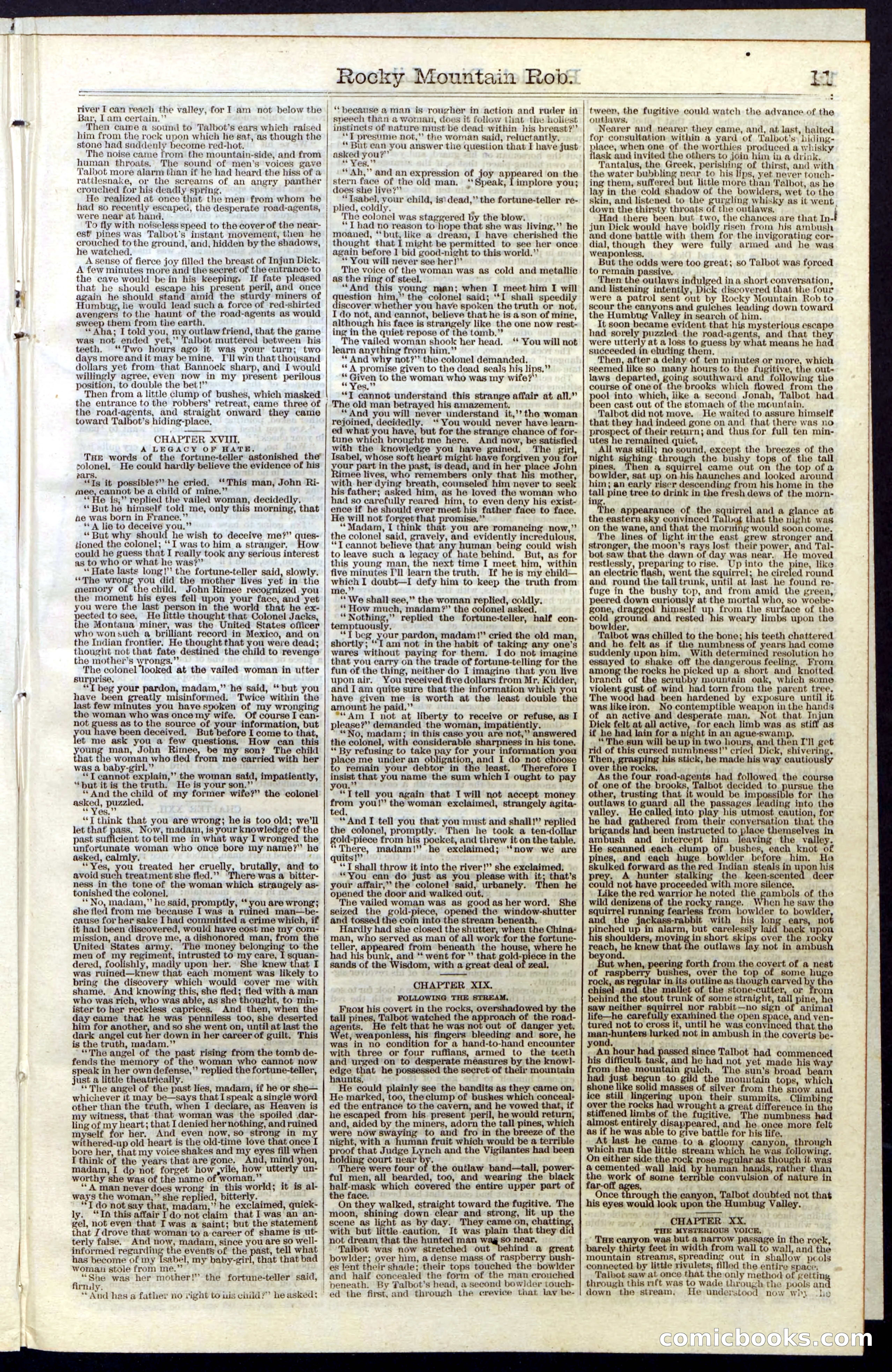
A restored page from Pulp Fiction, 1878. Page through the whole issue in the reader above.
📄 Transcribed text from this page (OCR, searchable)
Machine-transcribed from the original scan — historical spelling and the odd misread are preserved.
i river I can reach the valley, for I am not below the Bar, lam certain.” Then came a sound to Talbot’s ears which raised him from the rock upon which he sat, as though the stone had suddenly become red-hot, The noise came from the mountain-side, and from human throats. The sound of men’s voices gave Talbot more alarm than if he had heard the hiss of a rattlesnake, or the screams of an angry panther crouched for his deadly spring, He realized at onee that the men from whom he had so receutly escaped, the desperate road-agents, were near at hand, To fly with noiseless speed to the cover of the near- esf pines was Talbot's instant movement, then he crouched to the ground, and, hidden by the shadows, he watched. A sense of fierce joy filled the breast of Injun Dick. A few minutes more and the secret of the entrance to the cave would bein his keeping. If fate pleased that he should escape his present peril, and once again he should stand amid the sturdy miners of Humbug, he would lead such a force of red-shirted avengers tothe haunt of the road-agents as would sweep them from the earth. **Aha; I told you, my outlaw friend, that the game was not ended yet,’’ Talbot muttered between his teeth. “Two hours ago it was your turn; two days more andit may be mine. I'll win that thousand dollars yet from that Bannock sharp, and I would willingly agree, even now in my present perilous position, to double the bet!” Then from a little clump of bushes, which masked the entrance to the robbers’ retreat, came three of the road-agents, and straight onward they came toward Talbot’s hiding-place, CHAPTER XVIII. A LEGACY OF HATE. THE words of the fortune-teller astonished the colonel. He could hardly believe the evidence of his ars. “Ts it possible?” he cried. ‘*This man, John Ri- mee, cannot be a child of mine.” ‘*He is,” replied the vailed woman, decidedly. **But he himself told me, only this morning, that fe was born in France.” ** A lie to deceive you.” “But why should he wish to deceive me?’ ques- tioned the colonel; ‘‘I was to him a stranger, ow could he guess that I really took any serious interest as to who or what he was?” “Hate lasts long!’ the fortune-teller said, slowly. “The wrong you did the mother lives yet in the memory of the child, John Rimee recognized you the moment his eyes fell upon your face, and yet you were the last personin the world that he ex- pected to see, He little thought that Colonel Jacks, the Montana miner, was the United States officer who wonsuch a brilliant record in Mexico, and on the Indian frontier. He thought that you were dead; thought not that fate destined the child to revenge the mother’s wrongs.” The colonel ‘looked at the vailed woman in utter sur prise, sp dani} murt ‘I beg your pardon, madam,” he said, ut you have been greatly misinformed. Twice’ within the last few minutes you have spoken of my wronging the woman who was oncemy wife. Of course I can- not guess as to the source of tee information, but i ave been deceived. But before I come to that, et me ask you a few questions. How can this MA man, John Rimee, be my son? The child hat the woman who fled from me carried with her was a baby-girl.” ‘*T cannot explain,” the woman said, impatiently, “but itis the truth. He is your son.” ‘* And the child of my former wife?” the colonel asked, puzzled, “ Yes,”’ “T think that you are wrong; he is too old; we'll let that pass. Now, madam, is your knowledge of the past sufficient to tell me in what way I wronged the unfortunate woman who once bore my name?” h asked, y: : “Yes, you treated her cruelly, brutally, and to avoid such treatment she fled.” "Phere was a bitter- ness in the tone of the woman which strangely as- tonished the colonel, ‘*No, madam," he said, promptly, “‘ you are wrong; she fled from me because I was a ruined man—be- cause for her sake I had committed a crime which, if it had been discovered, would have cost me my com- mission, and drove me, a dishonored man, from the United States army. The money belongin to the men of ee intrusted to ~ care, uan- dered, foolishly, madly upon her. She knew that I was ruined—knew that each moment was likely to bring the discovery which would cover me with shame, And knowing this, she fled; fled with a man who was rich, who was able, as she thought, to min- ister to her reckless caprices. And then, when the day came that he was penniless too, she deserted him for another, and so she went on, until at last the dark angel cut her down in her career of guilt. This is the truth, madam.” “The angel of the past rising from the tomb de- fends the memory of the woman who cannot now speak in her own defense,"’ replied the fortune-teller, just a little theatrically. ‘The angel of the past lies, madam, if he or she— whichever it may be—says thatI apeek a single word other than the truth, when I declare, as Heaven is my witness, that that woman was the spoiled dar- ling of my heart; that I denied her nothing, and ruined myself for her. And even now, so strong in my withered-up old heart is the old-time love that once I bore her, that my voice shakes and my eyes fill when I think of the years that are gone, And, mind you, madam, I dp not forget how ,vile, how utterly un- worthy she was of the name of woman. +9 man never does wror Ce Mp it is al- ways the wo * she replied, bitterly. “IT do not say that, madam he exclaimed, quick- ly. “Ih this affair Ido not claim that I was an an- gel, not even that Iwas a saint; but the statement that 7 drove that woman to a career of shame is ut- terly false. And now, madam, since you are so well- informed regarding the events of the past, tell what has become of my Isabel, my baby-girl, that that bad woman stole from me.” ; - “She was her movher!"’ the fortune-teller said, rtuly. - And hes a father no vight to is child?” he asked; ee eee ' Rocky Mountain Rob. SE ‘because a man is rougher in action and ruder in speech than a woman, does it follow that the holiest instinets of nature must be dead within his breast?’ T prestime not,” the woman said, reluctantly. * But can you answer the question that I have just asked you?”’ “* Yes," ** Ah,” and an expression of stern face of the old man. does she live?” “Isabel, your child, is!dead,” the fortune-teller re- plied, coldly. _ The colonel was staggered by the blow. “IT had no reason to hope that she was living,”’ he moaned, ‘but, like a dream, I have cherished the thought that I might be permitted to see her once again before 1 bid good-night to this world.” ** You will never see her!’ The voice of the woman was as cold and metallic as the ring of steel. ““And this young man; when I meet him I will pega him,” the colonel said; “I shall speedil discover whether you have spoken the truth or not, I do not, and cannot, believe that he is a son of mine, although his face is strangely like the one now rest- ing in the quiet repose of the tomb.” The vailed woman shook her head, ‘ You will not learn anything from him.” ** And why not?’ the colonel demanded. **A promise given to the dead seals his lips.” - a to the woman who was my wife?” es,”” “T cannot understand this strange affair at all.” The old man betrayed his amazement. “‘And you will never understand it,’? the woman rejoined, decidedly. ‘* You would never have learn- ed what you have, but for the strange chance of for- tune which brought me here. And now, be satisfied with the knowledge you have gained. The girl, Isabel, whose soft heart might have forgiven you for your part in the past, is dead, and in her place John mee lives, who remembers only that his mother, with her dying breath, counseled him never to seek his father; asked him, as he loved the woman who had so carefully reared him, to even deny his exist- ence if he should ever meet his father face to face. He will not forget that promise.” ‘““Madam, I think that you are romancing now,” the colonel said, gravely, and evidently incredulous, “T cannot believe that any human being could wish to leave such a legacy of hate behind, But, as for this young man, the next time I meet him, within five minutes [ll learn the truth, If he is my child— which I doubt—I defy him to keep the truth from me.’ ‘* We shall see,”’ the woman replied, coldly. ‘How much, madam?” the colonel asked. “Nothing,” replied the fortune-teller, half con- temptuously. “T beg your pardon, madam!” cried the old man, shortly; ‘‘I am not in the habit of taking any one’s wares without paying for them. Ido not imagine that vou carry on the trade of fortune-telling for the fun of the thing, neither do I imagine that you live upon air. You received five dollars from Mr. Kidder, and Iam quite sure that the information which you have given me is worth at the least double the amount he paid.” *“Am I not at liberty to receive or refuse, as I please?” demanded the woman, impatiently. “No, madam; in this case you are not,’ answered the colonel, with considerable sharpness in his tone, “By refusing to take pay for your information you place me under an obligation, and I do not choose o remain your debtor in the least. Therefore I insist that you name the sum which I ought to pay ou.’ oy appeared on the “Speak, Limplore you; “Ttell you again that I will not accept money ae you!” the woman exclaimed, strangely agita- “And T tell you that you must and shall!” replied the colonel, promptly. Then he took a ten-dollar gold-piece from his pocket, and threw it on the table, : Age 8 madam!" he exclaimed; ‘now we are quits!” ; ‘*T shall throw it into the river!’ she exclaimed, ‘You can do just as you please with it; that’s your affair,” the colonel said, urbanely. Then he opened the door and walked out. The vailed woman was as goodas her word. She seized the gold-piece, opened the window-shutter and tossed the coin into the stream beneath, Hardly had she closed the shutter, when the China- man, who served as man of all work for the fortune- teller, appeared from beneath the h where he had his bunk, and “ went for ” that goldp ece in th sands of the Wisdom, with a great deal of zeal. CHAPTER XIX, FOLLOWING THE STREAM, t From his covert in the rocks, overshadowed by the tall pines, Talbot watched the approach of the road- y= He felt wom he was re eatin oer yet et, wea s fingers blee and sore, was in 25 00n tion for a hand-to-hand encounter with three or four ruffians, armed to the teeth and urged on to desperate measures by the knowl- cdge. that he possessed the secret of their mountain aunts. ; He could aly see the bandits as they came on. He marked, too, theclump of bushes which conceal- ed the entrance to the cavern, and he vowed that, if he “aes £4 from his. present peril, he would return, and, aided by the miners, adorn the tall pines, which were now swa to and fro in the breeze of the night, with a human fruit which would be a terrible proce that Judge pgnek and the Vigilantes had been olding court near va There were four of the outlaw band—tall, power- ful men, all bearded, too, and wearing the black half-m which covered the entire upper part of the face. On they walked, straight toward the fugitive. The moon, s mr down clear and strong, lit up the scene as as by day. They came on, cha with but little caution. It was plain that they did not dream that the hunted man wag so near. Talbot was now stretched out a bowlder; over him, a dense mass of raspberry bush- es lent their shade; their tops touched the bowlder and half concealed the form of the man crouched beneath. By Talbot’s head, a second bow)der touch- ed the first, and through the creviee that lav he- a bt — tween, the fugitive could watch the advance of the outlaws. Nearer and nearer they came, and, at last, halted foy consultation within a yard of Talbot's hiding- pa when one of the worthies produced a whisky lask and invited the others to join him in a drink. Tantalus, the Greek, perishing of thirst, and with the water bubbling near to his lips, yet never touch- ing them, suffered but little more than Talbot, as he lay in the cold shadow of the bowlders, wet to the skin, and listened to the gurgling whisky as it went. down the thirsty throats of the outlaws, ; Had there been but two, the chances are that In- jun Dick would have boldly risen from his ambush and done battle with them for the invigorating cor- dial, though they were fully armed and he was weaponless, But the odds were too great; so Talbot was forced to remain passive. Then the outlaws indulged ina short conversation, and listening intently, Dick discovered that the four were a patrol sent out by Rocky Mountain Rob to scour the canyons and gulches leading down toward the Humbug Valley in search of him. It soon became evident that his mysterious escape had sorely puzzled the road-agents, and that they were utterly at a loss to guess by what means he had succeeded in eluding them. Then, after a delay of ten minutes or more, which seemed like so many hours to the fugitive, the out- laws departed, going southward and following the course of one of the brooks which flowed from the 1 into which, like a second Jonah, Talbot had een cast out of the stomach of the mountain. Talbot did not move. He waited to assure himself that they had indeed gone on and that there was no prospect of their return; and thus for full ten min- utes he remained quiet, All was still; no sound, except the breezes of the night sighing through the bushy tops of the tall ines, Then a squirrel came out on the top ofa owlder, sat up on his haunches and looked around him; an early riser descending from his home in the tall pine tree to drink in the fresh dews of the morn- i . “he appearance of the squirrel and a glance at the eastern sky convinced Talbot that the night was on the wane, and that the morning would soon come. The lines of light imthe east grew stronger and stronger, the moon's rays lost their power, and Tal- bot saw that the dawn of day was near. He moved restlessly, preparing to rise. Upinto the pine, like an electric flach went the squirrel; he circled round and round the tall trunk, until at last he found re- fuge in the bushy top, and from amid the green, peered down curiously at the mortal who, so woebe- gone, dragged himself up from the surface of the a round and rested weary limbs upon the owlder, _ Talbot was chilled to the bone; his teeth chattered and he felt as if the numbness of years had come suddenly upon him, With determined resolution he essayed to shake off the dangerous rer nj From among the rocks he picked up a short and knotted branch of the scrubby mountain oak, which some violent gust of wind had torn from the parent tree, The wood been hardened by exposure until it was likeiron, No contemptible weapon in the hands of an active and desperate man, Not that Injun Dick felt at all active, for each limb was as stiff as if he had lain for a night in an ague-swamp, “The sun will beup in two hours, and then I'll get rid of this cursed numbness!” cried Dick, shivering, Then, grasp stick, he made his way cautiou over the As the four road-agents had followed the course of one of the brooks, Talbot decided to pursue the other, trusting that it would be impossible for the outlaws to guard all the passages leading into the yalley. He called into play his utmost caution, for he had gathered from their conversation that the brigands had been instructed to place themselves in ambush and intercept him ving the valley. He scanned each clump of bushes, each knot of ines, and each huge bowlder before him. He i pkg as the red Indian steals in upon his stalk the keen-scen deer ’ s Soni not have meatal with more silence, Like the red warrior he noted the bols of the wild denizens of the rocky range. en he saw the squirrel running fearless from bowlder to bowlder and the jackass-rabbit with his long ears, not inched up in alarm, but carelessly laid back upon his phoubiane, moving in short skips over the r foach, fe knew outlaws lay not in am But when, ing forth from the covert of a nest of fen moa Mh ret oo ne oe of sonnet re outline as though cary rock as ace t of the athe cutes r, or from chia e stout trunk of some straight, tall pin he = bbit tart of anitn saw neither squirrel nor lif and ven- e— y exarhin 0 ac tured not to cross it, until he wasconyinced that the man-hunters lurked not in ambush in the coverts be- _ An hour had since Talbot had co his difficult. on ie he had not yet made his \ ae from the mountain gulch, The sun's broad m had 1. n to gild the mountain tops, which shone solid masses of silver from the snow and ice still ering upon their summits. Climbing over the ' wrought a great difference in the stiffened limbs of the fugitive, numbness had almost entirely disa ed t as 4 a ve le to : sate battle for his tie rate “a came to a gloo canyon, thro puch ran the $4 atroain w peer following, ther e rock rose regular as though it was a& cemented wall laid by human hands, her hands, rather than oe work of some terrible convulsion of nature in Once t h the canyon, Talbot doubted not that his eyes would look upon the Humbug Valley. Dae canyon, was but a narrow. passnas si the roel barely thixty feet in width from wall to wall, nna the mountain s , 8p out in shallow pools conneeted by little rivulets, filled the entire space, Talbot saw at once that the only method of gettin through this mft was to wade =a ig the pools an down the stream, He understood now wh) he JOOKS (E(0) AMIS (E(0)