
Pulp Fiction, 1883 · page 3 of 32
Beadle's New York Dime Library No. 245 — page 3: what you’re looking at
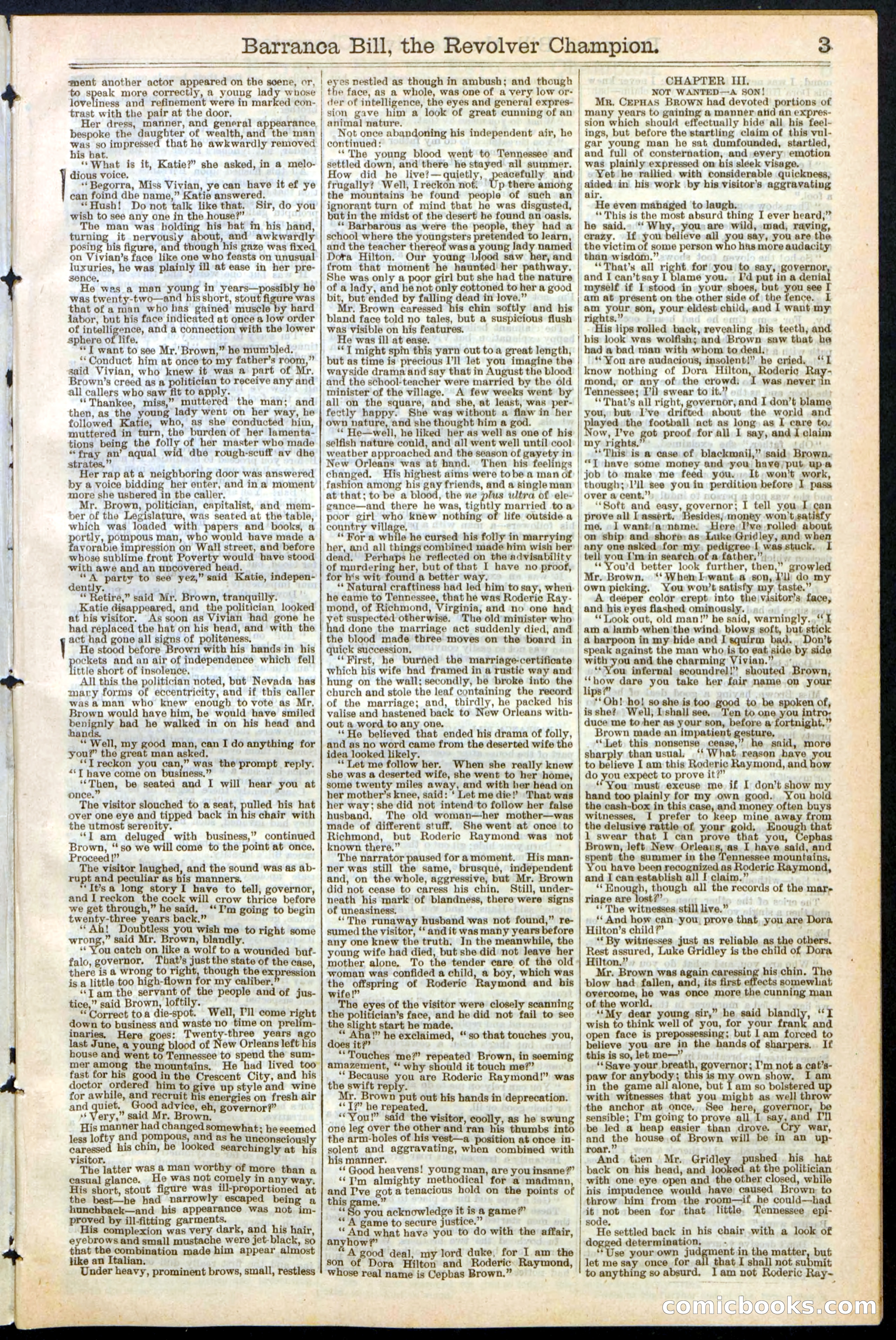
A restored page from Pulp Fiction, 1883. Page through the whole issue in the reader above.
📄 Transcribed text from this page (OCR, searchable)
Machine-transcribed from the original scan — historical spelling and the odd misread are preserved.
' | —-—----— —_— ment another actor appeared on the soene, or, to speak more correctly, a young ce whose loveliness and refinement were in marked con- trast with the pair at the door. Her dress, manner, and general appearance bespoke the daughter of wealth, and the man was so impressed that he awkwardly removed his hat. ‘‘What is it, Katie?” she asked, in a melo- dious voice. ‘*Begorra, Miss Vivian, ye can have it ef ye can foind dhe name,” Katie answered. *‘Hush! Do not talk like that. Sir, do you wish to see any one in the house?” The man was holding his bat in his hand, turning it nervously about, and awkwardly posing his figure, and though his gaze was fixed on Vivian’s face like one who feasts on unusual luxuries, he was plainly ill at ease in her pre- sence, He was a man young in years—possibly he was twenty-two—and his short, stout figure was that of aman who has gained muscle by hard jabor, but bis face indicated at once a low order of intelligence, and a connection with the lower sphere of life. “JT want to see Mr.'Brown,” he mumbled. ‘Conduct him at once to my father’s room,” said Vivian, who knew it was a part of Mr. Brown’s creed as a politician to receive any and all callers who saw fit to apply. ‘Thankee, miss,” muttered the man; and then, as the young lady went on her way, he followed Katie, who, as she conducted him, muttered in turn, the burden of her lamenta- tions being the folly of her master who made “fray an’ aqual wid dhe rough-scuff av dhe strates.” Her rap at a neighboring door was answered by a voice bidding her enter, and in a moment more she ushered in the caller. Mr. Brown, politician, capitalist, and mem- ber of the Legislature, was seated at the table, which was loaded with papers and books, a ortly, pompous man, who would have made a avorabie impression on Wall street, and before whose sublime front Poverty would have stood with awe and an uncovered head. “A party to see yez,” said Katie, indepen- dently. ‘ Retire,” said Mr. Brown, tranquilly. Katie disappeared, and the politician looked at his visitor. As soon as Vivian had gone he had replaced the hat on his head, and with the act had gone all signs of politeness. He stood before Brown with his hands in his ockets and an air of independence which fell ittle short of insolence. All this the politician noted, but Nevada has mary forms of eccentricity, and if this caller wasaman who knew enough to vote as Mr, Brown would have him, be would have smiled Lee nly bad he walked in on his head and ands. ‘** Well, my good man, can I do anything for you?” the great man asked. ‘IT reckon you can,” was the prompt reply. “*T have come on business.” ‘‘Then, be seated and I will hear you at once.” ; The visitor slouched to a seat, pulled his hat over one eye and tipped back in his chair with the utmost serenity. “J am deluged with business,” continued Brown, “so we will come to the point at once. Proceed!” The visitor laughed, and the sound was as ab- rupt and peculiar as his manners. ‘It’s a long story I have to tell, governor, and I reckon the cock will crow thrice before we get through,” he said. “I’m going to begin hah Ne PA aa back.” ‘*“Ab! Doubtless you wish me to right some wrong,” said Mr. Brown, blandly. : ‘* You catch on like a wolf to a wounded buf- falo, governor. That’s just the state of the case, there is a wrong to right, though the expression is a little too high-flown for my caliber. ‘‘Tam the servant of the people and of jus- tice,” said Brown, loftily. “Correct toa die-spot. Well, Pll come right down to business and waste no time on prelim- inaries, Here goes: Twenty-three years ago last June, a young blood of New Orleans left his house and went to Tennessee to spend the sum- mer among the mountains. He had lived too fast for his good in the Crescent City, and his doctor ordered him to give up style and wine cor, ana and egies his energies on fresh air and quiet, ce, eh, gov P * Very,” said Mr, Reverie ogra His manner had changed somewhat: he eeemed less lofty and pompous, and as he unconsciousl caressed his chin, he looked searchingly at his visitor. The latter was a man worthy of more than a casual glance. He was not comely in any way, His short, stout figure was ill-proportioned at the best—he had narrowly escaped being a eene—esid his yen was not im- proved by ill-fitting garmen His complexion oe very dark, and his hair, eyebrows and small mustache were jet-black, so that the combination made him appear almost tike an Italian. Under heavy, prominent brows, small, restless Barranea Bill, the Revolver | eyes nestled as though in ambush; and though | the face, as a whole, was one of a very low or- | der of intelligence, the eyes and general expres- sion gave him a look of great cunning of an animal nature. Not once abandoning his independent air, he continued: ‘The young blood went to Tennessee and settled down, and there he stayed all summer. How did he live?—quietly, gee and frugally? Well, Ireckon not: Up there among the mountains he found people of such an ignorant turn of mind that he was disgusted, but in the midst of the desert he found an oasis, ** Barbarous as were the people, they had a school where the youngsters pretended to learn, and the teacher thereof wasa young a named Dora Hilton. Our young blood saw her, and from that moment he haunted her pathway. She was only a poor girl but she had the nature of a lady, and he not only cottoned to her a good bit, but ended by wie Ser in love.” Mr. Brown caressed his chin softly and bis bland face told no tales, but a suspicious flush was visible on his features. He was ill at ease. “Tl might spin this yarn out toa great length, but as time is precious I'll let you imagine the wayside drama and say that in August the blood and the school-teacher were married by the old minister of the village. A few weeks went by all on the square, and she, at least, was per- fectly happy. She was without a flaw in her own nature, and she thought him a god. ‘* He—well, he liked her as well as one of his selfish nature could, and all went well until cool weatber approached and the season of gayety in New Orleans was at hand. Then his feelings changed. His highest aims were tobe a man of fashion among his gay friends, and a single man at that; to be a blood , the ne plus ultra of ele- gance—and there he was, tightly married toa poor girl who knew nothing of life outside a country Mees ‘* For a while he cursed his folly in marrying her, and all things combined made him wish ber dead. Perhaps he reflected on the advisability of murdering her, but of that I have no proof, for his wit found a better peek ‘“* Natural craftiness had led him to say, when he came to Tennessee, that he was Roderic Ray- mond, of Richmond, Virginia, and no one had be suspected otherwise. The old minister who ad done the marriage act suddenly died, and the blood made three moves on the board in quick succession, ‘First, he burned the marriage-certificate which his wife bad framed in a rustic way and hung on the wall; secondly, be broke into the church and stole the leaf containing the record of the marriage; and, Wale he packed his valise and hastened back to New Orleans with- out a word to any one. ‘“‘He believed that ended his drama of folly, and as no word came from the deserted wife the idea looked likely. **Let me follow her. When she really knew she was a deserted wife, she went to her home, some twenty miles away, and with her head on her mother’s knee, said: ‘ Let me die!’ That was her way; she did not intend to follow her false husband, The old woman—her mother—was made of different stuff. She went at once to Richmond, but Roderic Raymond was not known there.” The narrator paused foramoment. His man- ner was still the same, brusque, independent and, on the whole, aggressive, but Mr. Brown did not cease to caress his chin, Still, under- neath his mark of blandness, there were signs of uneasiness. ‘‘The runaway husband was not found,” re- sumed the visitor, ‘‘ andit was many years before any one knew the truth. In the meanwhile, the young wife had died, but she did not leave her mother alone, To the tender care of the old woman was confided a child, a boy, which was the offspring of Roderic Raymond and bis wife!” The eyes of the visitor were closely scanning the politician’s face, and he did not fail to see the ght start he made. ** Aha!” he exclaimed, “so that touches you, does it?’ ‘Touches me?” repeated Brown, in seeming amazement, “ why should it touch mef” ‘* Because you are Roderic Raymond!” was the swift reply. Mr. Brown put out his hands in deprecation. ‘*T?” he repeated. “You!” said the visitor, coolly, as he swung one leg over the other and ran his thumbs into the arm-boles of his vest—a position at once in- solent and aggravating, when combined with his manner. ‘‘ Good heavens! young man, are you insane?’ “Tm almighty methodical for a madman, and I’ve got a tenacious hold on the points of this game.” ; “So you acknowledge it is a game?” “A game to secure justice.” ‘** And what have you to do with the affair, anyhow?” A good deal, my lord duke, for I am the son of Dora Hilton and Roderic: Raymond, whose real name is Cepbas Brown.” 3 ee ae we ere CHAPTER UI. NOT WANTED—A SON! Mr, CepHas Brown had devoted portions of many "8 i to gaining a manner atid an expres- sion which should effectually hide all his feel- ings, but before the startling claim of this vul- gar young man he sat dumfounded, startled, and full of consternation, and every emotion was plainly expressed on bis sleek visage. Yet be rallied with considerable quickness, aided in his work by his visitor's aggravating air. He even mahaged to laugh. ** This is the most absurd thin he said,» “ wet fmm are wild, mad, raving, erazy. If you believe all you say, you are the the victim of some person who has more audacity than wisdom.” ‘That's all right for you to say, governor and I can’tsay I blame you. _ ’d putina denial myself if I stood in your sboes, but you see [ am at present on the other side of the fence. L ane yous son, your eldest child, and I want my rights. His lips rolled back, revealing bis teeth, and bis look was wolfish; and Brown saw that he had a bad man with whom to deal.) ‘You are audacious, insolent!” he cried, ‘1 know nothing of Dora Hilton, Roderic Ray- mond, or any of the crowd; I was never jin Tennessee; I'll swear to it.” * That’s all right, governor, and I don’t blame you, but I’ve drifted about the world and layed the football act as long as I care to. Yow, I’ve got proof for all 1 say, andi claim my rights,’ Sal ‘*This is a case of blackmail,” said Brown. “IT have some money and you havé/put up a job to make me feed you. It won't work, though; lll see youin perdition before I pass over a cent.” ‘Soft and easy, I ever heard;” overnor; I tell you. I fon prove all L assert, Besides; money won't.satisty me. I want/arname. Here I’ve rolled about on ship and shore: as Luke Gridley, and when any one asked for my. pedigree | was stuck, I tell you [min search of a father,” . “You'd better look further, then,” growled Mr. Brown. ‘*‘WhemI want a son, 7) do my own picking. You won’t satisfy my taste.” A deeper color crept into the visitor’s face, and his eyes flashed ominously. , Bey ‘Look out, old man!” he said, warningly..‘‘ I am a lamb when the wind. blows soft, but stick a harpoon in my bide and I squirm bad. Don’t speak against the man who is to eat, side by. side with you and the charming Vivian.” - ‘“You infernal scoundrel!” shouted Brown, Z ai dare you take her fair name on your Ips _ “Ob! hol so she is too good to be spoken of, is she? Well, lshall see, Ten to one you intro- duce me to -her as your son, before af ht,” Brown made an impatient gesture, ' ‘‘Let this nonsense cease,” he said, more sharply than usual, ‘‘ What. reason have you to believe I am this Roderic Raymond, and how do you expect to prove it?” — ‘You must excuse me if I don’t show my hand too plainly for my own good. You bold the cash-box in this case, and money often buys witnesses, I prefer to keep mine away from the delusive rattle of your gold, Enough that 1 swear that I can prove that you, Cepbas Brown, left New Orleans, as I have said, and spent the summer in the Tennessee mountains, ou have been recog as and I can establish all [ claim.” ‘‘ Enough, though all the records of the mars riage are lost?” ‘* The witnesses still live.” ‘‘ And how can you. prove that you are Dora, Hilton’s child?” | , ‘* By witnesses just as reliable as the others. Rest assured, Luke Gridley is the child of Dora ric Raymond, Hilton.” Mr. Brown was again caressing his chin. The blow had fallen, and, its first effects somewhat overcome, he was once more the cunning man of the world, ‘‘My dear young sir,” he said blandly, ‘I wish to think well of you, for ae frank and open face is pre ng; but lam forced to believe you are in the hands of sharpers.. If this is so, let me—” ‘Save your breath, governor; I'm not a cat’s- aw for anybody; this is my own show. I am in the game all alone, but { am so bolstered up with witnesses that you might as well throw the anchor at once, See here, governor, sensible; ’m going to prove all I say, and be led a heap easier than drove. .Cry war, and the house.of Brown will be in an up- And tien Mr. Gridley pushed his hat back on his head, and 1 at the politician with one eye open and the other closed, while nis impudence would have caused Brown, to throw him from the room—if he could—ha it ae been for that little. Tennessee epi- sode, ; He settled back in his chair with a look of dogged determination, 3s ent in the matter, buf ‘*Use yourown ju let me say once for that I shall not submit to anything so absurd. Iam not Roderic Ray~ Gomilcboo (E (E@) <S