
Pulp Fiction, 1883 · page 2 of 32
Beadle's New York Dime Library No. 245 — page 2: what you’re looking at
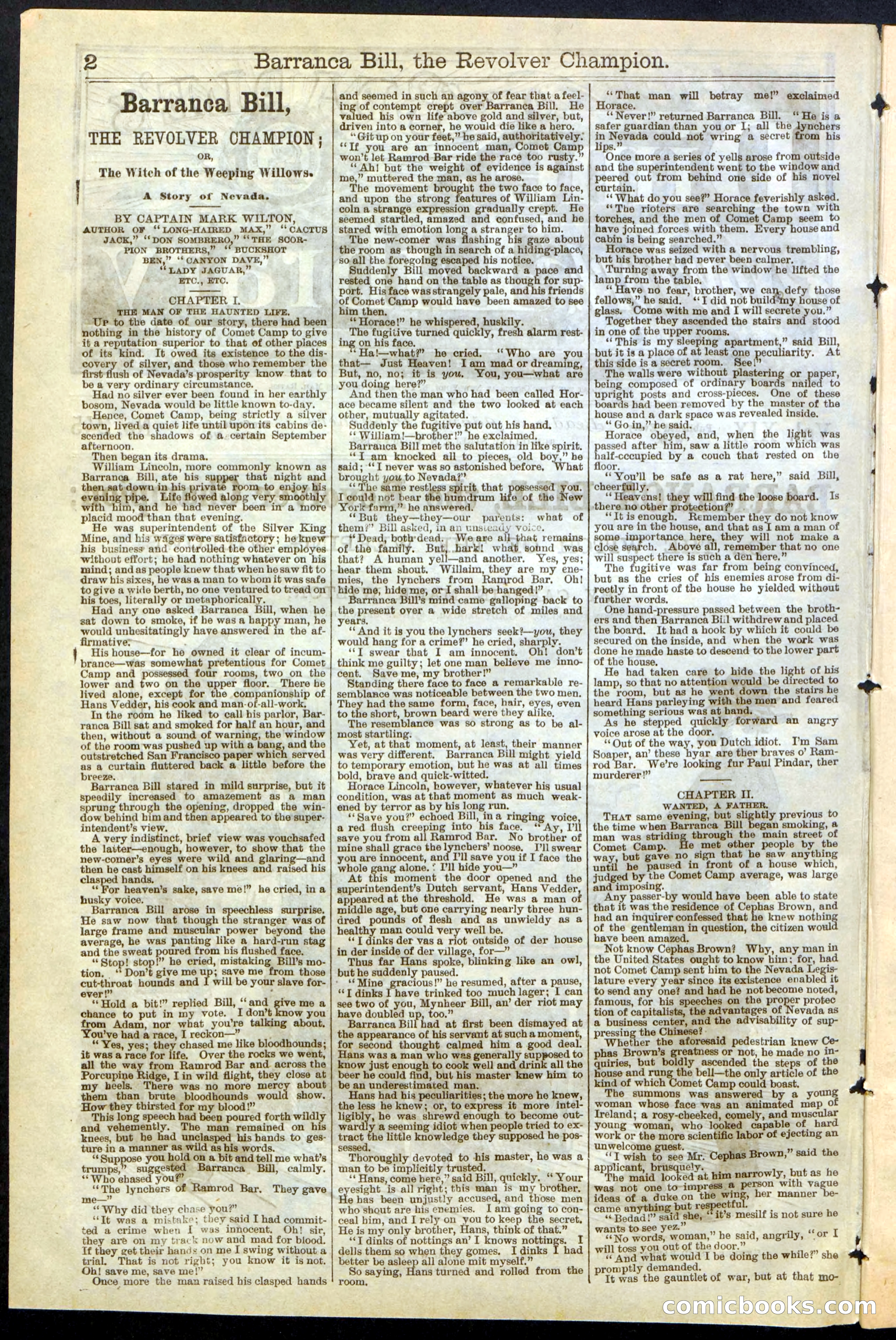
A restored page from Pulp Fiction, 1883. Page through the whole issue in the reader above.
📄 Transcribed text from this page (OCR, searchable)
Machine-transcribed from the original scan — historical spelling and the odd misread are preserved.
ts , the . evening pipe. Life with th —— ~——-—--—- -_- —- _—_—. — _—— ee Barranca, Bill, THE REVOLVER CHAMPION; OR, The Witch of the Weeping Willows. A Story of Nevada, BY CAPTAIN MARK WILTON, AUTHOR OF ‘‘LONG-HAIRED MAX,” ‘CACTUS JACK,” ‘‘DON SOMBRERO,” “‘ THE SCOR- PION BROTHERS,” ‘* BUCKSHOT BEN,” ‘‘CANYON DAVE,” “LADY JAGUAR,” ETC., ETC. hel ' CHAPTER I. _.\. THE MAN OF THE HAUNTED LIFE. Up to the date of our story, there had been nothing in the history of Comet Camp to give it a reputation superior to that of other places of its kind. It owed its existence to the dis- rnd of silver, and those who remember the first flush of Nevada’s prosperity know that to be a very ordinary circumstance. Had no silver ever been found in her earthly bosom, Nevada would be little known to-day. Hence, Comet Camp, being strictly a silver town, lived a quiet life until upon its cabins de- scended the shadows of a. certain September afternoon, Then began its drama. William Lincoln, more commonly known as Barraneca Bill, ate bis sup that night and at down in his aris ® room to enjoy he y 4 owed along very smoot m, and he had never been in’ a more placid mood than that evening. He was superintendent of the Silver King Mine, and his wages were satisfactory; heknew his business and controlled the other employes without effort; he had nothing whatever on his mind; and as people knew that when he saw fit to draw his sixes, he was a man to whom it was safe to give a wide berth, no one ventured to tread on his toes, literally or metaphorically. Had any one asked Barranca Bill, when he sat down to smoke, if he was a happy man, he would unhesitatingly have answered in the af- firmative: | His house—for he owned it clear of incum- brance—was somewhat pretentious for Comet Camp and possessed four rooms, two on the lower and two on the mpper floor. There be lived alone, except for the companionship of Hans Vedder, his cook and man-of-all-work, In the room he liked to call his parlor, Bar- ranca Bill sat and smoked for half an hour, and then, without a sound of warning, the window of the room was pushed up with a bang, and the outstretched San Francisco x which served as a curtain fluttered back a little before the breeze. Barranca Bill stared in mild surprise, but it speedily incr to amazement as a man sprung through the opening, dropped the win- ow behind bim and then appeared to the super- intendent’s view. A very indistinct, brief view was vouchsafed the laiter—enough, however, to show that the new-comer’s eyes were wild and glaring—and then he cast on his knees and raised his clas hands, ‘*For heaven’s sake, save me!” he cried, in a husky voice. Barranca Bill arose in hless surprise. He saw now that though the stranger was of large frame and muscular power beyond the average, he was panting like a hard-run stag and the sweat poured from his flushed face. “Stop! stop!’ he cried, mistaking Bill’s mo- tion. ‘ Don’t give me up; save me from those cut-throat hounds and I will be your slave for- ever!” . ‘* Hold a bit!” replied Bill, ‘‘and emea chance to put in my vote. I don’t know you from Adam, nor what you're talking about, You've had a race, I reckon—” “Yes, yes; they chased me like bloodhounds; it was a race for life. Over the rocks we went, way from Ramrod Bar and across the Porcupine Ridge, I in wild flight, they close at my heels. There was no more mercy about them than brute bloodhounds wo show. How they thirsted for my blood!” This long speech had been poured forth bonne | ' and vehemently. The man remained on knees, but he had unclasped his hands to ges- ture in a manner as wild as bis words. “ ppose you hold on a bit and tell me what’s trumps,” suggested ca Bill, calmly. ** Who ehased yout’ . “The lynchers of Ramrod Bar. They gave “Why did they chase you?” “Tt was a mistake; they said I had commit- ted a crime when I was innocent. Oh! sir, they are on my track now and mad for blood. If they get their hands on me I swing without.a trial. That is not right; you know it is not. Oh! save me, save me!” Once more the man raised his clasped hands Barranca Bill, the Revolve ee ae OS oe and seemed in such an agony Of fear that a feel- ing of contempt crept over nea Bill. He valued his own life above gold and silver, but, driven into a corner, he would die like a hero. “Git up on your feet,” he said, authoritatively: ‘‘Tf you are an innocent man, Comet Camp won’t let Ramrod Bar ride the race too rusty.” “Ah! but the weight of evidence is against me,” muttered the man, as he arose. The movement brought the two face to face, and upon the strong features of William Lin- coln a strange expression gradually crept. He seemed startled, amazed and confused, and he stared with emotion eal a stranger to bim. The new-comer was flashing his gaze about the room as though in search of a hiding-place, so-all the foregoing escaped his notice. Suddenly Bill moved backward a rested one hand on the table as though for sup- port. His face was strangely pale, and his friends of Comet Camp would have been amazed to see him then. ** Horace!” he whispered, huskily. The fugitive turned quickly, fresh alarm rest- ing on his face. *Ha!—what?” he cried. ‘Who are you that— Just Heaven! Iam mad or dreaming, But, no, no; it is you. You, you—what are you doing here?” And then the man who had been called Hor- ace became silent and the two looked at each other, mutually agitated. Suddenly the fugitive put out his hand, ** William!—brother!” he exclaimed. Barranca Bill met the salutation in like spirit. “fT am knocked all to pieces, old boy,” he said; ‘‘I never was so astonished before, hat brought you to Nevada?” . ““'T'he same restless spirit, that possessed you. T could not bear the humdrum life of the New York farm,” he answered. ; ‘But they—they—our parents: what of them?” Bill asked, in an unsicady voice. * Dead; bothdead:, Weare all-that remains of the family. But, .bark! what sound was that? A human yelli—and another. Yes, yes; hear them shout. Willaim, they are my ene- mies, the lynchers from Ramrod Bar, Oh! ce and ‘hide me; hide me, or I shall be hanged!” Barranca Bill’s mind came galloping back to the present over a wide stretch of miles and years. ** And it is you the lynchers seek?—you, they would hang for a crime?” he cried, sharply. ‘‘T swear that I am innocent. Oh! don’t think me guilty; let one man believe me inno- cent. Save me, my brother!” Standing there face to face a remarkable re- semblance was noticeable between the two men. They had the same form, face, hair, eyes, even to the short, brown beard were they alike, The resemblance was so strong as to be al- most startling. Yet, at that moment, at least, their manner was very different. Barranca Bill might yield to temporary emotion, but he was at all times bold, brave and quick-witted. Horace Lincoln, however, whatever his usual condition, was at that moment as much weak- ened by terror as by his long run. ‘‘Save you?” echoed Bill, ina ringing voice a red flush creeping into his face. “Ay, Dll save you from all Ramrod Bar. No brother of mine shall grace the lynchers’ noose. I'll swear you are innocent, and Ill save you if I face the whole gang alone.‘ I'll hide you—” At this moment the door opened and the superintendent’s Dutch servant, Hans Vedder appeared at the threshold. He was a man of middle age, but one carrying nearly three hun- dred pounds of flesh and as unwieldy as a healthy man could very well be. <i dinks der vas a riot outside of der house in der inside of der village, for—’ _ Thus far Hans spoke, blinking like an owl, but he suddenly paused. ** Mine cious!” he resumed, after a pause, ‘*T dinks I have trinked too much lager; I can see two of you, Mynheer Bill, an’ der riot may have doubled uP too.” ; Barranca Bill had at first been dismayed at the appearance of his servant at such a moment, for second thought calmed him a good deal. was a man who was generally eS to know just enough to cook well and drink all the beer he could find, but his master knew him to bean underestimated man. = Hans had his ties; the more he knew, the less he knew; or, to express it more intel- ligibly, he was shrewd enough to become out- wardly a seeming idiot when people tried to ex- tract the little knowledge they supposed he pos- sessed, Thoroughly devoted to his master, he was a man to be implicitly trusted. ‘‘ Hans, come here,” said Bill, quickly. “ Your eyesight is all right; this man is my brother. e has been unjustly accused, and those men who shout are his enemies. Iam going to con- ceal bim, and I rely on you to keep the secret, He is my only brother, Hans, think of that.” ‘“‘T dinks of nottings an’ I knows seat I dells them so when they gomes, I dinks I had better be asleep all alone mit myself.” So saying, Hans turned and rolled from the room, Bw. r Champion. “That man will betray me!” exclaimed Horace. “Never!” returned Barranca Bill. “ He is a safer guardian than you or 1; all the lynchers in Nevada could not wring a secret from his 8. Once more a series of yells arose from outside and the superintendent went to the window and peered out from behind one side of his novel curtain. ‘What do you see?” Horace feverishly asked. “The rioters are searching the town with torches, and the men of Comet Camp seem to have joined forces with them. Every house and cabin is being searched.” Horace was seized with a nervous trembling, but his brother had pever been calmer, Turning away from the window he lifted the ert: wey the table. ‘*‘ Have no fear, brother, we can,defy those fellows,” he said. ‘I did not build*my house of lass. Come with me and I will secrete you.” Togetber they ascended the stairs and stood in one of the upper rooms. ‘‘This is my sleeping apartment,” said Bill, but it is a place of at least one peculiarity. At this side is a secret room. See!” The walls were without plastering or paper, being composed of ordinary boards nailed to upright posts and cross-pieces, One of these boards had been removed by the master of the house and a dark space was revealed inside, ‘Go in,” he said. c Horace obeyed, and, when the light was passed after him, saw a little room which was Pon ee by a couch that rested on the oor. ‘“You’ll be safe as a rat here,” said Bill, cheerfully, ‘Heavens! they will find the loose board. Is there no other protection?” ‘‘Itis enough. Remember they do not know you are in the house, and that as I am a man of some.importance here, they will not make a close search. Above all, remember that no one will suspect there is such a den here,” The fugitive was far from being convinced, but as the cries of his enemies arose from di- rectly in front of the house he yielded without further words. One hand-pressure passed between the broth- ers and then Barranca Biil withdrew and placed the board. It had a hook by which it could be secured on the inside, and when the work was done he made haste to descend to the lower part of the house, P He had taken care to hide the light of his lamp, so that no attention would be directed to the room, but as he went down the stairs he heard Hans parleying with the men and feared something serious was at hand, As he stepped quickly forward an angry voice arose at the door. d= “Out of the way, you Dutch idiot. I’m Sam Soaper, an’ these hyar are ther braves o’ Ram- rod Bar. We're looking fur Paul Pindar, ther murderer!” ——K— CHAPTER II. WANTED, A FATHER, THAT same evening, but slightly previous to the time when nea Bill began smoking, 4 man was striding through the main street of Comet Camp. He met ether people by the way, but gave no sign that he saw anything until be paused in front of a house which, judged by the Comet Camp average, was large and imposing. Any passer-by would have been able to state that it was the residence of Cephas Brown, and had an inquirer confessed that he knew pee) of the gentleman in question, the citizen woul have been amazed. : Not know Cephas Brown? Why, any man in the United States ought to know him; for, had not Comet Camp sent him to the Nevada Legis- lature every year since its existence enabled it to send any one? and had he not become noted, eer for his cone on ie pre er Pe tion of capitalis vantages evada a pashene ona and the advisability of sup- the Chinese? - ressin sf Whether the aforesaid pedestrian knew Ce- phas Brown’s greatness or not, he made no in- quiries, but boldly ascended the steps of the house and rung the bell—the only article of the kind of which Comet Camp could boast. The summons was answered by a youn woman whose face was an animated map 0 Ireland; a rosy-cheeked, comely, and muscular young woman, who Ector o! of hard. mat the more scientific labor of ejecting an unwelcome guest. =. Wiss : “T wish to seo Mr. Cophas Brown,” said the applican udly.. ve "Phe nei looked at bim narrowly, but as he was not one to-impress.@ person with vague ideas of a duke oe the win > her manner mares bet she, ‘it’s mesilf is not sure he ez.” Males Peete woman,” he said, angrily, “‘or I will toss you out of the door.” St «“ And what would I be doing the while?” she promptly demanded. It was the gauntlet of war, but at that mo- Se ee >: _ 4 Gomicboo + es