
Pulp Fiction, 1883 · page 4 of 32
Beadle's New York Dime Library No. 245 — page 4: what you’re looking at
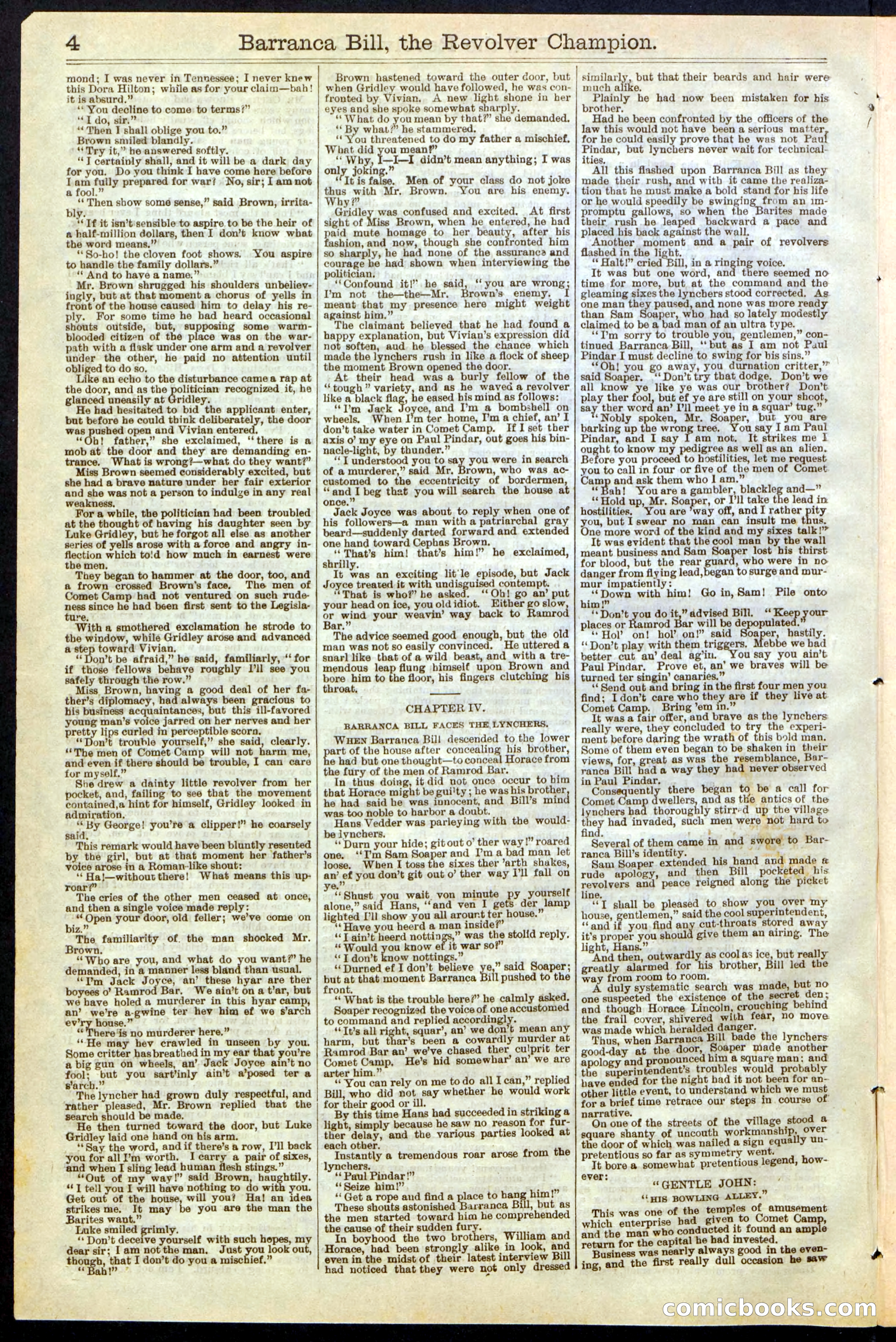
A restored page from Pulp Fiction, 1883. Page through the whole issue in the reader above.
📄 Transcribed text from this page (OCR, searchable)
Machine-transcribed from the original scan — historical spelling and the odd misread are preserved.
4 mond; I was never in Tennessee; I never knew this Dora Hilton; while as for your claim—bah! it is absurd.” ‘* You decline to come: to terms?” “I do, sir.” “Then I shall oblige you to.” Brown smiled blandly. ‘Try it,” he answered softly. “T certainly shall, and it will be a dark day for you. Do you think I have come here before I oe pe prepared for war? No, sir; lam not a fool.” ‘* Then show some sense,” said Brown, irrita- ———— ee eee y. ‘* Tf it isn’t'sensible to aspire to be the heir of a half-million dollars, then I don’t know what the word means.” **So-ho! the cloven foot shows, to handle the family dollars.” ‘* And to have a name.” Mr. Brown shrugged his shoulders unbeliev- ingly, but at that moment a chorus of yells in front of the house caused him to delay his re- ply. For some time he bad heard occasional shouts outside, but, supposing some warm- blooded citizen of the place was on the war- path with a flask under one arm and a revolver under the other, he paid no attention until obliged to do so. Like an echo to the disturbance came a rap at the door, and as the politiciam recognized it, he glanced uneasily at Gridley. He had hesitated to bid the applicant enter, but before he could think deliberately, the door was pushed open and Vivian entered. “Oh! father,” she exclaimed, ‘‘there is a mob at the door and they are demanding en- trance. What is wrong?—what do they want?” Miss Brown seemed considerably excited, but she had a brave nature under her fair exterior and she was not a person to indulge in any real weakness. For a while, the politician had been troubled at the thought of having his daughter seen by Luke Gridley, but he forgot all else as another series of yells arose with a force and angry in- flection which to!'d how much in earnest were the men. They began to hammer at the door, too, and a frown cr Brown's face, The men of Comet Camp had not ventured on such rude- ness since he had been first sent to the Legisla- You aspire ture. With a smothered exclamation he strode to the window, while Gridley arose and advanced a step toward Vivian. “Don’t be afraid,” he said, familiarly, *‘ for if those fellows behave roughly Vill see you safely through the row.” Miss Brown, having a good deal of her fa- ther’s diplomacy, had always been ous to his business acquaintances, but this ill-favored young man’s voice jarred on her nerves and her pretty lips curled in perceptible scorn, Don’t trouble yourself,” she said, clearly. ‘The men of Comet Camp wil) not harm me, and even if there should be trouble, I can care for myself.” She drew a dainty little revolver from her pocket, and, failing to see that the movement contained,a hint for himself, Gridley looked in admiration, te By George! you’re a clipper!” he coarsely said, This remark would have been bluntly resented by the girl, but at that moment her father’s voice arose in a Roman-like shout: ‘‘ Ha!—without there! What means this up- roar?” The cries of the other men ceased at once, and then a single voice made reply: “Open your door, old feller; we’ve come on The familiarity of. the man shocked Mr. Brown. “Who are you, and what do you want?” he demanded, in a manner less bland than usual. “Pm Jack Joyce, an’ these hyar are ther boyees o’ Ramrod Bar, We ain’t on a t’ar, but we bave holed a murderer in this hyar camp, an’ we're a-gwine ter hey him ef we s’arch ev’ry house.” “There ‘is no murderer here,” ‘‘He may hev crawled in unseen by you. Some critter has breathed in my ear that you’re a big gun on wheels, an’ Jack Joyce ain’t no fool; but you sart’inly ain’t a’posed ter a s’arch.” The lyncher had grown duly respectful, and rather pleased, Mr. Brown replied that the search should be made, He then turned toward the door, but Luke Gridley laid one hand on bis arm. _ “Say the word, andif there’s a row, I'll back ‘you for all ’m worth. Icarry a pair of sixes, and when I sling lead human flesh stings.” “Out of my way!” said Brown ime. pr “1 tell you I will have nothing to do with you. Get out of the house, will you? Ha! an idea strikes me. It may be you are the man the Barites want.” Luke smiled grimly. ‘* Don’t deceive yourself with such hopes, my dear sir; [am notthe man. Just you look out, thou . — I don’t do you a mischief.” me —— Brown hastened toward the outer door, but when Gridley would have followed, he was con- fronted by Vivian.. A new light shone in her eyes and she spoke somewbat sharply. ** What do you mean by that?” she demanded, ‘* By what?” he stammered, ‘You threatened to do my father a mischief, What did you mean?’ ‘‘ Why, I—I—I didn’t mean anything; I was only joking.” ‘It is false. thus with Mr. Why?” Gridley was confused and excited. At first sight of Miss Brown, when he entered, he had paid mute homage to her eeu f after his fashion, and now, though she confronted him so sharply, he had none of the assuranca and courage he had shown when interviewing the politician, ‘‘Confound it!” he said, ‘‘ you are wrong; I’m not the—the—Mr. Brown’s enemy. meant that my presence here might weight against him.” The claimant believed that he had found a happy explanation, but Vivian’s expression did not soften, aud he blessed the chance which made the lynchers rush in like a flock of sheep the moment Brown opened the door. At their head was a burly fellow of the “tough” variety, and as he waved a revolver like a black flag, he eased his mind as follows: ‘Tm Jack oyce, and I’m a bombshell on wheels, When I’m ter home, I’m a chief, an’ I don’t take water in Comet Camp. [If I set ther axis 0’ my eye on Paul Pindar, out goes his bin- nacle-light, by thunder.” ‘‘T understood you to say you were in search of a murderer,” said Mr, Brown, who was ac- customed to the eccentricity of bordermen, - and I beg that you will search the house at once. Jack Joyce was about to reply when one of his followers—a man with a patriarchal gray beard—suddenly darted forward and extended one hand toward Cephas Brown, ‘That’s him! that’s him!” he exclaimed, shrilly. . It was an exciting litle episode, but Jack Joyce treated it with wnalagnites contempt. “That is who?’ be asked. ‘‘Ob! go an’ put your head on ice, you oldidiot. Either go slow oy wind your weavin’ way back to Ramr ar. The advice seemed good enough, but the old man was not so easily convinced. He uttered a snarl like that of a wild beast, and with a tre- mendous leap flung himself upon Brown and a him to the floor, his fingers clutching his throat, Men of your class do not joke Brown. You are his enemy. —- ——— CHAPTER IV. BARRANCA BILL FACES THE, LYNCHERS, Wuen Barranca Bill descended to the lower art of the house after concealing his brother, e had but one thought—to conceal Horace from the fury of the men of Ramrod Bar. In thus doing, it did not once occur to him that Horace might be gui'ty ; he was his brother he had said he was innocent, and Bill’s mind was too noble to harbor a doubt. Hans Vedder was parleying with the would- be lynchers. “Durn your hide; git out o’ ther way!” roared one. ‘I’m Sam Soaper and I’m a bad man let loose. When I toss the sixes ther ’arth shakes, an’ ef you don’t git out o’ ther way I'll fall on ‘‘Shust you wait, von minute by yourself alone,” ety Hans, ‘‘and ven I gets der amp lighted Pll show you all arour-t ter house.’ ‘Have you heerd a man inside?” “T ain’t heerd nottings,” was the stolid reply. “Would you know ef it war sof” ‘“‘T don’t know nottings.” ‘‘Durned ef I don’t believe ye,” said Soaper; but at that moment Barranca Bill pushed to the front. “ What is the trouble here?’ he calmly asked. Soaper recognized the voice of one accustomed to command and replied accordingly. ‘‘Tt’s all right, squar’, an’ we don’t mean any harm, but thar’s been a cowardly murder at Ramrod Bar an’ we've chased ther cu!lprit ter Comet Camp, He’s hid somewhar’ an’ we are arter him.” “You can rely on me todo all Ican,” replied Bill, who did not say whether he would work for their good or ill. . By this time Hans had succeeded in striking a light, simply because he saw no reason for fur- ther delay, and the various parties looked at each other. : Instantly a tremendous roar arose from the lynchers. ‘* Paul Pindar!” “Seize him!” . ‘Get a rope and find a meee to bang him! These shouts astonished Barranca Bill, but as the men started toward him he comprehended the cause of their sudden fury. s In boyhood the two brothers, William and Horace, had been strongly alike in look, and even in the midst of their latest interview Bill had noticed that they were not only dressed _Barranca Bill, the Revolver Champion. | —$ — __—_—__ —__ —_.- — — —_——- — ———>_—— similarly, but that their beards and hair were much alike, Plainly he had now been mistaken for his brother. Had he been confronted by the officers of the law this would not have been a serious matter for he could easily prove that he was not Paul a but lynchers never wait for technical- ties. All this flashed upon Barranca Bill as they made their rush, and witb it came the realiza- tion that he must make a bold stand for his life or he would speedily be swinging from an 1m- promptu gallows, so when the Barites made their rush he Jeaped backward a pace and placed his back against the wall. Another moment and a pair of revolvers flashed in the light. ‘** Halt!” cried Bill, in a ringing voice. It was but one word, and there seemed no time for more, but at the command and the gleaming sixes the lynchers stood corrected, As one man they paused, and none was more ready than Sam Soaper, who had so lately modestly claimed to be a bad man of an ultra type. ‘‘T'm sorry to trouble you, gentlemen,” con- tinued Barranca Bill, ‘‘ but as I am not Paul Pindar I must decline to swing for bis sins.” “‘Oh! you go away, you durnation critter,” said Soaper. .‘‘ Don’t try that dodge. Don’t we all know ye like ye was our brother? Don’t play ther fool, but ef ye are still on your shoot, say ther word an’ I'll 'meet ye in a squar’ tug.” ‘Nobly spoken, Mr. Soa barking up the pegs 6 tree. You say I am Paul Pindar, and I say I am not, It strikes me |} a to know my pedigree as well as an alien. Before you proceed to hostilities, let me request you to call in four or five of the men of Comet Camp and ask them who I am.” “Bah! You are a gambler, blackleg and—” “Hold up, Mr. Soaper, or I’ll take the lead in hostilities. You are ’way off, andI rather pity you, but Iswear no man can insult me thus. One more word of the kind and my sixes talk!’” It was evident that the cool man by the wall meant business and Sam Soaper lost his thirst for blood, but the rear guard, who were in no danger from flying lead, began to surge and mur- mur impatiently: ‘‘Down with him! Go in, Sam! Pile onto him!” ‘* Don’t you do it,” advised Bill. ‘“‘ Kee your places or Ramred Bar will be depopulated.’ ‘* Hol’ on! hol’ on!” said r, hastily. ‘Don’t play with them triggers. Mebbe we bad better cut an’ deal ag’in. ou say you ain’t Paul Pindar. Prove et, an’ we braves will be turned ter singin’ canaries.” ‘Send out and bring in the first four men you find; I don’t care who they are if they live at Comet Camp. Bring ’em in.” It was a fair offer, and brave as the lynchers really were, they concluded to try the experi- ment before daring the wrath of this bold man. Some of them even began to be shaken in their views, for, great as was the resemblance, Bar- ranca Bill had a way they had never observed in Paul Pindar. Consequently there began to be a call for ‘yak Clas wellers, and as the antics of the lynchers had thoroughly stirred up the village hey had invaded, such men were not hard to find. : Spee! ey Several of them came in and swore to Bar- ranca Bill’s identity. > ae Sam Soaper extended his hand and made & rude apology, and then Bill pocketed his revolvers and peace reigned along the picket line. ‘‘T shall be pleased to show you over my house, gentlemen,” said the cool superintendent, “and if you find any cut-throats stored away it’s proper you should give them an airing. The light, Hans.” é ‘And then, outwardly as cool as ice, but really greatly alarmed for his brother, Bill led the way from room to room. A duly systematic search was made, but no one suspeeted the existence of the § den ; and though Horace Lincoln, crouching behind ihe, fall covet, ee was made which her . Thus, when Barranca Bill bade the lynchers good-day at the door, Soaper made another apology and pronounced him a square man; and the superintendent’s troubles would probably have ended for the night bad it not been for an- other little event, to understand which we must for a brief time retrace our steps in course of narrative. On one of the streets of the village stood a square shanty of uncouth workmanship, over the door of which was nailed a sign equally un- pretentious so far as symmetry went. It bore a somewhat pretentious legend, how- masts “GENTLE JOHN: (‘18 BOWLING ALLEY.” is one of the temples of amusement whieh enterprise bad given to Comet Camp, and the man who conducted it found an ample return for the capital he had invested. Business was nearly always good in the even- ing, and the first really dull occasion he saw r, but you are oa —, (E(0) ®, micboo ald Cc