
Pulp Fiction, 1879 · page 5 of 20
Beadle's Half Dime Library, No. 103 — page 5: what you’re looking at
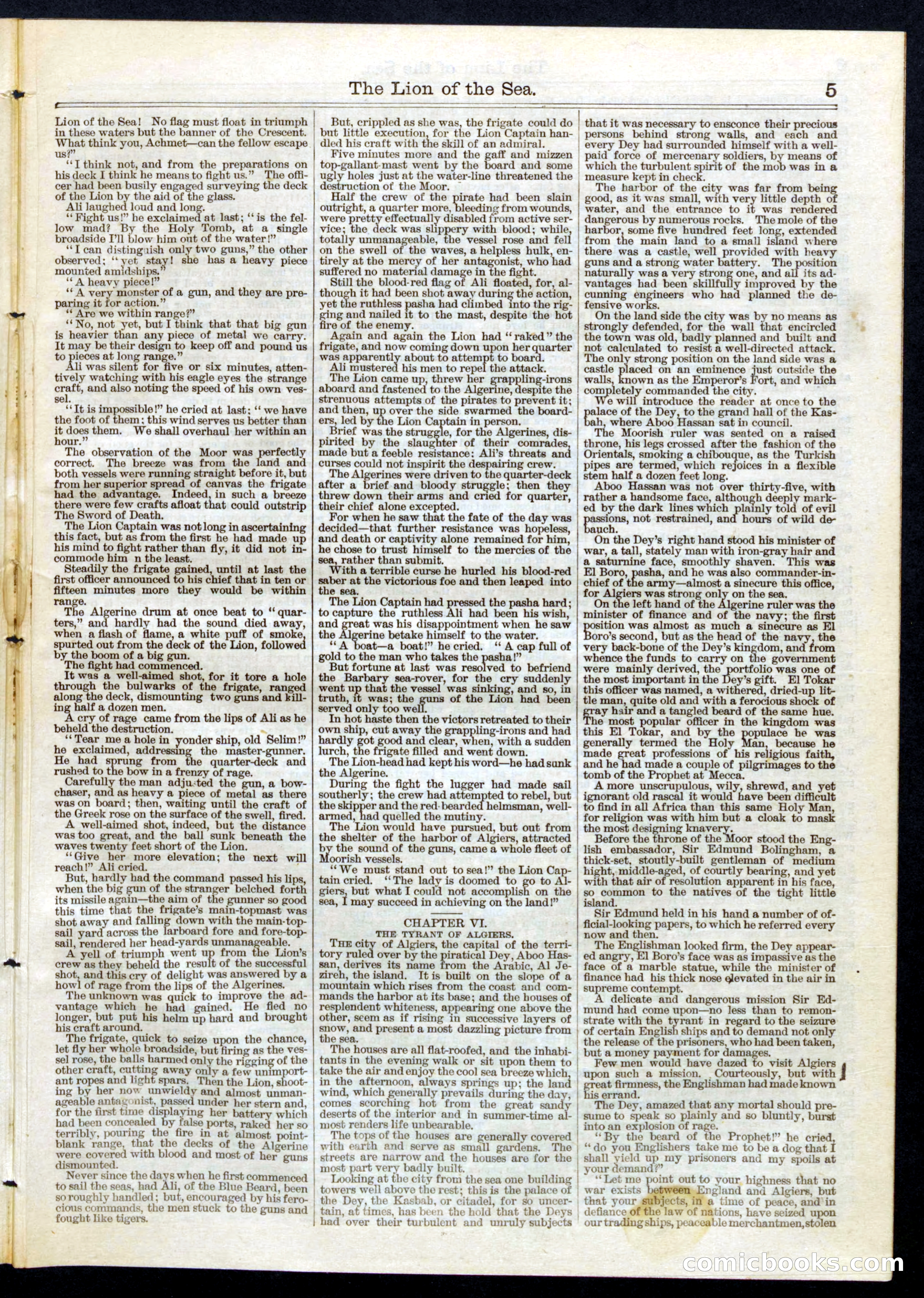
A restored page from Pulp Fiction, 1879. Page through the whole issue in the reader above.
📄 Transcribed text from this page (OCR, searchable)
Machine-transcribed from the original scan — historical spelling and the odd misread are preserved.
| TOES FETE a Lion of the Sea! No flag must float in triumph | in these waters but the banner of the Crescent. What think you, Achmet—can the fellow escape us?” “T think not, and from the preparations on his deck I think he means to fight us.” i cer had been busily engaged surveying the deck of the Lion by the aid of the glass. Ali laughed loud and long. ‘Fight us!” he exclaimed at last; ‘‘is the fel- low mad? By the Holy Tomb, at a single broadside I'll blow him out of the water!” ‘‘ITcan distinguish only two guns,” the other observed; ‘* yet stay ! she has a heavy piece mounted amidships.’ ‘A heavy piece!” ‘‘ A very monster of a gun, and they are pre- paring it for action.” ‘* Are we within range?” ‘*No, not yet, but I think that that big gun is heavier than any piece of metal we carry. It may be their design to keep off and pound us to pieces at long range.” li was silent for five or six minutes, atten- tively watching with his eagle eyes the strange att and also noting the speed of his own ves- sel. ‘It is impossible!” he cried at last: ‘‘ we have the foot of them; this wind serves us better than . does them. We shall overhaul her within an our. The observation of the Moor was yn correct. The breeze was from the land and both vessels were running straight before it, but from her superior spread of canvas the frigate had the advantage. Indeed, in such a breeze there were few crafts afloat that could outstrip The Sword of Death. The Lion Captain was not long in ascertaining this fact, but as from the first he had made up his mind to fight rather than fly, it did not in- commode him n the least. Steadily the frigate gained, until at last the first officer announced to his chief that in ten or fifteen minutes more they would be within range. The Algerine drum at once beat to ‘ quar- ters,” and hardly had the sound died away, when a flash of flame, a white puff of smoke spurted out from the deck of the Lion, followed by the boom of a big gun. The fight had commenced. It was a well-aimed shot, for it tore a hole through the bulwarks of the frigate, ran along the deck, dismounting two guns and kill- ing half Sposa men. 3 hl ses oe Aa cry of rage came from the lips o as he beheld the destruction. ~ ‘*Tear me a hole in yonder ship, old Selim!” he exclaimed, addressing the master-gunner. He had sprung from the quarter-deck and rushed to the bow in a frenzy of rage. Carefully the man adju-ted the , a bow- chaser, and as heavy a piece of metal as there was on board; then, waiting until the craft of the Greek rose on the surface of the swell, fired. A well-aimed shot, indeed, but the distance was too great, and the ball sunk beneath the waves twenty feet short of the Lion. ‘‘Give her more elevation; the next will reach!” Ali cried. . But, hardly had the command passed his lips, when the big gun of the stranger belched forth its missile again—the aim of the gunner so good this time that the frigate’s main-topmast was shot away and falling down with the main-top- sail yard across the larboard fore and fore-top- sail, rendered her head-yards unmanageable. A yell of triumph went up from the Lion’s crew as they beheld the result of the successful shot, and this cry of delight was answered by a howl of rage from the lips of the Algerines. The unknown was quick to improve the ad- vantage which he had gained. He fied no longer, but put his helm up hard and brought his craft around. The frigate, quick to seize upon the chance, let fly her whole broadside, but firing as the ves- sel rose, the balls harmed only the rigging of the other craft, cutting away only a few unimport- ant ropes and light spars. Then the Lion, = al ing by her now unwieldy and almost unman- ageable antagonist, passed under her stern and, for the first time displaying her battery which had been concealed by f alse ports, raked her so terribly, pouring the fire in at almost point- blank range, that the decks of the Algerine The Lion of the Sea. But, crippled as she was, the frigate could do but little syrgicr ce te the Lion Captain han- dled his craft with the skill of an admiral. Five minutes more and the gaff and mizzen | The off | top-gallant-mast went by the board and some | 16 Off- | ugly holes just at the water-line threatened the © destruction of the Moor. Half the crew of the pirate had been slain outright, a quarter more, bleeding from wounds, were pretty effectually disabled from active ser- vice; the deck was slippery with blood; while, totally unmanageable, the vessel rose and fell on the swell of the waves, a helpless hulk, en- tirely at the mercy of her antagonist, who had suffered no material damage in the fight. Still the blood-red flag of Ali floated, for, al- though it had been shot away during the action, yet the ruthless pasha had climbed into the rig- ging and nailed it to the mast, despite the hot fire of the enemy. Again and again the Lion had ‘“‘ raked” the frigate, and now coming down upon her quarter was apparently about to aan to board. Ali mustered his men to repel the attack. The Lion came up, threw her ppling-irons aboard and fastened to the Algerine, despite the strenuous attempts of the pirates to prevent it; and then, up over the side swarmed the board- ers, led by the Lion Captain in person. Brief was the struggle, for the Algerines, dis- pirited by the slaughter of their comrades made but'a feeble resistance: Ali’s threats and curses could not inspirit the despairing crew. The Algerines were driven to the quarter-deck after a brief and bloody struggle; then they threw down their arms and cried for quarter, their chief alone excepted. For when he saw that the fate of the day was decided—that further resistance was hopeless, and death or captivity alone remained for him, he chose to trust himself to the mercies of the sea, rather than submit. With a terrible curse he hurled his blood-red 7 at the victorious foe and then leaped into @ sea. The Lion Captain had pressed the pasha hard; to capture the ruthless Ali had been his wish, and _ was his disappointment when he saw the rine betake himself to the water. ‘‘A boat—a boat!” he cried. ‘ A cap full of gold to the man who takes the pasha!” But fortune at last was resolved to befriend the Barbary sea-rover, for the cry suddenly went up that the vessel was si g, and so, in truth, it was; the we of the Lion had been served only too well. In hot haste then the victors retreated to their own ship, cut away the grappling-irons and had hardly got good and clear, when, with a sudden lurch, the frigate filled and went down. The Lion-head had kept his word—he had sunk the Algerine. During the fight the lugger had made sail southerly; the crew had attempted to rebel, but the skipper and the red- bearded helmsman, well- armed, had quelled the mutiny. The Lion would have pursued, but out from the shelter of the harbor of Algiers, attracted by the sound of the guns, came a whole fleet of oorish vessels. ‘We must stand out to sea!” the Lion Cap- tain cried. ‘‘The lady is doomed to go to Al- giers, but what I could not accomplish on the sea, I may succeed in achieving on the land!” CHAPTER VI. THE TYRANT OF ALGIERS. THE city of Algiers, the capital of the terri- tory ruled over by the piratical Dey, Aboo Has- san, derives its name from the Arabic, Al Je- zireh, the island. Itis built on the slope of a mountain which rises from the coast and com- mands the harbor at its base; and the houses of resplendent whiteness, appearing one above the other, seem as if rising in successive layers of snow, and present a most dazzling picture from the sea. The houses are all flat-roofed, and the inhabi- tants in the evening walk or sit upon them to take the air and enjoy the cool sea breeze which in the afternoon, always springs up; the land wind, which generally prevails during the day, comes scorching hot from the great sandy deserts of the interior and in summer-time al- most renders life unbearable, The tops of the houses are generally covered with earth and serve as small gardens. The were covered with blood and most of her guns | streets are narrow and the houses are for the dismounted. Never since the days when he first commenced to sail the seas, had Ali, of the Blue Beard, been soroughly handled; but, encouraged by his fero- - | most part very badly built. Looking at the city from the sea one building | towers well above the rest; this is the palace of | the Dey, the Kasbab, or citadel, for so uncer- cious commands, the men stuck to the guns and | tain, at times, has been the hold that the Deys fought like tigers. | had over their turbulent and unruly subjects 7 | a 5 that it was necessary to ensconce their precious persons behind strong walls, and each and every Dey had surrounded himself with a well- paid force of mercenary soldiers, by means of which the turbulent spirit of the mob was in a measure kept in check. The harbor of the city was far from being good, as it was small, with very little depth of water, and the entrance to it was rendered dangerous by numerous rocks. The mole of the harbor, some five hundred feet long, extended from the main land to a small island where there was a castle, well provided with heavy guns and a strong water battery. The position naturally was a very strong one, and all its ad- vantages had been skillfully improved by the cunning engineers who had planned the de- fensive works. On the land side the city was by no means as strongly defended, for the wall that encircled the town was old, badly planned and built and not calculated to resist a well-directed attack. The only strong position on the land side was a castle placed on an eminence just outside the walls, known as the Emperor’s Fort, and which completely commanded the city. e will introduce the reader at once to the sce of the Dey, to the grand hall of the Kas- h, where Aboo Hassan sat in council. The Moorish ruler was seated on a raised throne, his legs crossed after the fashion of the Orientals, smoking a chibouque, as the Turkish pipes are termed, which rejoices in a flexible stem half a dozen feet long. Aboo Hassan was not over thirty-five, with rather a handsome face, although deeply mark- ed by the dark lines which paely told of evil = not restrained, and hours of wild de uc On the Dey’s right hand stood his minister of war, a tall, stately man with iron-gray hair and a saturnine face, smoothly shaven. This was El Boro, —— and he was also commander-in- chief of the army—almost a sinecure this office, for Algiers was strong only on the sea. On the left hand of the Ricorina ruler was the minister of finance and of the navy; the first ition was almost as much a sinecure as El oro’s second, but as the head of the navy, the very back-bone of the Dey’s kingdom, and from whence the funds to carry on the government were mainly derived, the portfolio was one of the most important in the Dey’s gift. E] Tokar this officer was named, a withered, dried-up lit- tle man, quite old and with a ferocious shock of pray hair and a tangled beard of the same hue. e most popular officer in the kingdom was this El Tokar, and by the ee he was generally termed the Holy Man, because he made great professions of his religious faith, and he had made a couple of pilgrimages to the tomb of the Prophet at Mecca. A more unscrupulous, wily, shrewd, and yet ignorant old rascal it would have been difficult to find in all Africa than this same Holy Man, for religion was with him but a cloak to mask the most eens pry at S Before the throne of the Moor stood the Eng- lish embassador, Sir Edmund Bolingham, a thick-set, stoutly-built gentleman of medium hight, middle-aged, of courtly bearing, and yet with that air of resolution apparent in his face, so 1 enc to the natives of the tight little island. Sir Edmund held in his hand a number of of- ficial-looking papers, to which he referred every now and then. The Englishman looked firm, the Dey appear- ed angry, El Boro’s face was as impassive as the face of a marble statue, while the minister of finance had his thick nose elevated in the air in supreme contempt. delicate and dangerous mission Sir Ed- mund had come upon—no less than to remon- strate with the tyrant in regard to the seizure of certain English ships and to demand not only the release of the prisoners, who had been taken, but a money payment for damages. Few men would have dazed visit Algiers upon such a mission, _ Courteously, but with t firmness, the Englishman had made known is errand. The Dey, amazed that any mortal should pre- sume to speak so plainly and so bluntly, burst into an explosion of rage. ‘*By the beard of the Prophet!” he cried, “‘do you Englishers take me to be a dog that I shall yield up my prisoners and my spoils at your demand?” ‘*Let me point out to your highness that no war exists ween [ingland and Algiers, but that your ects, if a time of peace, and’in defiance é law of nations, have seized upon our trading ships, peaceable merchantmen, stolen J CORNICE OOOKS (C