
Pulp Fiction, 1879 · page 6 of 20
Beadle's Half Dime Library, No. 103 — page 6: what you’re looking at
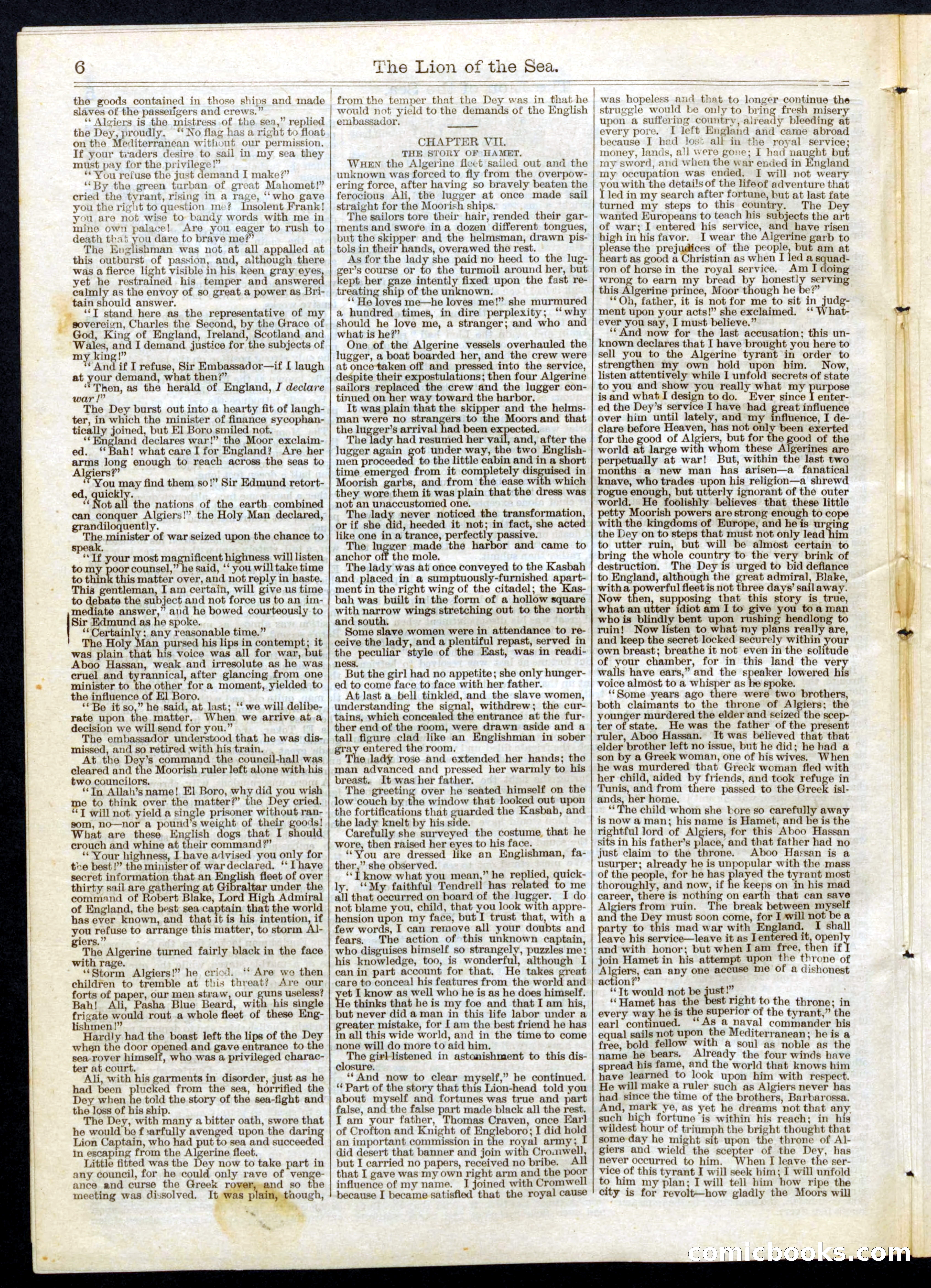
A restored page from Pulp Fiction, 1879. Page through the whole issue in the reader above.
📄 Transcribed text from this page (OCR, searchable)
Machine-transcribed from the original scan — historical spelling and the odd misread are preserved.
6 ee ——— —— — the goods contained in those ships and made , > , slaves of the passeligers and crews.” ‘* Alciers is the mistress of the sea,” replied | ; I the Dey, proudly. ‘‘ No flag has a right to float on the Mediterranean without our permission. If your traders desire to sail in my sea they must pay for the privilege!” ‘You refuse the just demand I make?” ‘By the green turban of great Mahomet!” cried the tyrant, rising in a rage, ‘‘ who gave you the rigit to question me? Insolent Frank! you are not wise to bandy words with me in mine own palace! Are you eager to rush to death that you dare to brave me?” The Englishman was not at all appalled at this outburst of passion, and, although there was a fierce light visible in his keen gray eyes yet he restrained his temper and answere calmly as the envoy of so great a power as Bri- tain should answer. ‘‘T stand here as the representative of my iP sovereivn, Charles the Second, by the Grace of . emer. God, King of England, Ireland, Scotland and Wales, and I demand justice for the subjects of my king!” ‘And if I refuse, Sir Embassador—if [ laugh at your demand, what then?’ “Then, as the herald of England, J declare war |” The Dey burst out into a hearty fit of laugh- ter, in which the minister of finance sycophan- tically joined, but El Boro smiled not. ‘*England declares war!” the Moor exclaim- ed. ‘Bah! what care I for England? Are her arms long enough to reach across the seas to Algiers?” ** You may find them so!” Sir Edmund retort- ed, eyed ‘* Not all the nations of the earth combined can conquer Algiers!” the Holy Man declared, grandiloquently. The. minister of war seized upon the chance to speak. ‘Tf your most magnificent highness will listen to rn Magee counsel,” he said, ‘‘ you will take time to t this matter over, and not reply in haste. This gentleman, I am certain, will give us time to debate the subject and not force us to an im- mediate answer,” and he bowed courteously to Sir Edmund as he spoke. ‘*Certainly ; any reasonable time.” The Holy Man pursed his lips in contempt; it was plain that his voice was all for war, but Aboo Hassan, weak and irresolute as he was cruel and tyrannical, after glancing from one minister to the other for a moment, yielded to the influence of El Boro. ‘** Be it so,” he said, at last; ‘‘ we will delibe- rate upon the matter, When we arrive ata decision we will send for you.” The embassador understood that he was dis- missed, and so retired with his train. . At the Dey’s command the council-hall was cleared and the Moorish ruler left alone with his two councilors. ‘“Tn Allah’s name! El Boro, why did you wish me to think over the matter?’ the Dey cried. ‘I will not yielda single prisoner without ran- som, no—nor a pourid’s weight of their goods! What are these English dogs that I should crouch and whine at their command?” ‘‘ Your highness, I have advised you only for tne best!” the minister of wardeclared. ‘* I have secret information that an English fleet of over thirty sail are gathering at Gibraltar under the command of Robert Blake, Lord High Admiral of England, the best sea captain that the world has ever known, and that it is his intention, if you refuse to arrange this matter, to storm Al- ers. or The Algerine turned fairly black in the face with rage. ‘‘Storm Algiers!’ he criod. ‘‘ Are we then children to tremble at this threat? Are our forts of paper, our men straw, our guns useless? Bah! Ali, Pasha Blue Beard, with his single frigate would rout a whole fleet of these Eng- lishmen!” Hardly had the boast left the lips of the Dey when the door opened and gave entrance to the sea-rover himself, who was a privileged charac- ter at court. Ali, with his garments in disorder, just as he had been plucked from the sea, horrified the Dey when he told the story of the sea-fight and the loss of his ship. The Dey, with many a bitter oath, swore that he would be f»arfully avenged upon the darin Lion Captain, who had put to sea and succeed in escaping from the Algerine fleet. Little fitted was the Dey now to take part in any council, for he could only rave of venge- anee and curse the Greek rover,,and so the meeting was dissolved. It was plain, though, . 7) The Lion of the Sea. | from the temper that the Dey was in that he | | would not yield to the demands of the English | embassador. CHAPTER VIL. THE STORY OF HAMET, WHEN the Algerine ficct sailed out and the unknown was forced to fly from the overpow- ering force, after having so bravely beaten the ferocious Ali, the lugger at once made sail straight for the Moorish ships. The sailors tore their hair, rended their gar- ments and swore ina dozen different tongues, but the skipper and the helmsman, drawn pis- tols in their hands, overawed the rest. As for the lady she paid no heed to the lug- ger’s course or to the turmoil around her, but kept her gaze intently fixed upon the fast re- treating ship of the unknown. os Be leres me—he loves me!” she murmured a hundred times, in dire perplexity; ‘why should he love me, a stranger; and who and what is he?’ One of the Algerine vessels overhauled the lugger, a boat boarded her, and the crew were at oncetaken off and pressed into the service, despite their e tulations; then four Algerine sailors replaced the crew and the lugger con- tinued on her way toward the harbor. It was plain that the skipper and the helms- man were no strangers to the Moors and that the lugger’s arrival had been expected. The lady had resumed her vail, and, after the lugger again sige under way, the two English- men proceeded to the little cabin and in a short time emerged from it ann rae disgui in Moorish garbs, and from the ease with which they wore them it was plain that the dress was not an unaccustomed one. The lady never noticed the transformation or if she did, heeded it not; in fact, she acted like one in a trance, perfectly passive. The lugger made the harbor and came to anchor off the mole. The lady was at once conveyed to the Kasbah and placed in a sumptuously-furnished apart- ment in the right wing of the citadel; the Kas- bah was built in the form of a hollow square with narrow wings stretching out to the north and south. Some slave women were in attendance to re- ceive the lady, and a Pe repast, served in the peculiar style of the East, was in readi- ness. But the girl had no appetite; she only hunger- ed to come face to face with her father. At last a bell tinkled, and the slave women, understanding the signal, withdrew; the cur- tains, which concealed the entrance at the fur- ther end of the room, were drawn aside and a tall figure clad like an Englishman in sober oray entered the room. The lady rose and extended her hands; the man advanced and pressed her warmly to his breast. It was her father. The greeting over he seated himself on the low couch by the window that looked out upon the fortifications that guarded the Kasbah, and the lady knelt by his side. Carefully she surveyed the costume, that he wore, then raised her eyes to his face. “You are dressed like an Englishman, fa- ther,” she observed. ‘*T know what you mean ly. ‘*My faithful Tendrell has related to me all that occurred on board of the lugger. I do not blame you, child, that you look with appre- hension upon my face, but I trust that, with a few words, I can remove all your doubts and fears. The action of this unknown captain, who disguises himself so strangely, puzzles me: his knowledge, too, is wonderful, although I can in part account for that. He takes great care to conceal his features from the world and og I know as well who he is as he does himself. e thinks that he is my foe and that I am his, but never did a man in this life labor under a eater mistake, for [ am the best friend he has in all this wide world, and in the time to come none will do more to aid him. The girl-listened in astanishment to this dis- closure. ‘*And now to clear myself,” he continued. ‘Part of the story that this Lion-head told you about myself and fortunes was true and part false, and the false part made black all the rest. I am your father, Thomas Craven, once Ear of Crofton and Knight of Engleboro; I did hold an important commission in the royal army; I did desert that banner and join with Croawell but I carried no papers, received no bribe. ii that I gave was my own right arm and the poor influence of my name. I joined with Cromwe because I became satisfied that the royal cause *he replied, quick- ne a —— eee ee Le — was hopeless and that to longer continue the struggle would be only to bring fresh misery upon a suffering country, already bleeding at every pore. I left England and came abroad because I hed loss all in the royal service; money, lands, all were gone; I had naught but my sword, and when the war ended in England my occupation was ended. I will not weary you with the detai!s of the lifeof adventure that [ led in my search after fortune, but at last fate turned my steps to this country. The Dey wanted Europeans to teach his subjects the art of war; I entered his service, and have risen high in his favor. I wear the Algerine garb to — the prejudices of the people, but am at eart as good a Christian as when I led a uad- ron of horse in the royal service. Am I doing wrong to earn my bread b woes § serving this Algerine prince, Moor though he be?” ‘Oh, father, it is not for me to sit in judg- ment upon your acts!” she exclaimed. ‘‘ What- ever you say, I must believe.” ‘‘And now for the last accusation; this un- known declares that I have brought you here to sell you to the Algerine tyrant in order to strengthen my own hold upon him. Now, listen attentively while I unfold secrets of state to you and show you really what my purpose is and what I design todo. Ever since I enter- ed the Dey’s service I have had great influence over him until lately, and my influence, I de- clare before Heaven, has not only been exerted for the good of Algiers, but for the good of the world at large with whom these Algerines are perpetually at war! But, within the last two months a new man has arisen—a fanatical knave, who trades upon his religion—a shrewd rogue enough, but utterly ignorant of the outer world. He foolishly believes that these little tty Moorish powers are strong enough to co with the kingdoms of Europe, and heis urging the Dey on to steps that must not only lead ‘him to utter ruin, but will be almost certain to bring the whole country to the very brink of destruction. The Dey is urged to bid defiance to England, although the great admiral, Blake, witha powerful fleet is not three days’ sailaway. Now then, supposing that this story is true, what an utter idiot am I to give you toa man who is sean bent upon rushing headlong to ruin! Now listen to what my plans really are, and keep the secret locked securely within your own breast; breathe it not even in the solitude of your chamber, for in this land the ver walls have ears,” and the speaker lowered his voice almost to a whisper as he spoke. ‘‘Some years ago there were two brothers, both claimants to the throne of Algiers; the younger murdered the elder and seized the scep- ter of state. He was the father of the present ruler, Aboo Hassan. It was believed that that elder brother left no issue, but he did; he had a son by a Greek woman, one of his wives. When he was murdered that Greck woman fled with her child, aided by friends, and took refuge in Tunis, and from there passed to the Greek isl- ands, her home. =* The child whom she bore so carefully away is now a man; his name is Hamet, and he is the rightful lord of Algiers, for this Aboo Hassan sits in his father’s place, and that father had no just claim to the throne. Aboo Harsan is a usurper; already he is unpopular with the mass of the people, for he has played the tyrant most thoroughly, and now, if he keeps on in his mad career, there is nothing on earth that can save Algiers from ruin. The break between myself and the we § must soon come, for I will not be a a to this mad war with England. I shall eave his service—leave it as Ientered it ey and with honor; but when Iam free, then if join Hamet in his attempt upon the throne of Algiers, can any one accuse me of a dishonest action?” ‘Tt would not be just!” : ‘‘Hamet has the t right to the throne; in every way he is the superior of the tyrant,” the earl continued. ‘“‘As a naval commander his equal sails not upon the Mediterranean; he is a free, bold fellow with a soul as noble as the name he bears. Already the four winds have spread his fame, and the world that knows him have learned to look upon him with respect. He will make a ruler such as Algiers never has had since the time of the brothers, Barbarossa. And, mark ye, as yet he dreams not that any such high fortune is within his reach; in his wildest hour of triumph the bright thought that some day he might sit upon the throne of A)- giers and wield the ee of the Dey, has never occurred to him. When I leave the ser- vice of this tyrant I will seek him; I will unfold to him my plan; I will tell him how ripe the city is for revolt—how gladly the Moors will (lO) ' 7 > & ehbooks:c¢om”