
Pulp Fiction, 1879 · page 4 of 20
Beadle's Half Dime Library, No. 103 — page 4: what you’re looking at
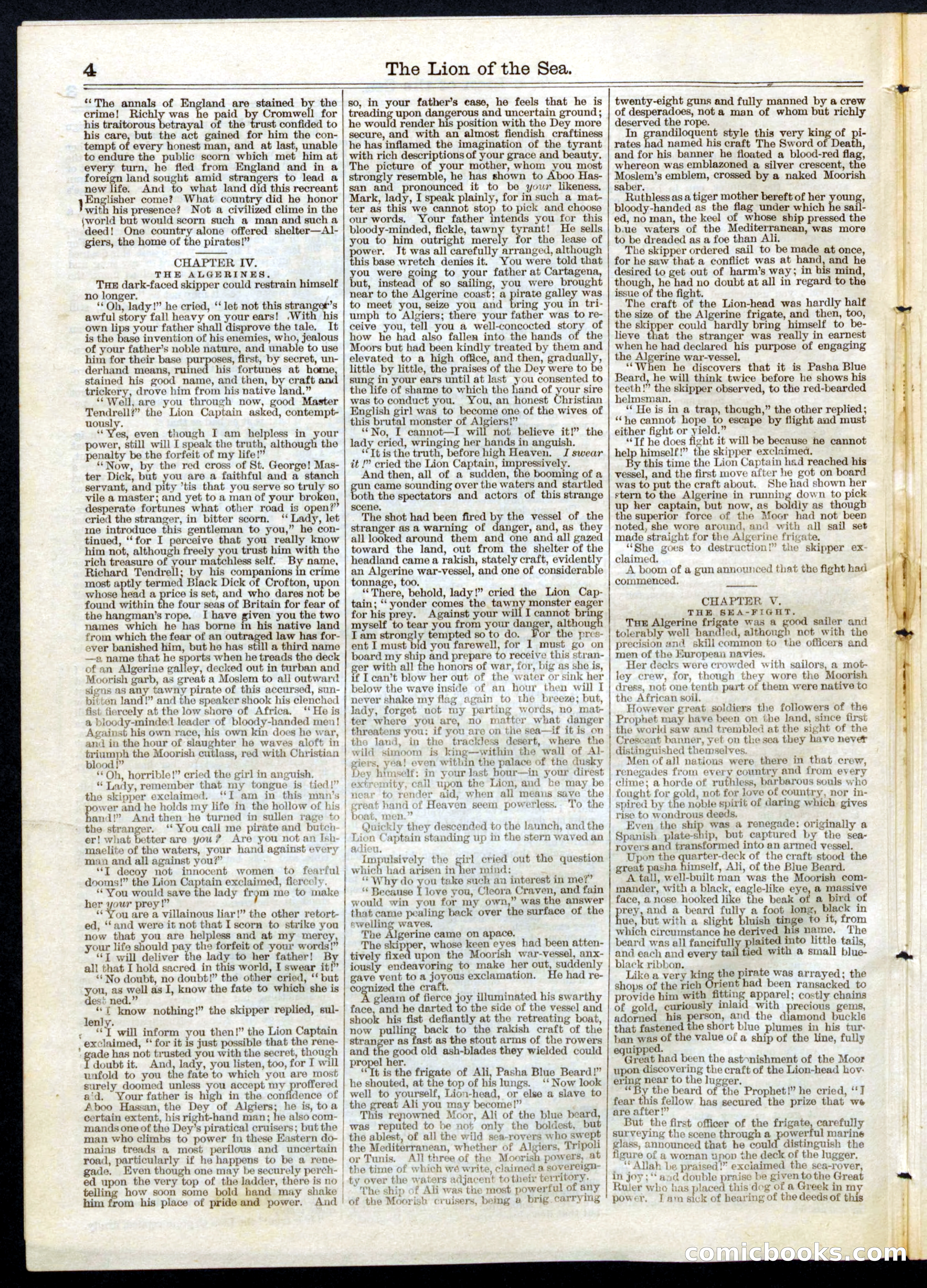
A restored page from Pulp Fiction, 1879. Page through the whole issue in the reader above.
📄 Transcribed text from this page (OCR, searchable)
Machine-transcribed from the original scan — historical spelling and the odd misread are preserved.
ot The Lion of the Sea. ‘The annals of England are stained by the crime! Richly was he paid by Cromwell for his traitorous betrayal of the trust confided to his care, but the act gained for him the con- tempt of every honest man, and at last, unable to endure the public scorn which met him at every turn, he fled from England and in a foreign land sought amid strangers to lead a new life. And to what land did this recreant y Rnglisher come? What country did he honor with his presence? Not a civilized clime in the (world but would scorn such a man and such a deed! One country alone offered shelter—A1- giers, the home of the pirates!” CHAPTER IV. THE ALGERINES. THe dark-faced skipper could restrain himself no longer. ‘Oh, lady!” he cried, ‘‘ let not this stranget’s awful story fall heavy on your ears! ,With his own lips your father shall disprove the tale, It is the base invention of his enemies, who, jealous of your father’s noble nature, and unable to use him for their base purposes, first, by secret, un- derhand means, ruined his fortunes at home stained his good name, and then, by craft and trickery, drove him from his native land,” ‘Well, are you through now, good Master Tendrell?” the Lion Captain asked, contempt- uously. “Yes, even though I am helpless in your power, still will I speak the truth, although the penalty be the forfeit of my life!” ‘‘Now, by the red cross of St. George! Mas- ter Dick, but you are a faithful and a stanch servant, and pity ’tis that you serve so truly so vile a master; and yet to a manof your broken, desperate fortunes what other road is open?’ cried the stranger, in bitter scorn. ‘“ Lady, let me introduce this gentleman to you,” he con- tinued, ‘for I perceive that you really know him not, although freely you trust him with the rich treasure of a matchless self. By name, Richard Tendrell; by his companions in crime most aptly termed Black Dick of Crofton, upon whose head a price is set, and who dares not be found within the four seas of Britain for fear of the hangman’s rope. I have eve you the two names which he has borne in his native land from which the fear of an outraged law has for- ever banished him, but he has still a third name —a name that he sports when he treads the deck of an Algerine galley, decked out in turban and Moorish garb, as great a Moslem to all outward signs as any tawny pirate of this accursed, sun- bitten land!” and the speaker shook his clenched fist, fiercely at the low shore of Africa. ‘‘ He is a bloody-minded leader of bloody-handed men! Against his own race, his own kin does he war, and in the hour of slaughter he waves aloft in triumph the Moorish cutlass, red with Christian blood!” ‘*Oh, horrible!” cried the girl in anguish. “ Lady, remember that my tongue is tied!” the skipper exclaimed. ‘‘I am in this mnn’s ower and he holds my life in the hollow of his and!” And then he turned in sullen rage to . the stranger. ‘‘ You call me pirate and butch er! what better are you ? Are you not an Ish- maelite of the waters, your hand against every man and all against you?” ‘IT decoy not innocent women to fearful dooms!” the Lion Captain exclaimed, fiercely. ‘You would save the lady from me to make her your prey!” ‘*’You are a villainous liar!” the other retort- ed, ‘‘and were it not that I scorn to strike you now that you are helpless and at my mercy, your life should pay the forfeit of your words!” ‘‘T will deliver the lady to her father! By all that I hold sacred in this world, I swear it!” ‘‘ No doubt, no doubt!” the other cried, ‘‘ but you, as well as I, know the fate to which she is des! ned.” ‘‘T know nothing!” the skipper replied, sul- enly. ‘*] will inform you then!” the Lion Captain exclaimed, “ for it is just possible that the rene- ' gade has not trusted you with the secret, though doubt it. And, lady, you listen, too, for I will unfold to you the fate to which you are most surely doomed unless you accept my proffered a'd. Your father is high in the confidence of Aboo Hassan, the Dey of Algiers; he is, toa certain extent, his right-hand man; he also com- mands one of the Dey’s piratical cruisers; but the man who climbs to power in these Eastern do- mains treads a most perilous and uncertain road, particularly if he happens to be a rene- gade, Even though one may be securely perch- ee ee a ee oe oe a ET — —— ee ee” | so, in your father’s case, he feels that he is treading upon dangerous and uncertain ground; he would render his position with the Dey more secure, and with an almost fiendish craftiness he has inflamed the imagination of the tyrant with rich descriptions of your grace and beauty. The picture of your mother, whom you most strongly resemble, he has shown to Aboo Has- san and pronounced it to be your likeness. Mark, lady, I speak plainly, for in such a mat- ter as this we cannot stop to pick and choose our words. Your father intends you for this bloody-minded, fickle, wor tyrant! He sells you to him outright merely for the lease of power. Jt was all carefully arranged, although this base wretch denies it. You were told that you were going to your father at Cartagena, but, instead of so sailing, you were brought near to the Algerine coast: a pirate galley was to meet you, seize you and bring you in tri- umph to Algiers; there your father was to re- ceive you, tell you a well-concocted story of how he had also fallen into the hands of the Moors but had been kindly treated by them and elevated to a high office, and then, gradually, little by little, the praises of the Dey were to be sung in your ears until at last you consented to the life of shame to which the hand of your sire was to conduct you. You, an honest Christian English girl was to become one of the wives of this brutal monster of Algiers!” ‘*No, I cannot—I will not believe it!” the lady cried, wringing her hands in anguish. ‘Tt is the truth, before high Heaven, J swear it !” cried the Lion Captain, impressively. And then, all of a sudden, the booming of a n came sounding over the waters and startled th the spectators and actors of this strange scene. The shot had been fired by the vessel of the stranger as a warning of danger, and, as they all looked around them and one and all gazed toward the land, out from the shelter of the headland came a rakish, stately craft, evident] an Algerine war-vessel, and one of considerable tonnage, too. ‘There, behold, lady!” cried the Lion Cap- tain; ‘‘ yonder comes the tawny monster eager for his prey. Against your will I cannot brin myself to tear you from your danger, althoug I am strongly tempted so to do. For the pres- ent I must bid you farewell, for 1 must go on board my ship and prepare to receive this stran- er with all the honors of war, for, big as she is, if I can’t blow her out of the water or sink her below the wave inside of an hour then will I never shake my flag again to the breeze; but, lady, forget not my parting words, no mat- ter where you are, no matter what danger threatens you: if you are on the sea—if it is on the land, in the trackless desert, where the wild simoom is king—within the wall of Al- | giers, yea! even within the palace of the dusky Dey himself: in your last bour—in your direst extremity, call upon the Lion, and be may be near to render aid, when all means save the great hand of Heaven seem powerless. To the boat, men.” Quickly they descended to the launch, and the | Lion Captain standing up in the stern waved an ey oe the girl cried out the question which had arisen in her mind: “Why do you take such an interest in me?” ‘‘ Because I love you, Cleora Craven, and fain would win you for my own,” was the answer that came pealing back over the surface of the ewelling waves. The Algerine came on apace. The skipper, whose keen eyes had been atten- tively fixed upon the Moorish war-vessel, anx- iously endeavoring to make her out, suddenly gave vent to a joyous exclamation. He had re- cognized the craft. . gleam of fierce joy illuminated his swarthy face, and he darted to the side of the vessel and shook his fist defiantly at the retreating boat, now pulling back to the rakish craft of the stranger as fast as the stout arms of the rowers and the good old ash-blades they wielded could propel her. “Tt is the frigate of Ali, Pasha Blue Beard!” he shouted, at the top of his lungs. ‘‘ Now look well to yourself, Lion-head, or else a slave to the great Ali you may become!” This renowned Moor, Ali of the blue beard, was reputed to be not only the boldest, but the ablest, of all the wild sea-rovers who swept the Mediterranean, whether of Algiers, Tripoli or Tunis. All three of the Moorish powers, at the time of which wé write, claimed a sovereign- ed upon the very top of the ladder, there is no | ty over the waters adjacent to their territory. telling how soon some bold hand may shake | him from his place of pride and power. And The ship of Ali was the most powerful of any of the Moorish cruisers, beimg a brig.carrylg twenty-eight guns and fully manned by a crew of desperadoes, not a man of whom but richly deserved the rope. In grandiloquent style this very king of pi- rates had named his craft The Sword of Death, and for his banner he floated a blood-red flag, whereon was emblazoned a silver crescent, the os oa emblem, crossed by a naked Moorish saber. Ruthless as a tiger mother bereft of her young, bloody-handed as the flag under which he sail. ed, no man, the keel of whose ship pressed the b.ue waters of the Mediterranean, was more to be dreaded as a foe than Ali. The skipper ordered sail to be made at once, for he saw that a conflict was at hand, and he desired to get out of harm’s way; in his mind, though, he had no doubt at all in regard to the issue of the fight. The craft of the Lion-head was hardly half the size of the Algerine frigate, and then, too, the skipper could hardly bring himself to be- lieve that the stranger was really in earnest when he had declared his purpose of engaging the Algerine war-vessel. ‘“When he discovers that it is Pasha Blue Beard, he will think twice before he shows his teeth!” the skipper observed, to the red-bearded helmsman. ‘‘ He is in a trap, though,” the other replied; ‘‘he cannot hope to escape by flight and must either fight or yield.” “Tf he does fight it will be because he cannot help himself!” the skipper exclaimed. y this time the Lion Captain had reached his vessel, and the first move after he got on board was to put the craft about. She had shown her stern to the Algerine in running down to pick up her captain, but now, as boldiy as though the superior force of the Moor had not been noted, she wore around, and with all sail set made straight for the Algerine frigate. “She goes to destruction!” the skipper ex- claimed. A boom of a gun announced that the fight had commenced. CHAPTER V. THE SEA-FIGHT. THE Algerine frigate was a good sailer and tolerably well handled, although not with the precision and skill common to the officers and men of the European navies. Her decks were crowded with sailors, a mot- ley crew, for, though they wore the Moorish dress, not one tenth part of them were native to the African soil. However great soldiers the followers of the Prophet may have been on the land, since first the world saw and trembled at the sight of the Crescent banner, yet on the sea they have never distinguished themselves. Men of all nations were there in that crew, renegades from every country and from every clime; a horde of ruthless, barbarous souls who fought for gold, not for love of country, nor in- spired by the noble spirit of daring which gives | rise to wondrous deeds, Even the ship was a renegade: originally a Spanish plate-ship, but captured by the sea- rovers and transformed into an armed vessel. Upon the quarter-deck of the craft stood the great pasha himself, Ali, of the Blue Beard. A tall, well-built man was the Moorish com- mander, with a black, eagle-like eye, a massive face, a nose hooked like the beak of a bird of rey, and a beard fully a foot long, black in ue, but with a slight binish tinge to it, from which circumstance he derived his name. The beard was all fancifully plaited into little tails, and each and every tail tied with a small blue- black ribbon. : Like a very king the pirate was arrayed; the shops of the rich Orient had been ransacked to provide him with fitting apparel; costly chains of gold, curiously inlaid with precious gems, adorned his person, and the diamond buckle that fastened the short blue plumes in his tur. ban was Of the value of a ship of the line, fully uipped. Great had been the astonishment of the Moor upon discovering the craft of the Lion-head lov: ering near to the lugger. “By the beard of the Prophet!” he cried, ‘J fear this fellow has secured the prize that we are after!” But the first officer of the frigate, carefully surveying the scene through a ,owerful marine glass, announced that he could distinguish the figure of a woman upon the deck of the lugger. _ “Allah be praised!” exciaimed the sea-rover, in joy ; ‘‘ and double praise be given tothe Great Ruler who has placed this dog of a Greek in my power. JT am sick of bearing of the deeds of this (C(O) my ’ a00KS.cOM ~