
Pulp Fiction, 1955 · page 82 of 146
Authentic Science Fiction Monthly No. 53 — page 82: what you’re looking at
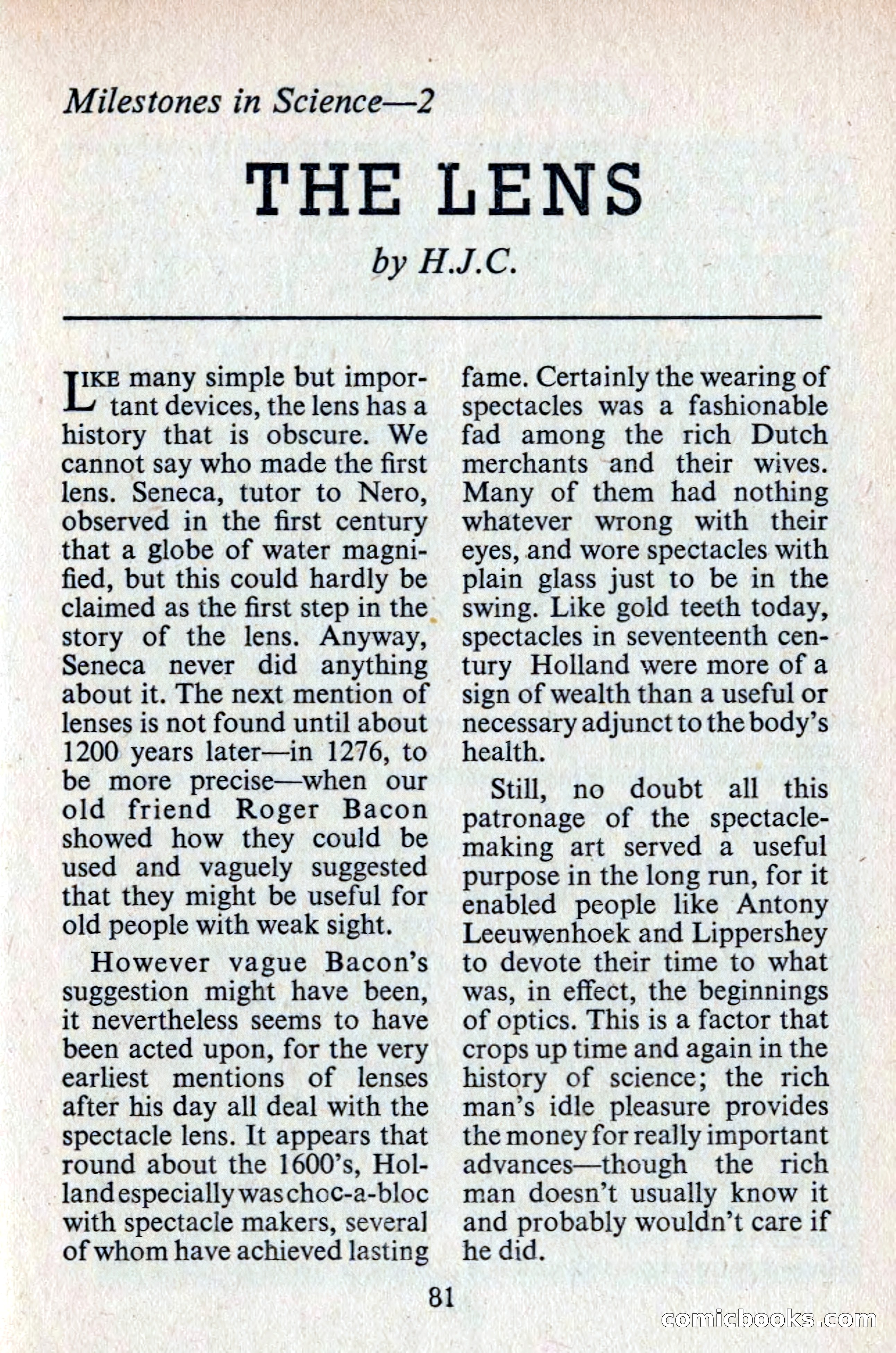
A restored page from Pulp Fiction, 1955. Page through the whole issue in the reader above.
📄 Transcribed text from this page (OCR, searchable)
Machine-transcribed from the original scan — historical spelling and the odd misread are preserved.
Milestones in Science—2 THE LENS by H.J.C. IKE many simple but impor- tant devices, the lens has a history that is obscure. We cannot say who made the first lens. Seneca, tutor to Nero, observed in the first century that a globe of water magni- fied, but this could hardly be claimed as the first step in the. story of the lens. Anyway, Seneca never did anything about it. The next mention of lenses is not found until about 1200 years later—in 1276, to be more precise—when our old friend Roger Bacon showed how they could be used and vaguely suggested that they might be useful for old people with weak sight. However vague Bacon’s suggestion might have been, it nevertheless seems to have been acted upon, for the very earliest mentions of lenses after his day all deal with the spectacle lens. It appears that round about the 1600’s, Hol- landespecially waschoc-a-bloc with spectacle makers, several of whom have achieved lasting 81 fame. Certainly the wearing of spectacles was a fashionable fad among the rich Dutch merchants and their wives. Many of them had nothing whatever wrong with their eyes, and wore spectacles with plain glass just to be in the swing. Like gold teeth today, spectacles in seventeenth cen- tury Holland were more of a sign of wealth than a useful or necessary adjunct to the body’s health. Still, no doubt all this patronage of the spectacle- making art served a useful purpose in the long run, for it enabled people like Antony Leeuwenhoek and Lippershey to devote their time to what was, in effect, the beginnings of optics. This is a factor that crops up time and again in the history of science; the rich man’s idle pleasure provides the money for really important advances—though the rich man doesn’t usually know it and probably wouldn’t care if he did. connicloooks.comn