
Pulp Fiction, 1955 · page 81 of 146
Authentic Science Fiction Monthly No. 53 — page 81: what you’re looking at
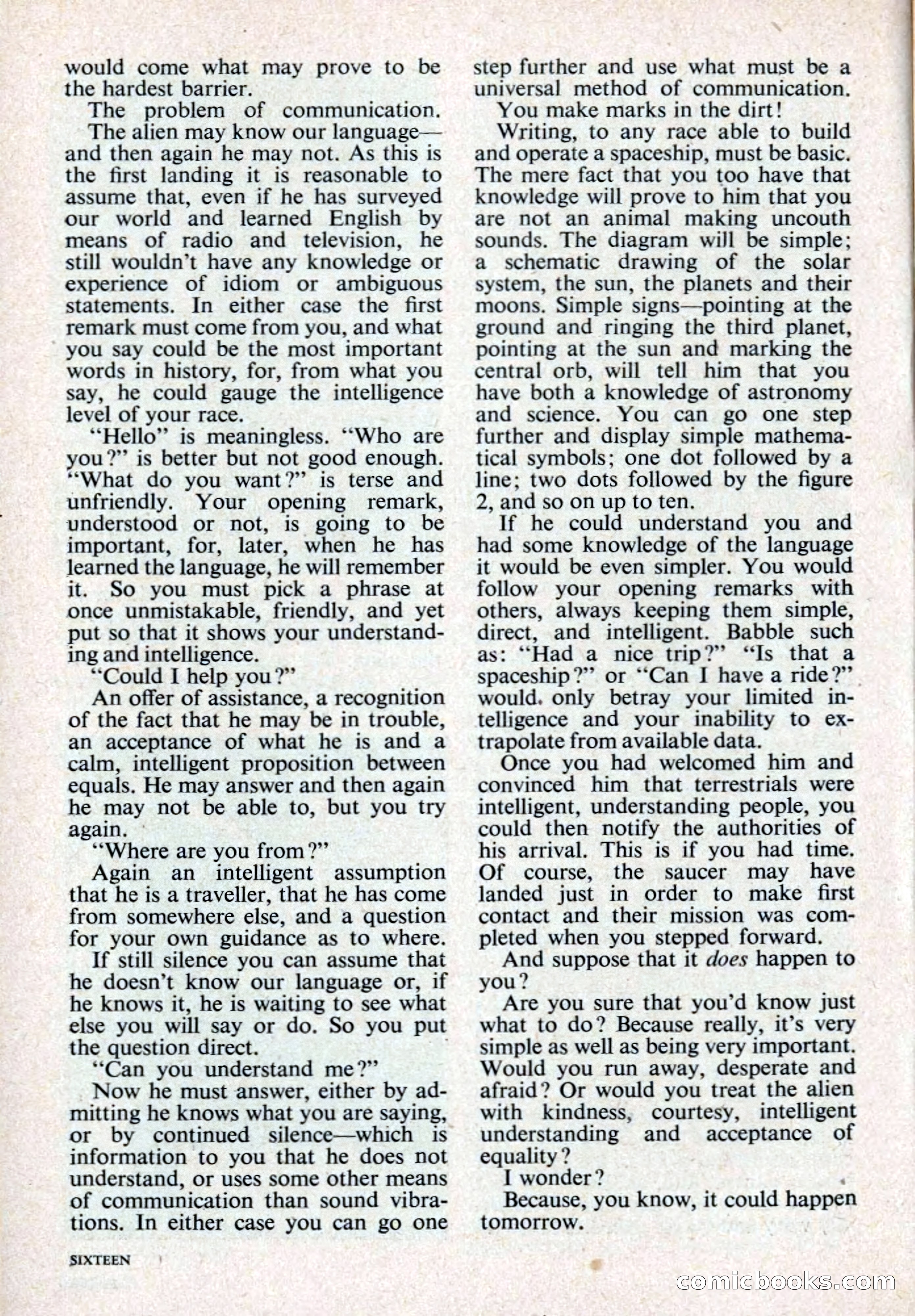
A restored page from Pulp Fiction, 1955. Page through the whole issue in the reader above.
📄 Transcribed text from this page (OCR, searchable)
Machine-transcribed from the original scan — historical spelling and the odd misread are preserved.
would come what may prove to be the hardest barrier. The problem of communication. The alien may know our language— and then again he may not. As this is the first landing it is reasonable to assume that, even if he has surveyed our world and learned English by means of radio and television, he still wouldn’t have any knowledge or experience of idiom or ambiguous statements. In either case the first remark must come from you, and what you say could be the most important words in history, for, from what you say, he could gauge the intelligence level of your race. **Hello”’ is meaningless. ““Who are you?” is better but not good enough. *‘What do you want?’ is terse and unfriendly. Your opening remark, understood or not, is going to be important, for, later, when he has learned the language, he will remember it. So you must pick a phrase at once unmistakable, friendly, and yet put so that it shows your understand- ing and intelligence. ““Could I help you ?” An offer of assistance, a recognition of the fact that he may be in trouble, an acceptance of what he is and a calm, intelligent proposition between equals. He may answer and then again he may not be able to, but you try again. *‘Where are you from?” Again an intelligent assumption that he is a traveller, that he has come from somewhere else, and a question for your Own guidance as to where. If still silence you can assume that he doesn’t know our language or, if he knows it, he is waiting to see what else you will say or do. So you put the question direct. “Can you understand me?” Now he must answer, either by ad- mitting he knows what you are saying, or by continued silence—which is information to you that he does not understand, or uses some other means of communication than sound vibra- tions. In either case you can go one SIXTEEN step further and use what must be a universal method of communication, You make marks in the dirt! Writing, to any race able to build and operate a spaceship, must be basic. The mere fact that you too have that knowledge will prove to him that you are not an animal making uncouth sounds. The diagram will be simple; a schematic drawing of the solar system, the sun, the planets and their moons. Simple signs—pointing at the ground and ringing the third planet, pointing at the sun and marking the central orb, will tell him that you have both a knowledge of astronomy and science. You can go one step further and display simple mathema- tical symbols; one dot followed by a line; two dots followed by the figure 2, and so on up to ten. If he could understand you and had some knowledge of the language it would be even simpler. You would follow your opening remarks with others, always keeping them simple, direct, and intelligent. Babble such as: “Had a nice trip?” “Is that a spaceship?” or “Can I have a ride?” would. only betray your limited in- telligence and your inability to ex- trapolate from available data. Once you had welcomed him and convinced him that terrestrials were intelligent, understanding people, you could then notify the authorities of his arrival. This is if you had time. Of course, the saucer may have landed just in order to make first contact and their mission was com- pleted when you stepped forward. And suppose that it does happen to you? Are you sure that you’d know just what to do? Because really, it’s very simple as well as being very important. Would you run away, desperate and afraid? Or would you treat the alien with kindness, courtesy, intelligent understanding and acceptance of equality ? I wonder? Because, you know, it could happen tomorrow. comicbooks.com