
Pulp Fiction, 1955 · page 83 of 146
Authentic Science Fiction Monthly No. 53 — page 83: what you’re looking at
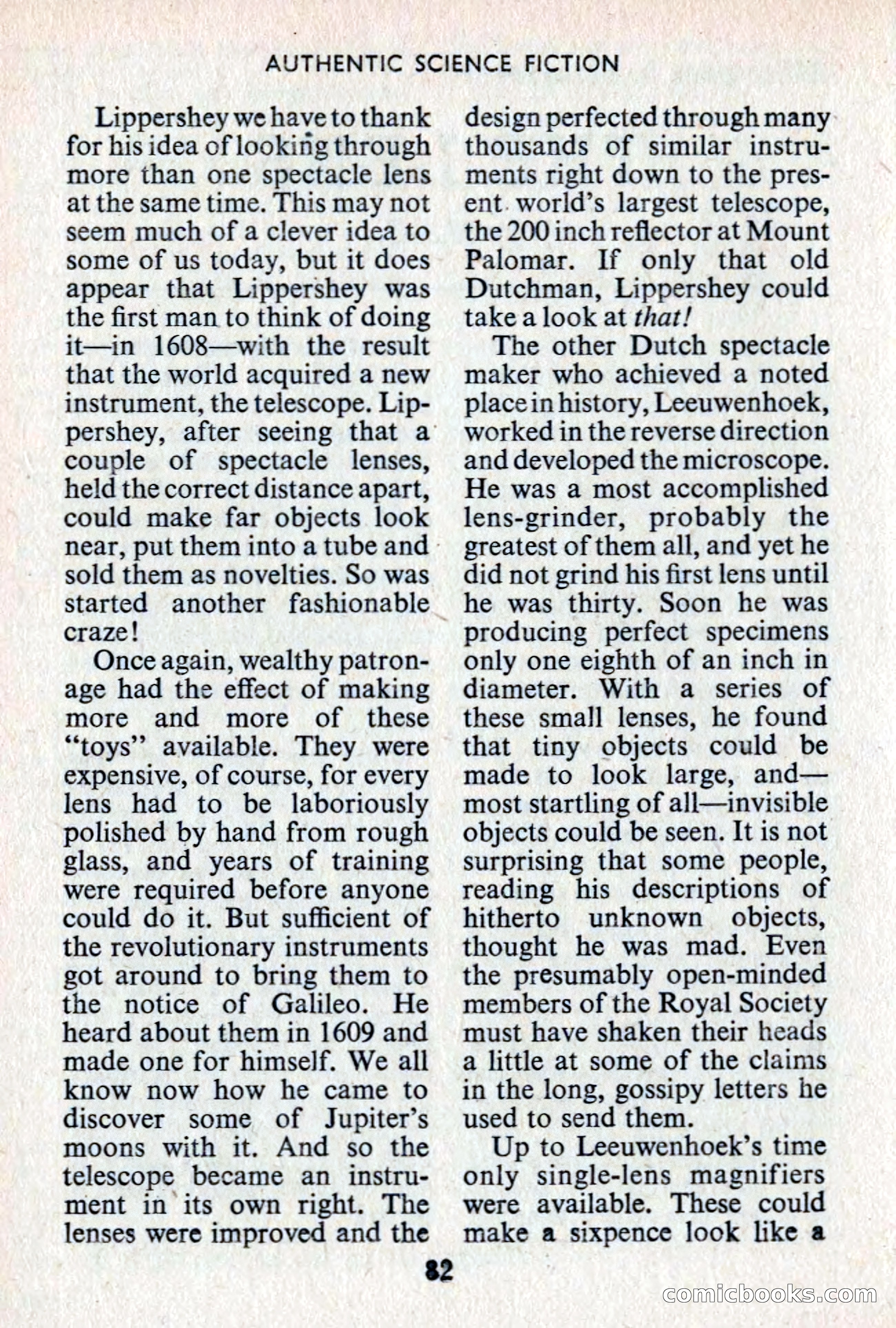
A restored page from Pulp Fiction, 1955. Page through the whole issue in the reader above.
📄 Transcribed text from this page (OCR, searchable)
Machine-transcribed from the original scan — historical spelling and the odd misread are preserved.
AUTHENTIC SCIENCE FICTION Lippershey we have to thank for his idea of looking through more than one spectacle lens at the same time. This may not seem much of a clever idea to some of us today, but it does appear that Lippershey was the first man to think of doing it—in 1608—with the result that the world acquired a new instrument, the telescope. Lip- pershey, after seeing that a couple of spectacle lenses, held the correct distance apart, could make far objects look near, put them into a tube and » sold them as novelties. So was started another fashionable_ craze! Once again, wealthy patron- age had the effect of making more and more of these “*toys’’ available. They were expensive, of course, for every lens had to be laboriously polished by hand from rough glass, and years of training were required before anyone could do it. But sufficient of the revolutionary instruments got around to bring them to the notice of Galileo. He heard about them in 1609 and made one for himself. We all know now how he came to discover some of Jupiter’s moons with it. And so the telescope became an instru- ment in its own right. The lenses were improved and the 82 design perfected through many thousands of similar instru- ments right down to the pres- ent. world’s largest telescope, the 200 inch reflector at Mount Palomar. If only that old Dutchman, Lippershey could take a look at that! The other Dutch spectacle maker who achieved a noted placein history, Leeuwenhoek, worked in the reverse direction and developed the microscope. He was a most accomplished lens-grinder, probably the greatest of them all, and yet he did not grind his first lens until he was thirty. Soon he was producing perfect specimens only one eighth of an inch in diameter. With a series of these small lenses, he found that tiny objects could be made to look large, and— most startling of all—invisible objects could be seen. It is not surprising that some people, reading his descriptions of hitherto unknown objects, thought he was mad. Even the presumably open-minded members of the Royal Society must have shaken their heads a little at some of the claims in the long, gossipy letters he used to send them. Up to Leeuwenhoek’s time only single-lens magnifiers were available. These could make a sixpence look like a conmicloooks.con