
Pulp Fiction, 1955 · page 110 of 146
Authentic Science Fiction Monthly No. 53 — page 110: what you’re looking at
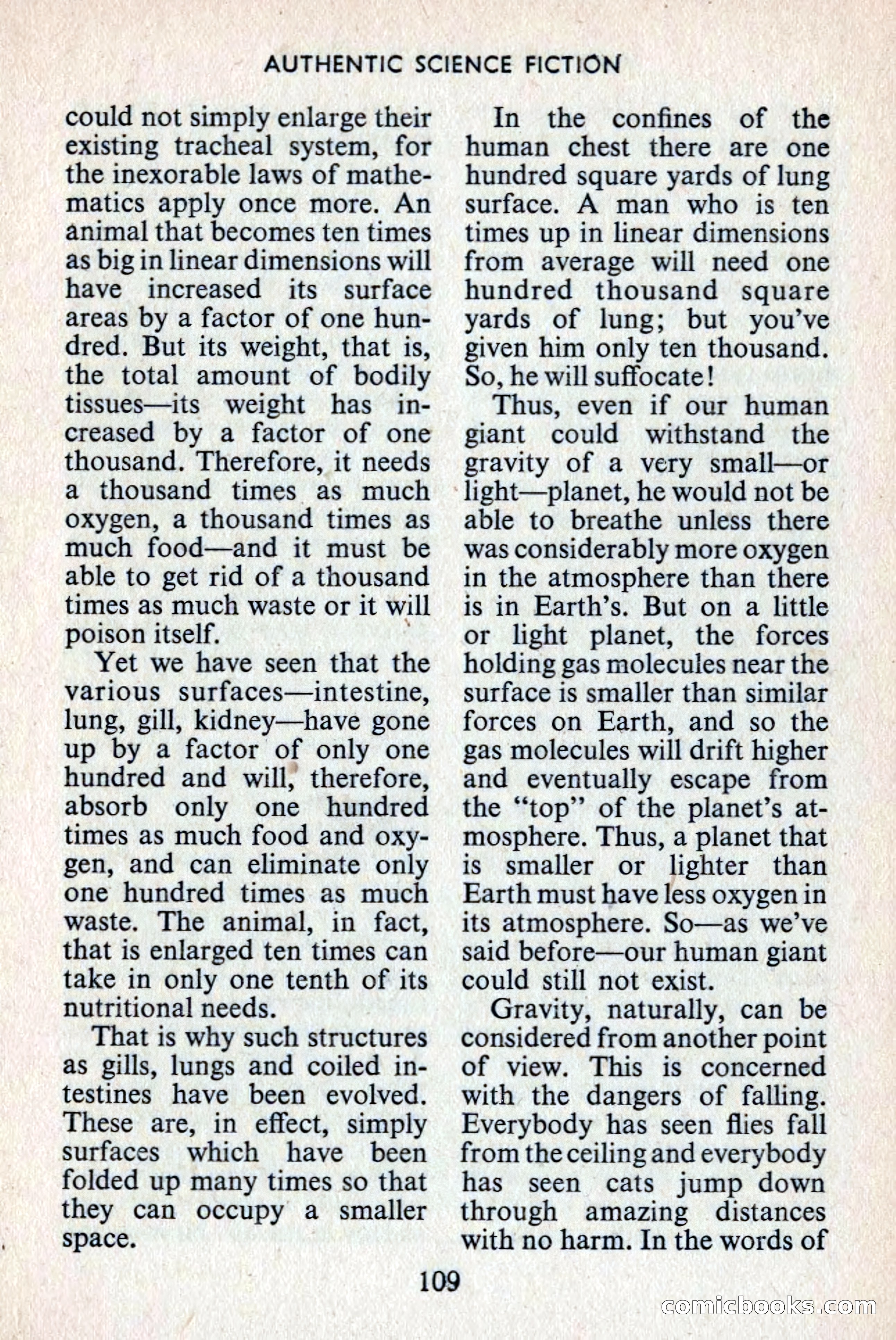
A restored page from Pulp Fiction, 1955. Page through the whole issue in the reader above.
📄 Transcribed text from this page (OCR, searchable)
Machine-transcribed from the original scan — historical spelling and the odd misread are preserved.
AUTHENTIC SCIENCE FICTION could not simply enlarge their existing tracheal system, for the inexorable laws of mathe- matics apply once more. An animal that becomes ten times as big in linear dimensions will have increased its surface areas by a factor of one hun- dred. But its weight, that is, the total amount of bodily tissues—its weight has in- creased by a factor of one thousand. Therefore, it needs a thousand times as much oxygen, a thousand times as much food—and it must be able to get rid of a thousand times as much waste or it will poison itself. ’ Yet we have seen that the various surfaces—intestine, lung, gill, kidney—have gone up by a factor of only one hundred and will, therefore, absorb only one hundred times as much food and oxy- gen, and can eliminate only one hundred times as much waste. The animal, in fact, that is enlarged ten times can take in only one tenth of its nutritional needs. That is why such structures as gills, lungs and coiled in- testines have been evolved. These are, in effect, simply surfaces which have been folded up many times so that they can occupy a smaller space. In the confines of the human chest there are one hundred square yards of lung surface. A man who is ten times up in linear dimensions from average will need one hundred thousand square yards of lung; but you’ve given him only ten thousand. So, he will suffocate! Thus, even if our human giant could withstand the gravity of a very small—or light—planet, he would not be able to breathe unless there was considerably more oxygen in the atmosphere than there is in Earth’s. But on a little or light planet, the forces holding gas molecules near the surface is smaller than similar forces on Earth, and so the gas molecules will drift higher and eventually escape from the “‘top’’ of the planet’s at- mosphere. Thus, a planet that is smaller or lighter than Earth must have less oxygen in its atmosphere. So—as we’ve said before—our human giant could still not exist. Gravity, naturally, can be considered from another point of view. This is concerned with the dangers of falling. Everybody has seen flies fall from the ceiling and everybody has seen cats jump down through amazing distances with no harm. In the words of 109 conmicloooks.comn