
Pulp Fiction, 1955 · page 109 of 146
Authentic Science Fiction Monthly No. 53 — page 109: what you’re looking at
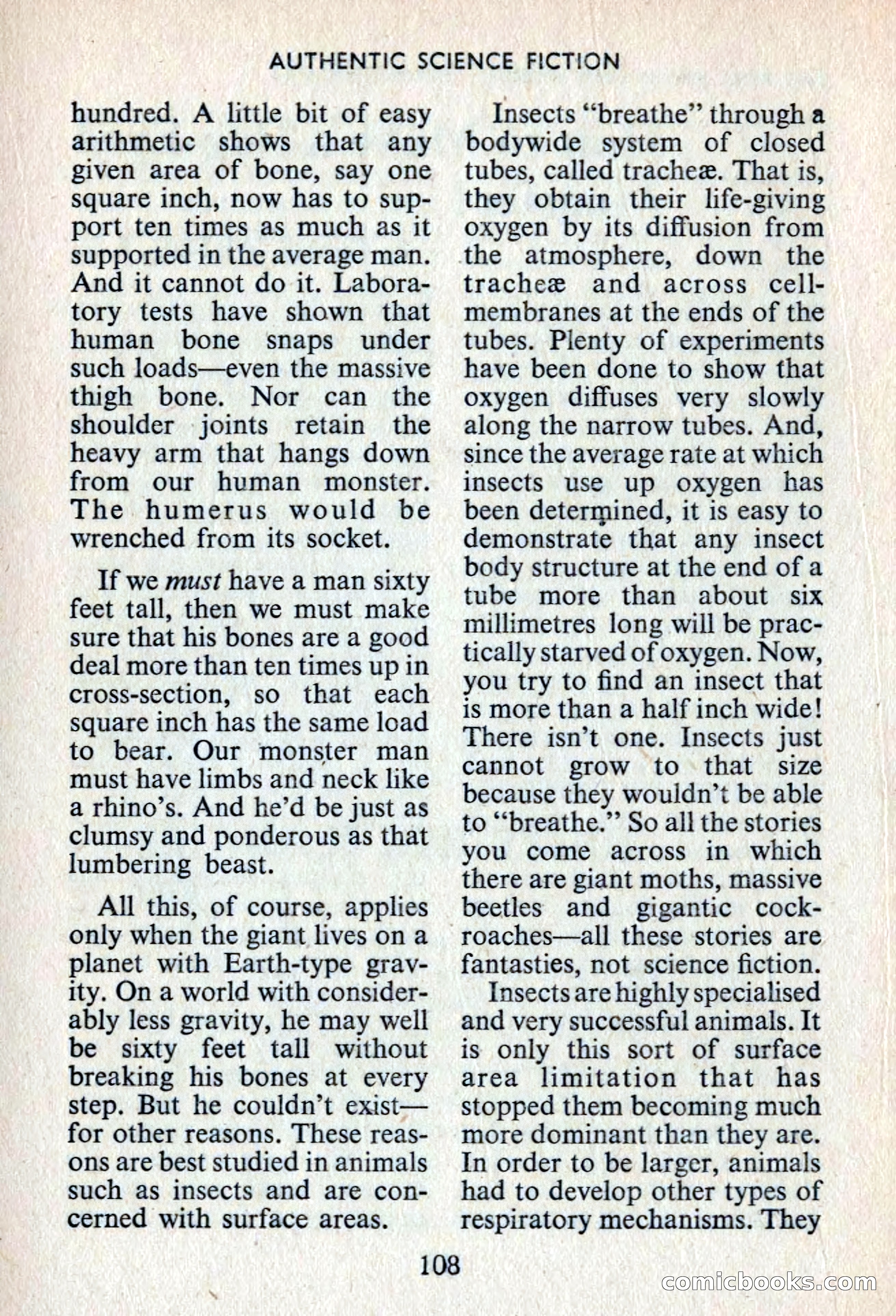
A restored page from Pulp Fiction, 1955. Page through the whole issue in the reader above.
📄 Transcribed text from this page (OCR, searchable)
Machine-transcribed from the original scan — historical spelling and the odd misread are preserved.
AUTHENTIC SCIENCE FICTION hundred. A little bit of easy arithmetic shows that any given area of bone, say one square inch, now has to sup- port ten times as much as it supported in the average man. And it cannot do it. Labora- tory tests have shown that human bone snaps under such loads—even the massive thigh bone. Nor can the shoulder joints retain the heavy arm that hangs down from our human monster. The humerus would be wrenched from its socket. If we must have a man sixty feet tall, then we must make sure that his bones are a good deal more than ten times up in cross-section, so that each square inch has the same load to bear. Our monster man must have limbs and neck like a rhino’s. And he’d be just as clumsy and ponderous as that lumbering beast. All this, of course, applies only when the giant lives on a planet with Earth-type grav- ity. On a world with consider- ably less gravity, he may well be sixty feet tall without breaking his bones at every step. But he couldn’t exist— for other reasons. These reas- ons are best studied in animals such as insects and are con- cerned with surface areas. 108 Insects “breathe” through a bodywide system of closed tubes, called trachee. That is, they obtain their life-giving oxygen by its diffusion from the atmosphere, down the trachee and across cell- membranes at the ends of the tubes. Plenty of experiments have been done to show that oxygen diffuses very slowly along the narrow tubes. And, since the average rate at which insects use up oxygen has been determined, it is easy to demonstrate that any insect body structure at the end of a tube more than about six millimetres long will be prac- tically starved of oxygen. Now, you try to find an insect that is more than a half inch wide! There isn’t one. Insects just cannot grow to that size because they wouldn’t be able to “‘breathe.”’ So all the stories you come across in which there are giant moths, massive beetles and gigantic cock- roaches—all these stories are fantasties, not science fiction. Insects are highly specialised and very successful animals. It is only this sort of surface area limitation that has stopped them becoming much more dominant than they are. In order to be larger, animals had to develop other types of respiratory mechanisms. They comicloooks.conn