
Pulp Fiction, 1955 · page 111 of 146
Authentic Science Fiction Monthly No. 53 — page 111: what you’re looking at
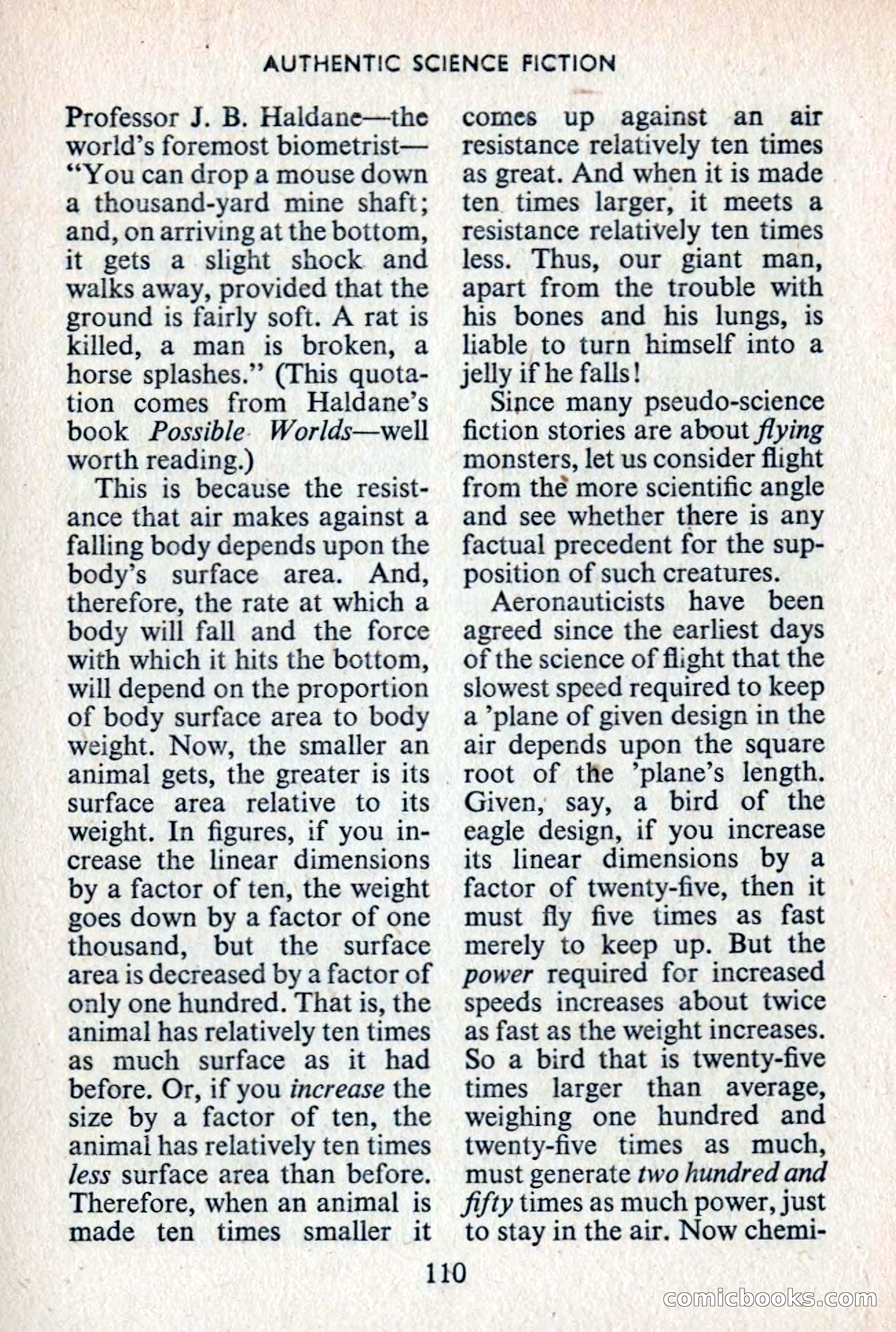
A restored page from Pulp Fiction, 1955. Page through the whole issue in the reader above.
📄 Transcribed text from this page (OCR, searchable)
Machine-transcribed from the original scan — historical spelling and the odd misread are preserved.
AUTHENTIC SCIENCE FICTION Professor J. B. Haldane—the world’s foremost biometrist— **You can drop a mouse down a thousand-yard mine shaft; and, on arriving at the bottom, it gets a slight shock and walks away, provided that the ground is fairly soft. A rat is killed, a man is broken, a horse splashes.’ (This quota- tion comes from Haldane’s book Possible. Worlds—well worth reading.) This is because the resist- ance that air makes against a falling body depends upon the body’s surface area. And, therefore, the rate at which a body will fall and the force with which it hits the bottom, will depend on the proportion of body surface area to body weight. Now, the smaller an animal gets, the greater is its surface area relative to its weight. In figures, if you in- crease the linear dimensions by a factor of ten, the weight goes down by a factor of one thousand, but the surface area is decreased by a factor of only one hundred. That is, the animal has relatively ten times as much surface as it had before. Or, if you increase the size by a factor of ten, the animai has relatively ten times less surface area than before. Therefore, when an animal is made ten times smaller it comes up against an air resistance relatively ten times as great. And when it is made ten times larger, it meets a resistance relatively ten times less. Thus, our giant man, apart from the trouble with his bones and his lungs, is liable to turn himself into a jelly if he falls! Since many pseudo-science fiction stories are about flying monsters, let us consider flight from thé more scientific angle and see whether there is any factual precedent for the sup- position of such creatures. Aeronauticists have been agreed since the earliest days of the science of flight that the slowest speed required to keep a plane of given design in the air depends upon the square root of the ’plane’s length. Given, say, a bird of the eagle design, if you increase its linear dimensions by a factor of twenty-five, then it must fly five times as fast merely to keep up. But the power required for increased speeds increases about twice as fast as the weight increases. So a bird that is twenty-five times larger than average, weighing one hundred and twenty-five times as much, must generate two hundred and fifty times as much power, just to stay in the air. Now chemi- 110 conmicloooks.conm