
Pulp Fiction, 1954 · page 86 of 146
Authentic Science Fiction Monthly, No. 51 — page 86: what you’re looking at
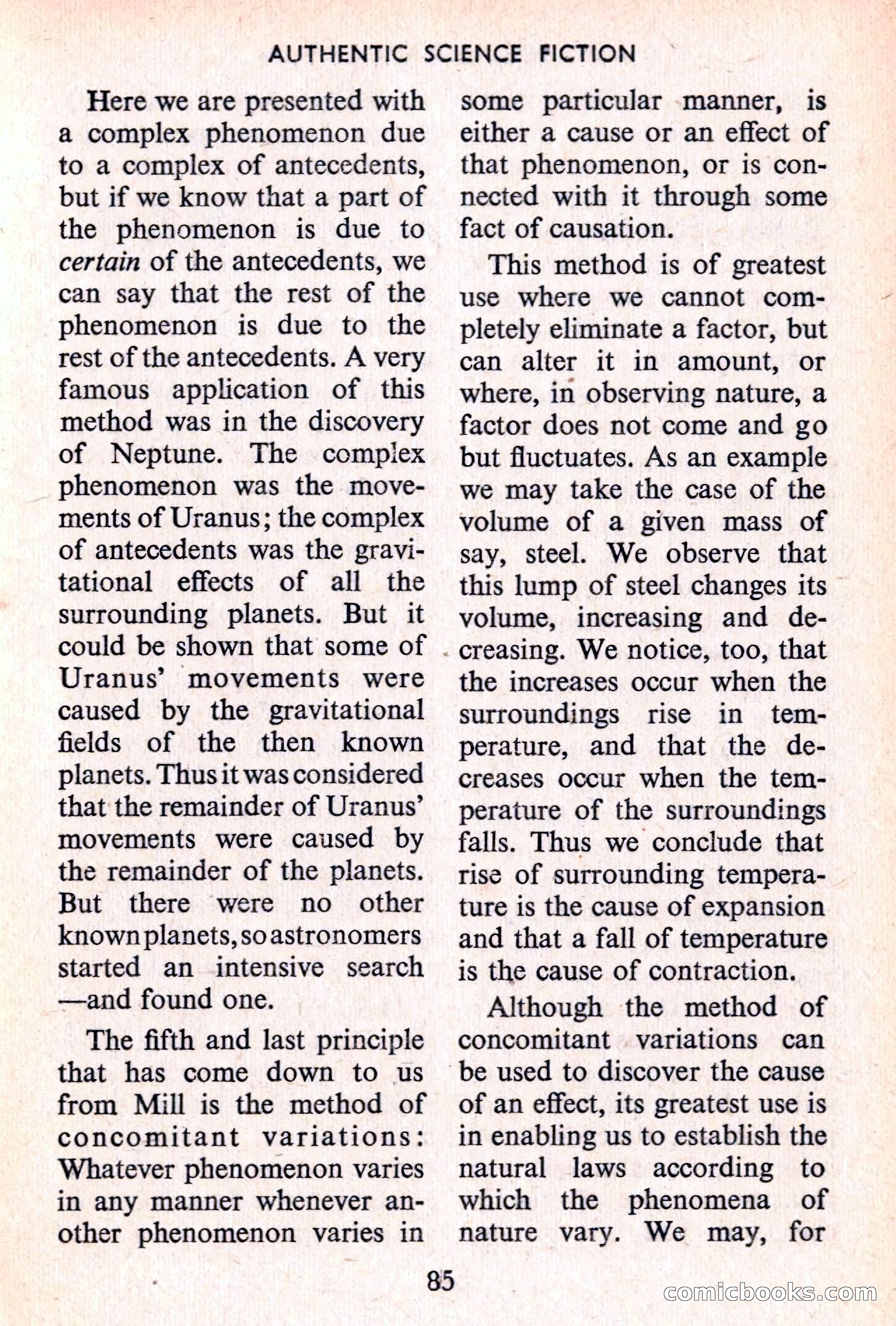
A restored page from Pulp Fiction, 1954. Page through the whole issue in the reader above.
📄 Transcribed text from this page (OCR, searchable)
Machine-transcribed from the original scan — historical spelling and the odd misread are preserved.
AUTHENTIC SCIENCE FICTION Here we are presented with a complex phenomenon due to a complex of antecedents, but if we know that a part of the phenomenon is due to certain of the antecedents, we can say that the rest of the phenomenon is due to the rest of the antecedents. A very famous application of this method was in the discovery of Neptune. The compiex phenomenon was the move- ments of Uranus; the complex of antecedents was the gravi- tational effects of all the surrounding planets. But it could be shown that some of Uranus’ movements were caused by the gravitational fields of the then known planets. Thus it was considered that the remainder of Uranus’ movements were caused by the remainder of the planets. But there were no other known planets, soastronomers started an intensive search —and found one. The fifth and last principle that has come down to us from Mill is the method of concomitant variations: Whatever phenomenon varies in any manner whenever an- other phenomenon varies in some particular manner, is either a cause or an effect of that phenomenon, or is con- nected with it through some fact of causation. This method is of greatest use where we cannot com- pletely eliminate a factor, but can alter it in amount, or where, in observing nature, a factor does not come and go but fluctuates. As an example we may take the case of the volume of a given mass of say, steel. We observe that this lump of steel changes its volume, increasing and de- . creasing. We notice, too, that 85 the increases occur when the surroundings rise in tem- perature, and that the de- creases occur when the tem- perature of the surroundings falls. Thus we conclude that rise of surrounding tempera- ture is the cause of expansion and that a fall of temperature is the cause of contraction. Although the method of concomitant variations can be used to discover the cause of an effect, its greatest use is in enabling us to establish the natural laws according to which the phenomena of nature vary. We may, for comiclbooks.cormn