
Pulp Fiction, 1954 · page 85 of 146
Authentic Science Fiction Monthly, No. 51 — page 85: what you’re looking at
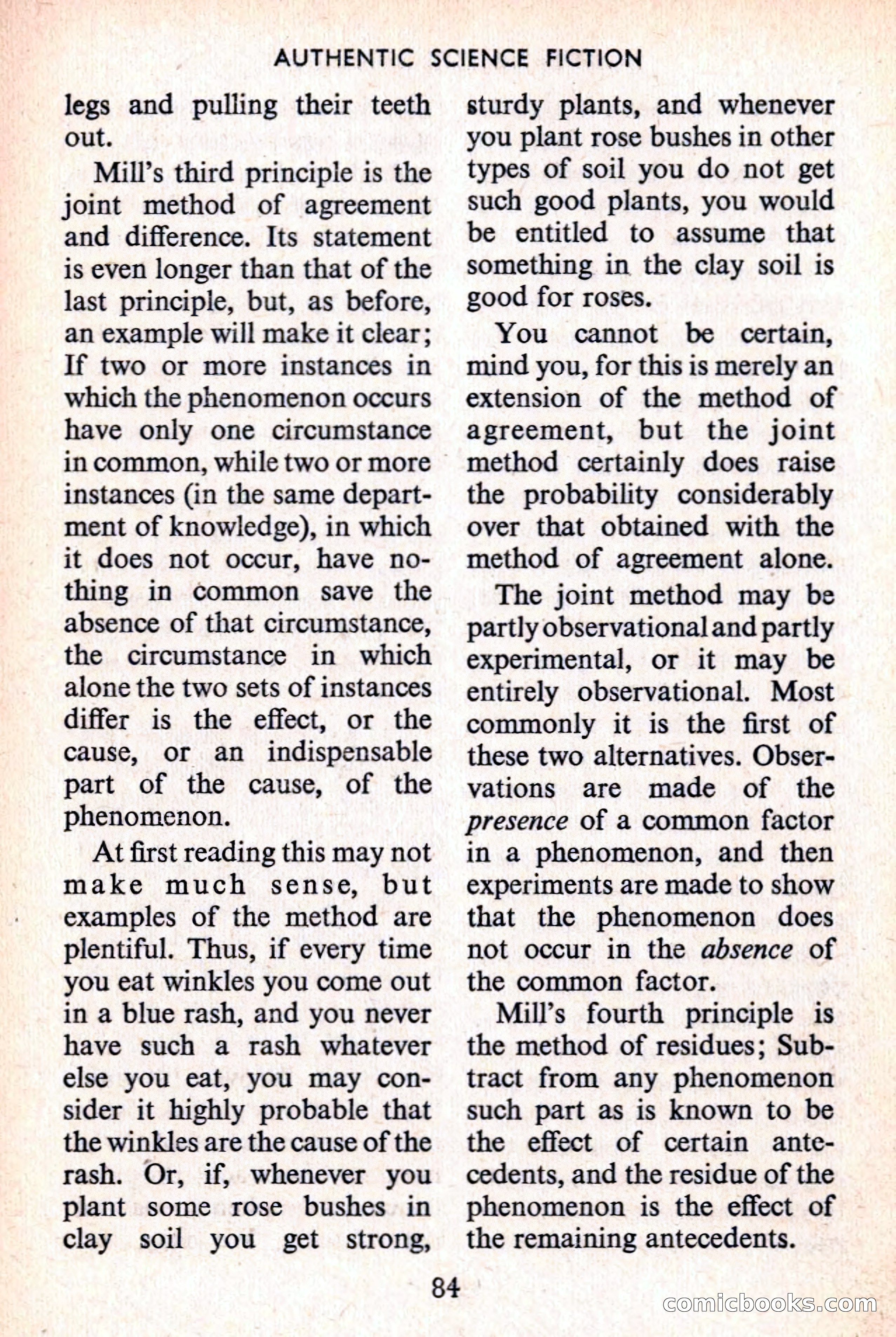
A restored page from Pulp Fiction, 1954. Page through the whole issue in the reader above.
📄 Transcribed text from this page (OCR, searchable)
Machine-transcribed from the original scan — historical spelling and the odd misread are preserved.
AUTHENTIC SCIENCE FICTION legs and pulling their teeth out. Mill’s third principle is the joint method of agreement and difference. Its statement is even longer than that of the last principle, but, as before, an example will make it clear; If two or more instances in which the phenomenon occurs have only one circumstance in common, while two or more instances (in the same depart- ment of knowledge), in which it does not occur, have no- thing in common save the absence of that circumstance, the circumstance in which alone the two sets of instances differ is the effect, or the cause, or an indispensable part of the cause, of the phenomenon. At first reading this may not make much sense, but examples of the method are plentiful. Thus, if every time you eat winkles you come out in a blue rash, and you never have such a rash whatever else you eat, you may con- sider it highly probable that the winkles are the cause of the rash. Or, if, whenever you plant some rose bushes in clay soil you get strong, 84 sturdy plants, and whenever you plant rose bushes in other types of soil you do not get such good plants, you would be entitled to assume that something in the clay soil is good for roses. You cannot be certain, mind you, for this is merely an extension of the method of agreement, but the joint method certainly does raise the probability considerably over that obtained with the method of agreement alone. The joint method may be partly observational and partly experimental, or it may be entirely observational. Most commonly it is the first of these two alternatives. Obser- vations are made of the presence of a common factor in a phenomenon, and then experiments are made to show that the phenomenon does not occur in the absence of the common factor. Mill’s fourth principle is the method of residues; Sub- tract from any phenomenon such part as is known to be the effect of certain ante- cedents, and the residue of the phenomenon is the effect of the remaining antecedents. comiclbooks.conrn