
Pulp Fiction, 1954 · page 87 of 146
Authentic Science Fiction Monthly, No. 51 — page 87: what you’re looking at
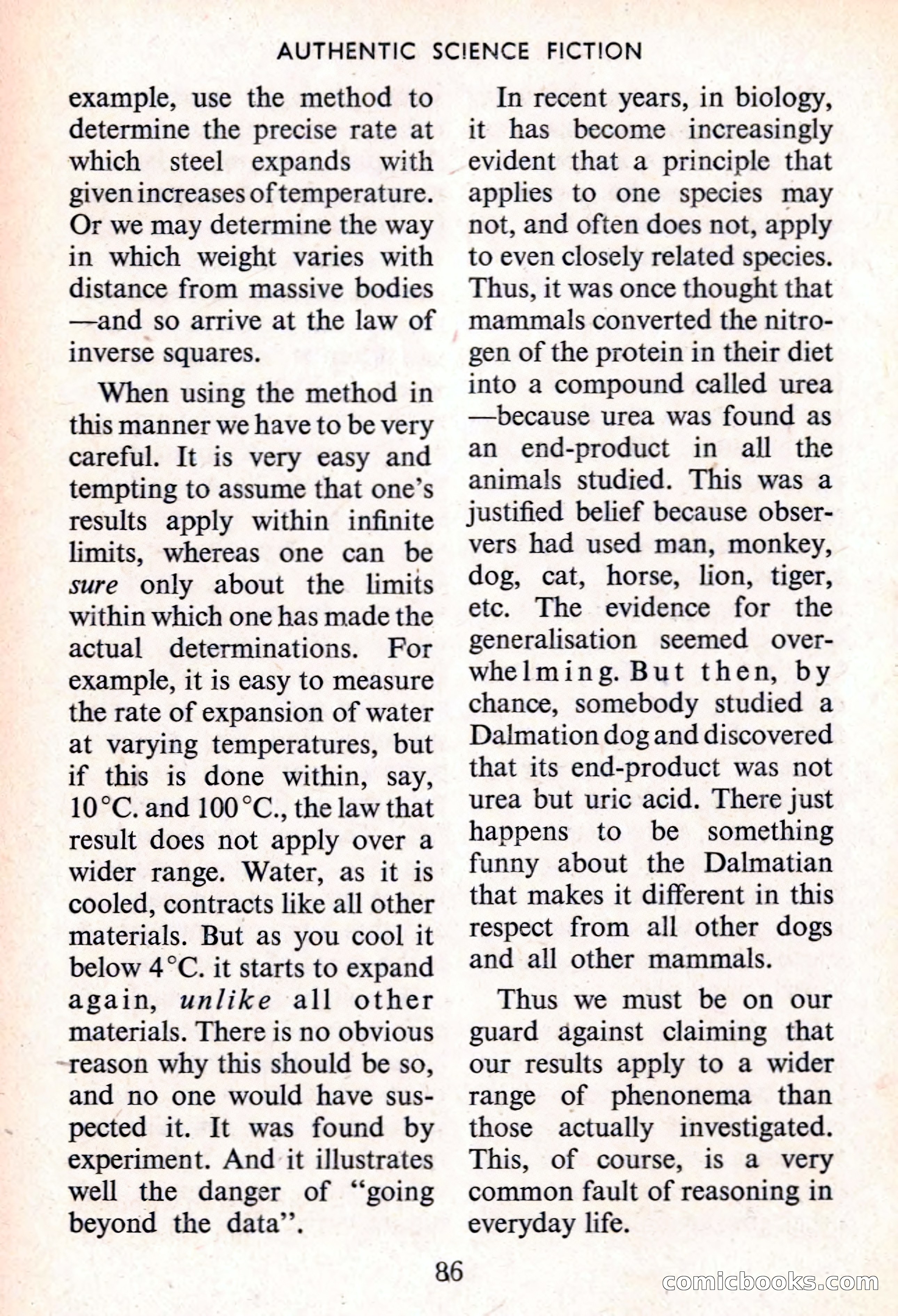
A restored page from Pulp Fiction, 1954. Page through the whole issue in the reader above.
📄 Transcribed text from this page (OCR, searchable)
Machine-transcribed from the original scan — historical spelling and the odd misread are preserved.
AUTHENTIC SCIENCE FICTION example, use the method to determine the precise rate at which steel expands with given increases of temperature. Or we may determine the way in which weight varies with distance from massive bodies —and so arrive at the law of inverse squares. When using the method in this manner we have to be very careful. It is very easy and tempting to assume that one’s results apply within infinite limits, whereas one can be sure only about the limits within which one has made the actual determinations. For example, it is easy to measure the rate of expansion of water at varying temperatures, but if this is done within, say, 10°C. and 100°C., the law that result does not apply over a wider range. Water, as it is cooled, contracts like all other materials. But as you cool it below 4°C. it starts to expand again, unlike all other materials. There is no obvious -reason why this should be so, and no one would have sus- pected it. It was found by experiment. And it illustrates well the danger of “going beyond the data’’. 86 In recent years, in biology, it has become increasingly evident that a principle that applies to one species may not, and often does not, apply to even closely related species. Thus, it was once thought that mammals converted the nitro- gen of the protein in their diet into a compound called urea —because urea was found as an end-product in all the animals studied. This was a justified belief because obser- vers had used man, monkey, dog, cat, horse, lion, tiger, etc. The evidence for the generalisation seemed over- whelming. But then, by chance, somebody studied a Dalmation dog and discovered that its end-product was not urea but uric acid. There just happens to be _ something funny about the Dalmatian that makes it different in this respect from all other dogs and all other mammals. Thus we must be on our guard against claiming that our results apply to a wider range of phenonema than those actually investigated. This, of course, is a very common fault of reasoning in everyday life. comiclooks.com