
Pulp Fiction, 1954 · page 84 of 146
Authentic Science Fiction Monthly, No. 51 — page 84: what you’re looking at
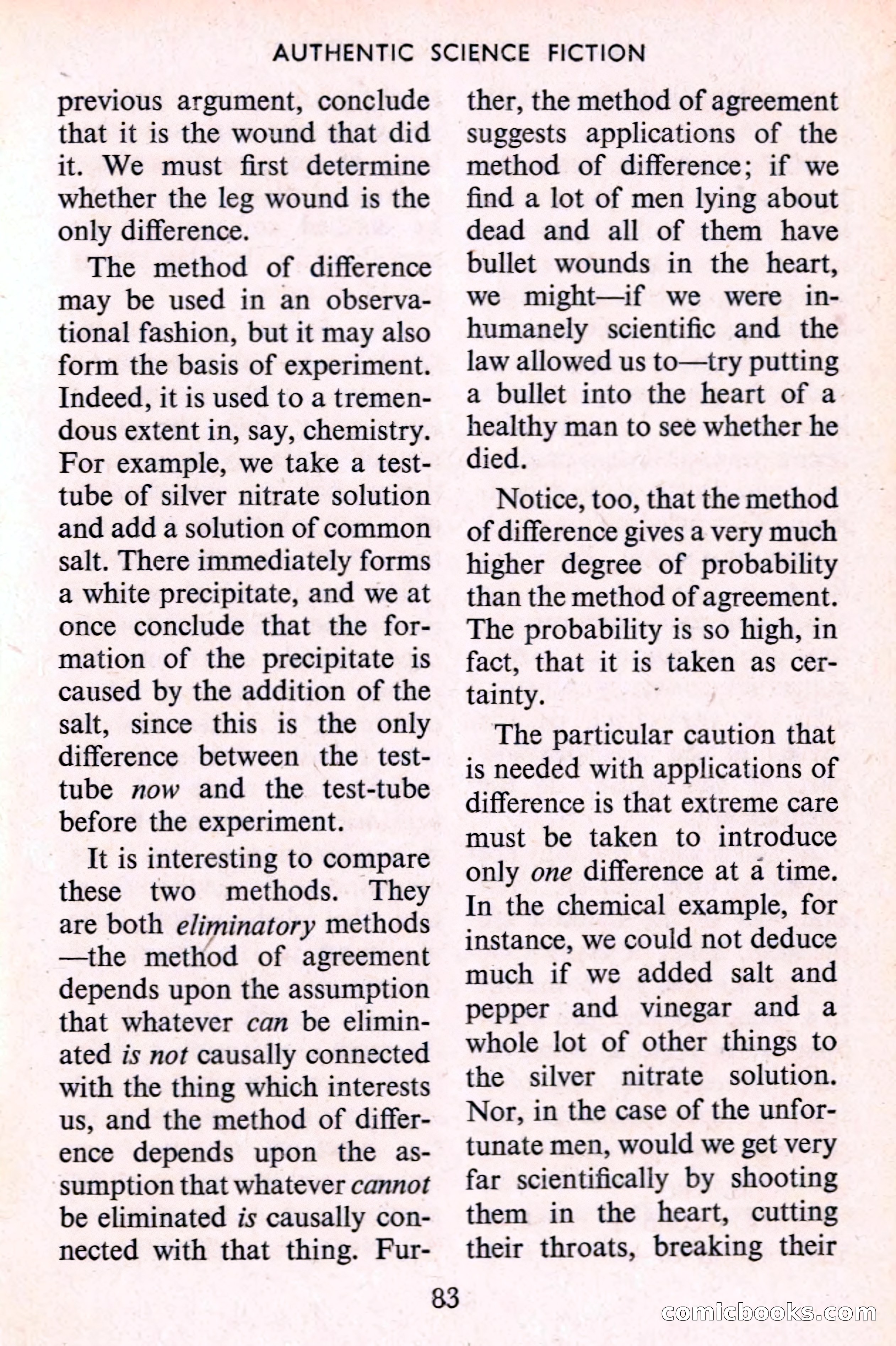
A restored page from Pulp Fiction, 1954. Page through the whole issue in the reader above.
📄 Transcribed text from this page (OCR, searchable)
Machine-transcribed from the original scan — historical spelling and the odd misread are preserved.
AUTHENTIC SCIENCE FICTION previous argument, conclude that it is the wound that did it. We must first determine whether the leg wound is the only difference. The method of difference may be used in an observa- tional fashion, but it may also form the basis of experiment. Indeed, it is used to a tremen- dous extent in, say, chemistry. For example, we take a test- tube of silver nitrate solution and add a solution of common salt. There immediately forms a white precipitate, and we at once conclude that the for- mation of the precipitate is caused by the addition of the salt, since this is the only difference between the test- tube mow and the test-tube before the experiment. It is interesting to compare these two methods. They are both eliminatory methods —the method of agreement depends upon the assumption that whatever can be elimin- ated is not causally connected with the thing which interests us, and the method of differ- ence depends upon the as- sumption that whatever cannot be eliminated is causally con- nected with that thing. Pur- ther, the method of agreement suggests applications of the method of difference; if we find a lot of men lying about dead and all of them have bullet wounds in the heart, we might—if we were in- humanely scientific and the law allowed us to—try putting a bullet into the heart of a healthy man to see whether he died. Notice, too, that the method of difference gives a very much higher degree of probability than the method of agreement. The probability is so high, in fact, that it is taken as cer- tainty. The particular caution that is needed with applications of difference is that extreme care must be taken to introduce only one difference at a time. In the chemical example, for instance, we could not deduce much if we added salt and pepper and vinegar and a whole lot of other things to the silver nitrate solution. Nor, in the case of the unfor- tunate men, would we get very far scientifically by shooting them in the heart, cutting their throats, breaking their commicloooks.com