
Pulp Fiction, 1954 · page 83 of 146
Authentic Science Fiction Monthly, No. 51 — page 83: what you’re looking at
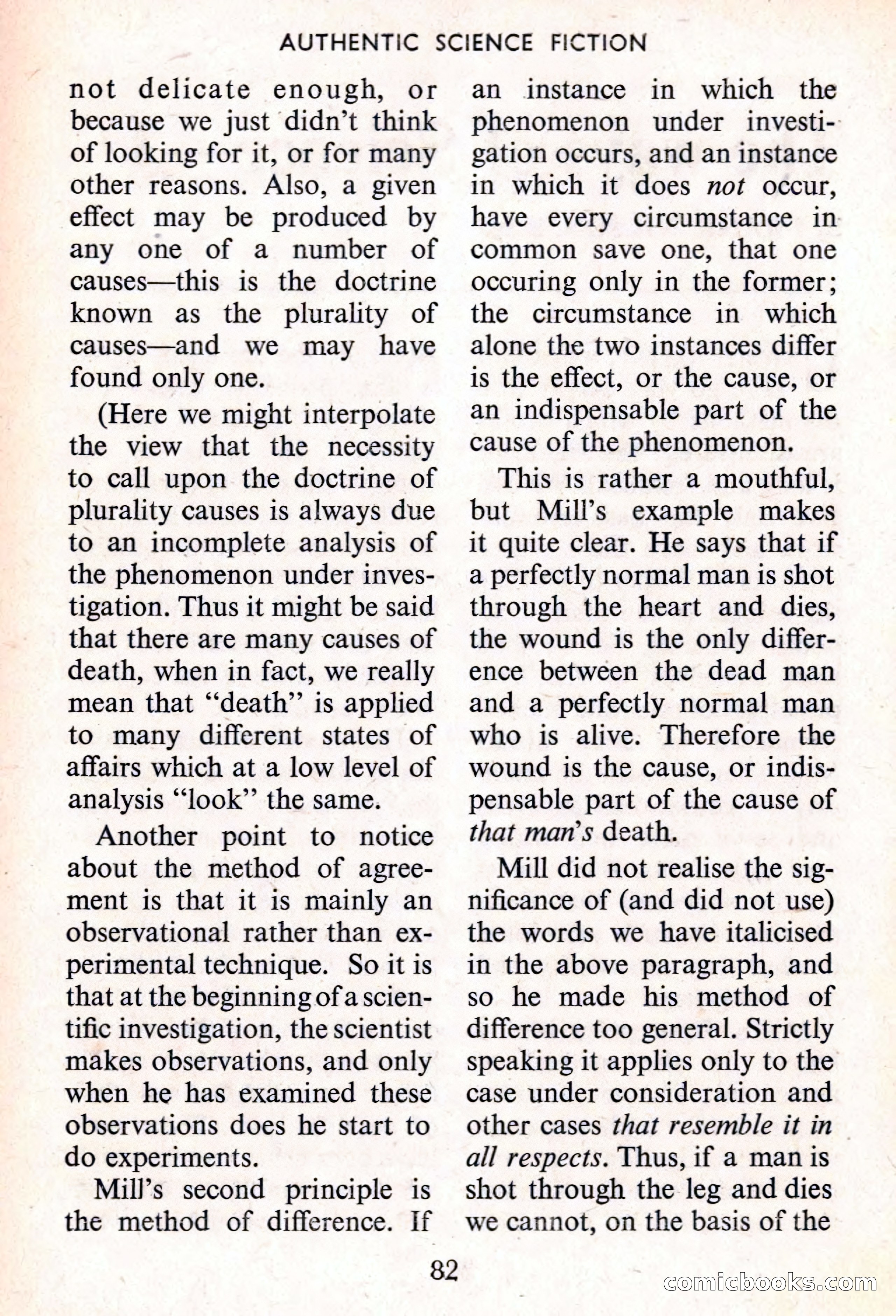
A restored page from Pulp Fiction, 1954. Page through the whole issue in the reader above.
📄 Transcribed text from this page (OCR, searchable)
Machine-transcribed from the original scan — historical spelling and the odd misread are preserved.
AUTHENTIC SCIENCE FICTION not delicate enough, or because we just didn’t think of looking for it, or for many other reasons. Also, a given effect may be produced by any one of a number of causes—this is the doctrine known as the plurality of causes—and we may have found only one. (Here we might interpolate the view that the necessity to call upon the doctrine of plurality causes is always due to an incomplete analysis of the phenomenon under inves- tigation. Thus it might be said that there are many causes of death, when in fact, we really mean that “‘death’’ is applied to many different states of affairs which at a low level of analysis “look” the same. Another point to notice about the method of agree- ment is that it is mainly an observational rather than ex- perimental technique. So it is that at the beginning ofa scien- tific investigation, the scientist makes observations, and only when he has examined these observations does he start to do experiments. Mill’s second principle is the method of difference. If 82 an instance in which the phenomenon under investi- gation occurs, and an instance in which it does not occur, have every circumstance in common save one, that one occuring only in the former; the circumstance in which alone the two instances differ is the effect, or the cause, or an indispensable part of the cause of the phenomenon. This is rather a mouthful, but Miull’s example makes it quite clear. He says that if a perfectly normal man is shot through the heart and dies, the wound is the only differ- ence between the dead man and a perfectly normal man who is alive. Therefore the wound is the cause, or indis- pensable part of the cause of that man’s death. Mill did not realise the sig- nificance of (and did not use) the words we have italicised in the above paragraph, and so he made his method of difference too general. Strictly speaking it applies only to the case under consideration and other cases that resemble it in all respects. Thus, if a man is shot through the leg and dies we cannot, on the basis of the comiclooks.cormn