
Pulp Fiction, 1954 · page 82 of 146
Authentic Science Fiction Monthly, No. 51 — page 82: what you’re looking at
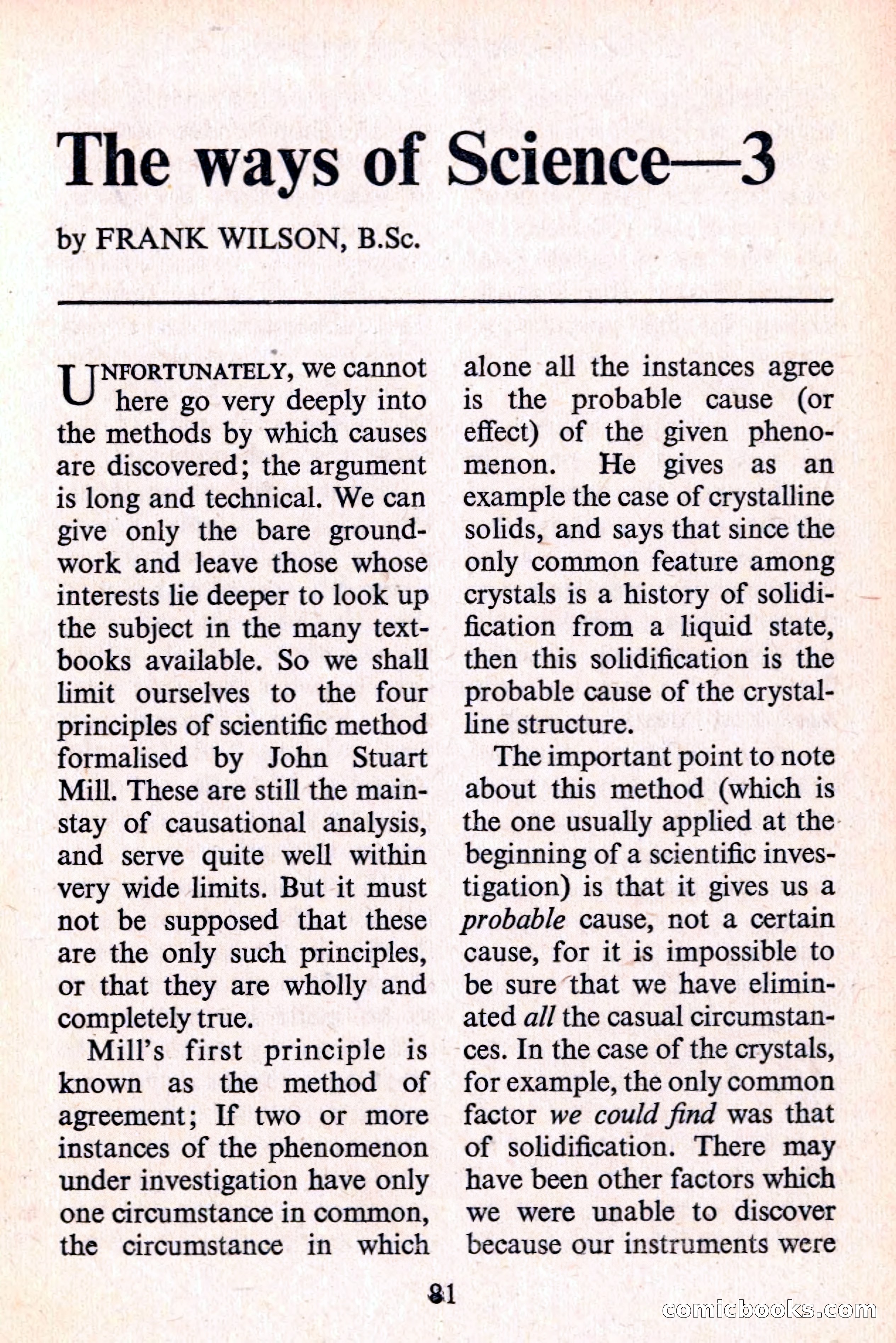
A restored page from Pulp Fiction, 1954. Page through the whole issue in the reader above.
📄 Transcribed text from this page (OCR, searchable)
Machine-transcribed from the original scan — historical spelling and the odd misread are preserved.
The ways of Science—3 by FRANK WILSON, B.Sc. NFORTUNATELY, we cannot here go very deeply into the methods by which causes are discovered; the argument is long and technical. We can give only the bare ground- work and leave those whose interests lie deeper to look up the subject in the many text- books available. So we shall limit ourselves to the four principles of scientific method formalised by John Stuart Mill. These are still the main- stay of causational analysis, and serve quite well within very wide limits. But it must not be supposed that these are the only such principles, or that they are wholly and completely true. Mill’s first principle is known as the method of agreement; If two or more instances of the phenomenon under investigation have only one circumstance in common, the circumstance in which 1 alone all the instances agree is the probable cause (or effect) of the given pheno- menon. He gives as an example the case of crystalline solids, and says that since the only common feature among crystals is a history of solidi- fication from a liquid state, then this solidification is the probable cause of the crystal- line structure. The important point to note about this method (which is the one usually applied at the beginning of a scientific inves- tigation) is that it gives us a probable cause, not a certain cause, for it is impossible to be sure that we have elimin- ated all the casual circumstan- ces. In the case of the crystals, for example, the only common factor we could find was that of solidification. There may have been other factors which we were unable to discover because our instruments were commiclooolks.com