
Pulp Fiction, 1954 · page 127 of 146
Authentic Science Fiction Monthly, No. 51 — page 127: what you’re looking at
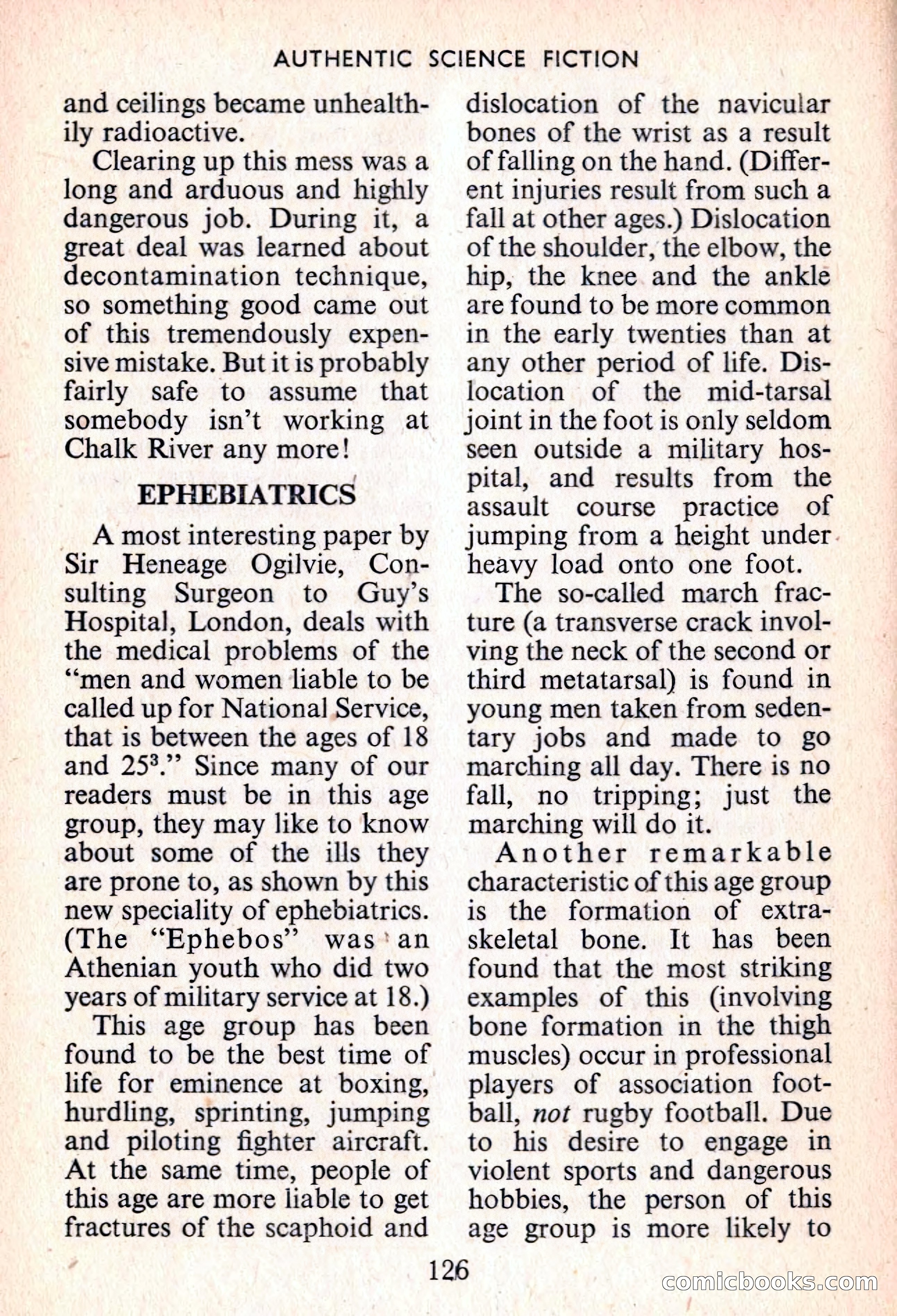
A restored page from Pulp Fiction, 1954. Page through the whole issue in the reader above.
📄 Transcribed text from this page (OCR, searchable)
Machine-transcribed from the original scan — historical spelling and the odd misread are preserved.
AUTHENTIC SCIENCE FICTION and ceilings became unhealth- ily radioactive. Clearing up this mess was a long and arduous and highly dangerous job. During it, a great deal was learned about decontamination technique, so something good came out of this tremendously expen- sive mistake. But it is probably fairly safe to assume that somebody isn’t working at Chalk River any more! EPHEBIATRICS _ A most interesting paper by Sir Heneage Ogilvie, Con- sulting Surgeon to Guy’s Hospital, London, deals with the medical problems of the “‘men and women liable to be called up for National Service, that is between the ages of 18 and 25°.”” Since many of our readers must be in this age group, they may like to know about some of the ills they are prone to, as shown by this new speciality of ephebiatrics. (The “Ephebos” was'‘an Athenian youth who did two years of military service at 18.) This age group has been found to be the best time of life for eminence at boxing, hurdling, sprinting, jumping and piloting fighter aircraft. At the same time, people of this age are more liable to get fractures of the scaphoid and 126 dislocation of the navicular bones of the wrist as a result of falling on the hand. (Differ- ent injuries result from such a fall at other ages.) Dislocation of the shoulder, the elbow, the hip, the knee and the ankle are found to be more common in the early twenties than at any other period of life. Dis- location of the mid-tarsal joint in the foot is only seldom seen outside a military hos- pital, and results from the assault course practice of jumping from a height under. heavy load onto one foot. The so-called march frac- ture (a transverse crack invol- ving the neck of the second or third metatarsal) is found in young men taken from seden- tary jobs and made to go marching all day. There is no fall, no tripping; just the marching will do it. Another remarkable characteristic of this age group is the formation of extra- skeletal bone. It has been found that the most striking examples of this (involving bone formation in the thigh muscles) occur in professional players of association foot- ball, not rugby football. Due to his desire to engage in violent sports and dangerous hobbies, the person of this age group is more likely to comicloooks.com