
Pulp Fiction, 1954 · page 126 of 146
Authentic Science Fiction Monthly, No. 51 — page 126: what you’re looking at
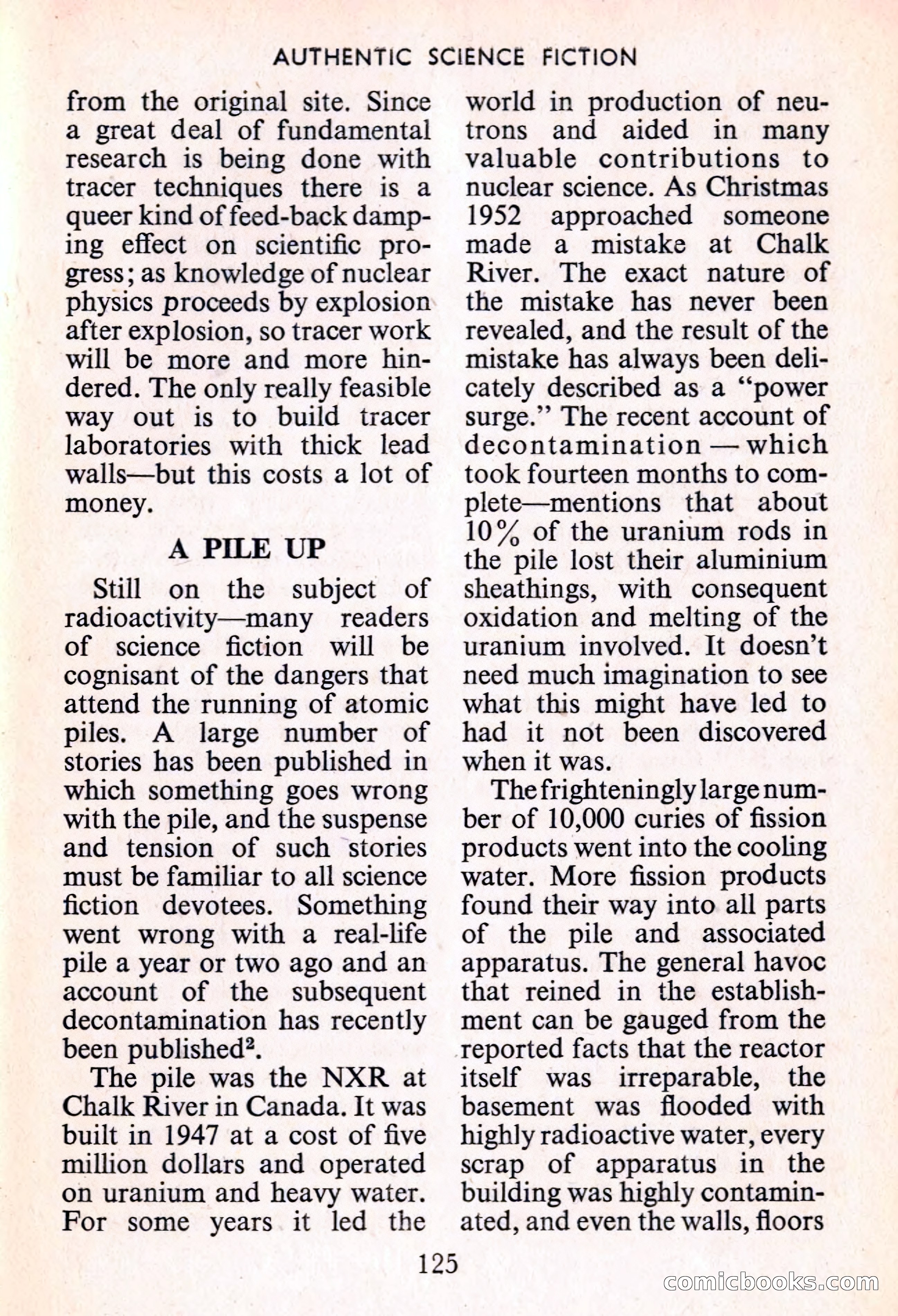
A restored page from Pulp Fiction, 1954. Page through the whole issue in the reader above.
📄 Transcribed text from this page (OCR, searchable)
Machine-transcribed from the original scan — historical spelling and the odd misread are preserved.
AUTHENTIC SCIENCE FICTION from the original site. Since a great deal of fundamental research is being done with tracer techniques there is a queer kind of feed-back damp- ing effect on scientific pro- gress; as knowledge of nuclear physics proceeds by explosion after explosion, so tracer work will be more and more hin- dered. The only really feasible way out is to build tracer laboratories with thick lead walls—but this costs a lot of money. A PILE UP Still on the subject of radioactivity—many readers of science fiction will be cognisant of the dangers that attend the running of atomic piles. A large number of stories has been published in which something goes wrong with the pile, and the suspense and tension of such stories must be familiar to all science fiction devotees. Something went wrong with a real-life pile a year or two ago and an account of the subsequent decontamination has recently been published?. The pile was the NXR at Chalk River in Canada. It was built in 1947 at a cost of five million dollars and operated on uranium and heavy water. For some years it led the 125 world in production of neu- trons and aided in many valuable contributions to nuclear science. As Christmas 1952 approached someone made a mistake at Chalk River. The exact nature of the mistake has never been revealed, and the result of the mistake has always been deli- cately described as a “‘power surge.’ The recent account of decontamination — which took fourteen months to com- plete—mentions that about 10% of the uranium rods in the pile lost their aluminium sheathings, with consequent oxidation and melting of the uranium involved. It doesn’t need much imagination to see what this might have led to had it not been discovered when it was. The frighteningly large num- ber of 10,000 curies of fission products went into the cooling water. More fission products found their way into all parts of the pile and associated apparatus. The general havoc that reined in the establish- ment can be gauged from the reported facts that the reactor itself was irreparable, the basement was flooded with highly radioactive water, every scrap of apparatus in the building was highly contamin- ated, and even the walls, floors comicloooks.com