
Pulp Fiction, 1954 · page 128 of 146
Authentic Science Fiction Monthly, No. 51 — page 128: what you’re looking at
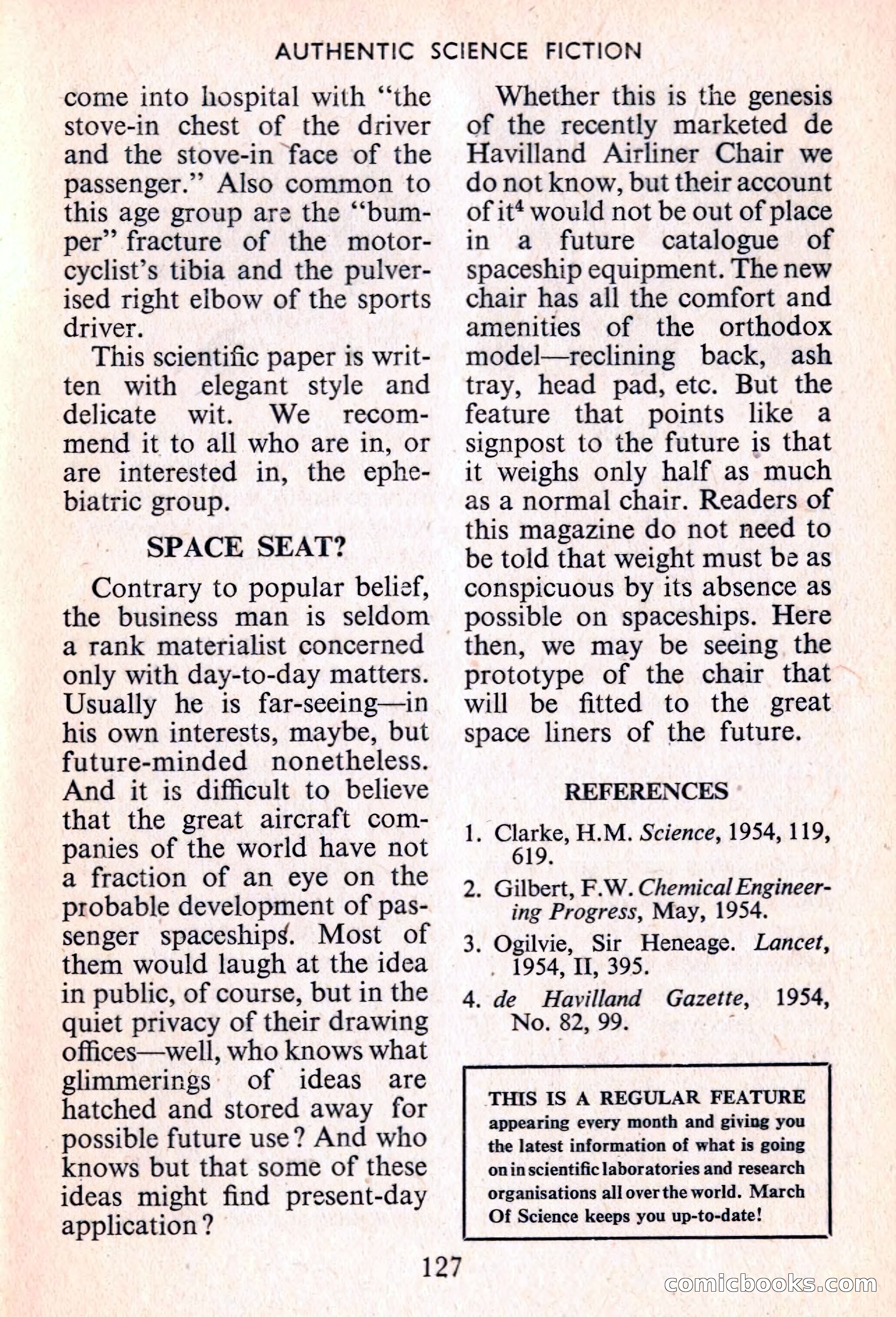
A restored page from Pulp Fiction, 1954. Page through the whole issue in the reader above.
📄 Transcribed text from this page (OCR, searchable)
Machine-transcribed from the original scan — historical spelling and the odd misread are preserved.
AUTHENTIC SCIENCE FICTION come into hospital with “‘the stove-in chest of the driver and the stove-in face of the passenger.’ Also common to this age group are the ““bum- per’ fracture of the motor- cyclist’s tibia and the pulver- ised right elbow of the sports driver. This scientific paper is writ- ten with elegant style and delicate wit. We recom- mend it to all who are in, or are interested in, the ephe- biatric group. SPACE SEAT? Contrary to popular belief, the business man is seldom a rank materialist concerned only with day-to-day matters. Usually he is far-seeing—in his own interests, maybe, but future-minded nonetheless. And it is difficult to believe that the great aircraft com- panies of the world have not a fraction of an eye on the probable development of pas- senger spaceships. Most of them would laugh at the idea in public, of course, but in the quiet privacy of their drawing offices—well, who knows what glimmerings of ideas are hatched and stored away for possible future use? And who knows but that some of these ideas might find present-day application? 127 Whether this is the genesis of the recently marketed de Havilland Airliner Chair we do not know, but their account of it* would not be out of place in a future catalogue of spaceship equipment. The new chair has all the comfort and amenities of the orthodox model—reclining back, ash tray, head pad, etc. But the feature that points like a signpost to the future is that it weighs only half as much as a normal chair. Readers of this magazine do not need to be told that weight must be as conspicuous by its absence as possible on spaceships. Here then, we may be seeing the prototype of the chair that will be fitted to the great space liners of the future. REFERENCES 1. Clarke, H.M. Science, 1954, 119, 619. 2. Gilbert, F.W. Chemical Engineer- ing Progress, May, 1954. 3. Ogilvie, Sir Heneage. Lancet, . 1954, II, 395. 4. de Havilland Gazette, No. 82, 99. : 1954, THIS IS A REGULAR FEATURE appearing every month and giving you the latest information of what is going onin scientific laboratories and research organisations all over the world. March Of Science keeps you up-to-date! comiclooks.cormn