
Pulp Fiction, 1954 · page 125 of 146
Authentic Science Fiction Monthly, No. 51 — page 125: what you’re looking at
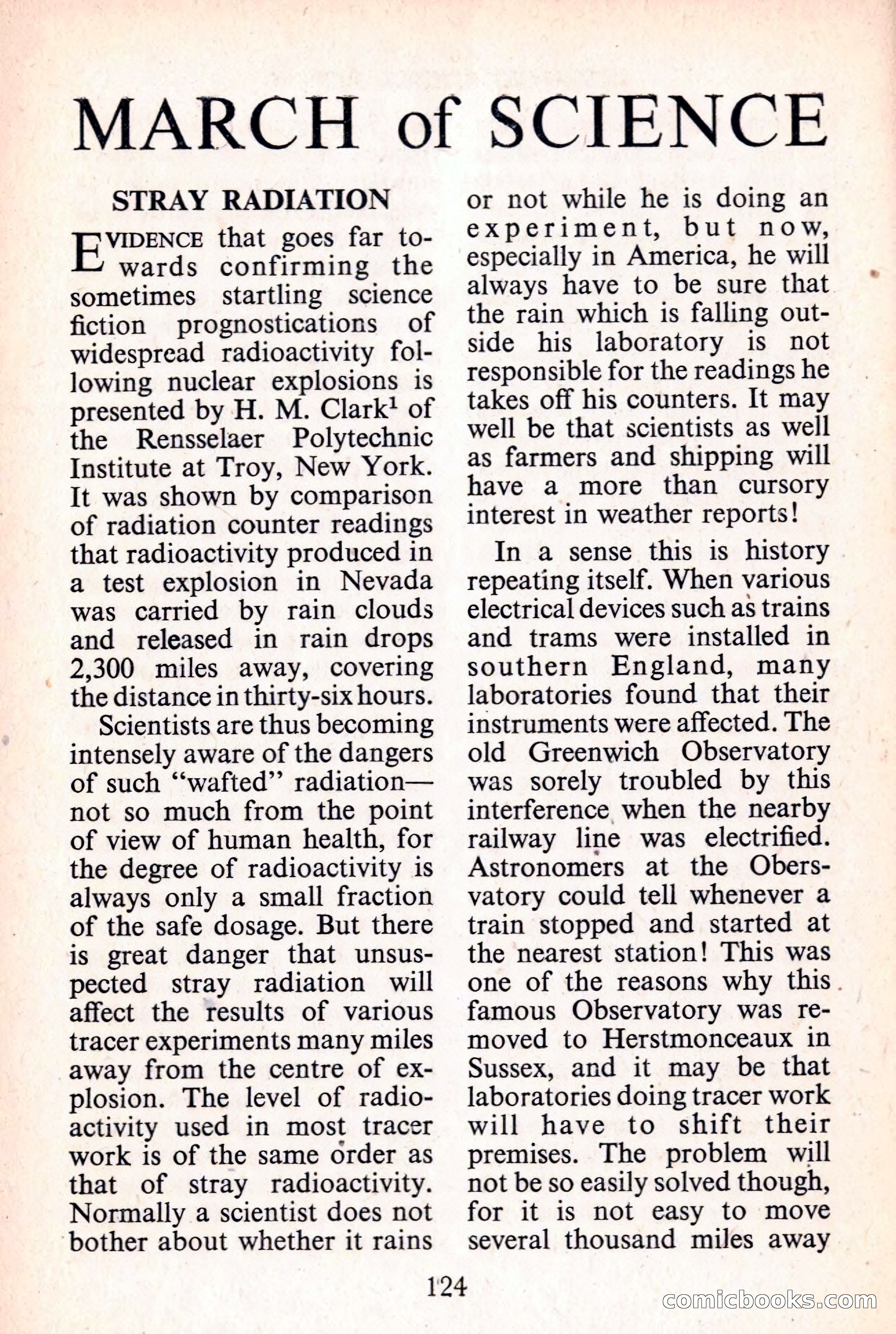
A restored page from Pulp Fiction, 1954. Page through the whole issue in the reader above.
📄 Transcribed text from this page (OCR, searchable)
Machine-transcribed from the original scan — historical spelling and the odd misread are preserved.
MARCH of SCIENCE STRAY RADIATION | Sais ay that goes far to- wards confirming the sometimes startling science fiction prognostications of widespread radioactivity fol- lowing nuclear explosions is presented by H. M. Clark* of the Rensselaer Polytechnic Institute at Troy, New York. It was shown by comparison of radiation counter readings that radioactivity produced in a test explosion in Nevada was carried by rain clouds and released in rain drops - 2,300 miles away, covering the distance in thirty-six hours. Scientists are thus becoming intensely aware of the dangers of such “‘wafted’”’ radiation— not so much from the point of view of human health, for the degree of radioactivity is always only a small fraction of the safe dosage. But there is great danger that unsus- pected stray radiation will affect the results of various tracer experiments many miles away from the centre of ex- plosion. The level of radio- activity used in most tracer work is of the same order as that of stray radioactivity. Normally a scientist does not bother about whether it rains 1'24 or not while he is doing an experiment, but now, especially in America, he will always have to be sure that the rain which is falling out- side his laboratory is not responsible for the readings he takes off his counters. It may well be that scientists as well as farmers and shipping will have a more than cursory interest in weather reports! In a sense this is history repeating itself. When various electrical devices such as trains and trams were installed in southern England, many laboratories found that their instruments were affected. The old Greenwich Observatory was sorely troubled by this interference when the nearby railway line was electrified. Astronomers at the Obers- vatory could tell whenever a train stopped and started at the nearest station! This was one of the reasons why this. famous Observatory was re- moved to Herstmonceaux in Sussex, and it may be that laboratories doing tracer work will have to shift their premises. The problem will not be so easily solved though, for it is not easy to move several thousand miles away comiclbooks.com