
Pulp Fiction, 1865 · page 85 of 399
The Argosy — page 85: what you’re looking at
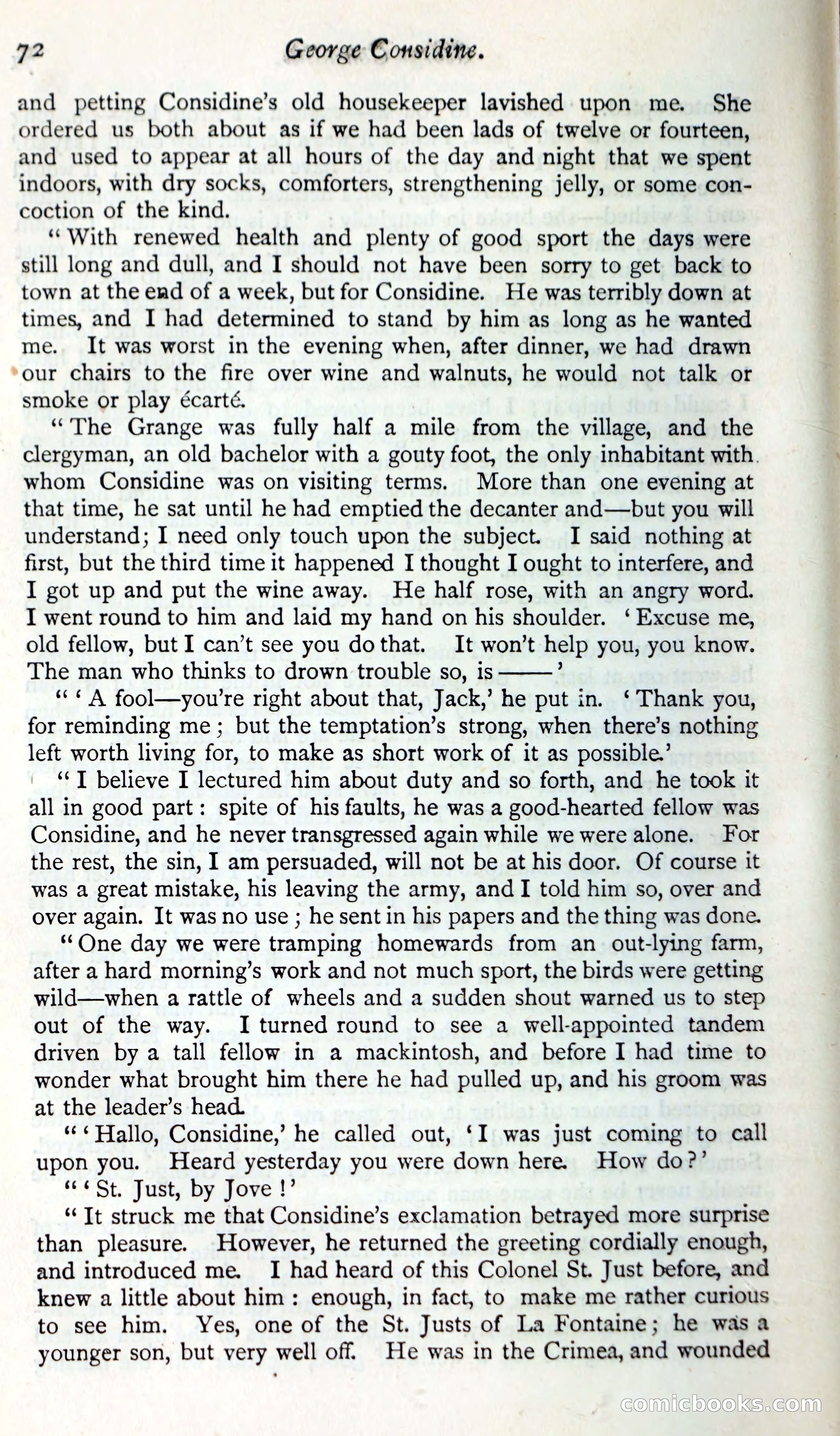
A restored page from Pulp Fiction, 1865. Page through the whole issue in the reader above.
📄 Transcribed text from this page (OCR, searchable)
Machine-transcribed from the original scan — historical spelling and the odd misread are preserved.
72 George Considine. and petting Considine’s old housekeeper lavished upon me. She ordered us both about as if we had been lads of twelve or fourteen, and used to appear at all hours of the day and night that we spent indoors, with dry socks, comforters, strengthening jelly, or some con- coction of the kind. ‘With renewed health and plenty of good sport the days were still long and dull, and I should not have been sorry to get back to town at the end of a week, but for Considine. He was terribly down at times, and I had determined to stand by him as long as he wanted me. It was worst in the evening when, after dinner, we had drawn ‘our chairs to the fire over wine and walnuts, he would not talk or smoke or play écarté. “The Grange was fully half a mile from the village, and the clergyman, an old bachelor with a gouty foot, the only inhabitant with. whom Considine was on visiting terms. More than one evening at that time, he sat until he had emptied the decanter and—but you will understand; I need only touch upon the subject. I said nothing at first, but the third time it happened I thought I ought to interfere, and I got up and put the wine away. He half rose, with an angry word. I went round to him and laid my hand on his shoulder. ‘ Excuse me, old fellow, but I can’t see you dothat. It won’t help you, you know. The man who thinks to drown trouble so, is “«¢ A fool—youw’re right about that, Jack,’ he put in. ‘ Thank you, for reminding me; but the temptation’s strong, when there’s nothing left worth living for, to make as short work of it as possible.’ ‘‘T believe I lectured him about duty and so forth, and he took it all in good part: spite of his faults, he was a good-hearted fellow was Considine, and he never transgressed again while we were alone. For the rest, the sin, I am persuaded, will not be at his door. Of course it was a great mistake, his leaving the army, and I told him so, over and over again. It was no use ; he sent in his papers and the thing was done. ‘One day we were tramping homewards from an out-lying farm, after a hard morning’s work and not much sport, the birds were getting wild—when a rattle of wheels and a sudden shout warned us to step out of the way. I turned round to see a well-appointed tandem driven by a tall fellow in a mackintosh, and before I had time to wonder what brought him there he had pulled up, and his groom was at the leader’s head. “© Frallo, Considine,’ he called out, ‘I was just coming to call upon you. Heard yesterday you were down here. How do?’ St. Just py Jove!’ ‘It struck me that Considine’s exclamation betrayed more surprise than pleasure. However, he returned the greeting cordially enough, and introduced me._ I had heard of this Colonel St. Just before, and knew a little about him: enough, in fact, to make me rather curious to see him. Yes, one of the St. Justs of La Fontaine; he was a younger son, but very well off. He was in the Crimea, and wounded COMIC LOOKS, (E00)