
Pulp Fiction, 1865 · page 371 of 399
The Argosy — page 371: what you’re looking at
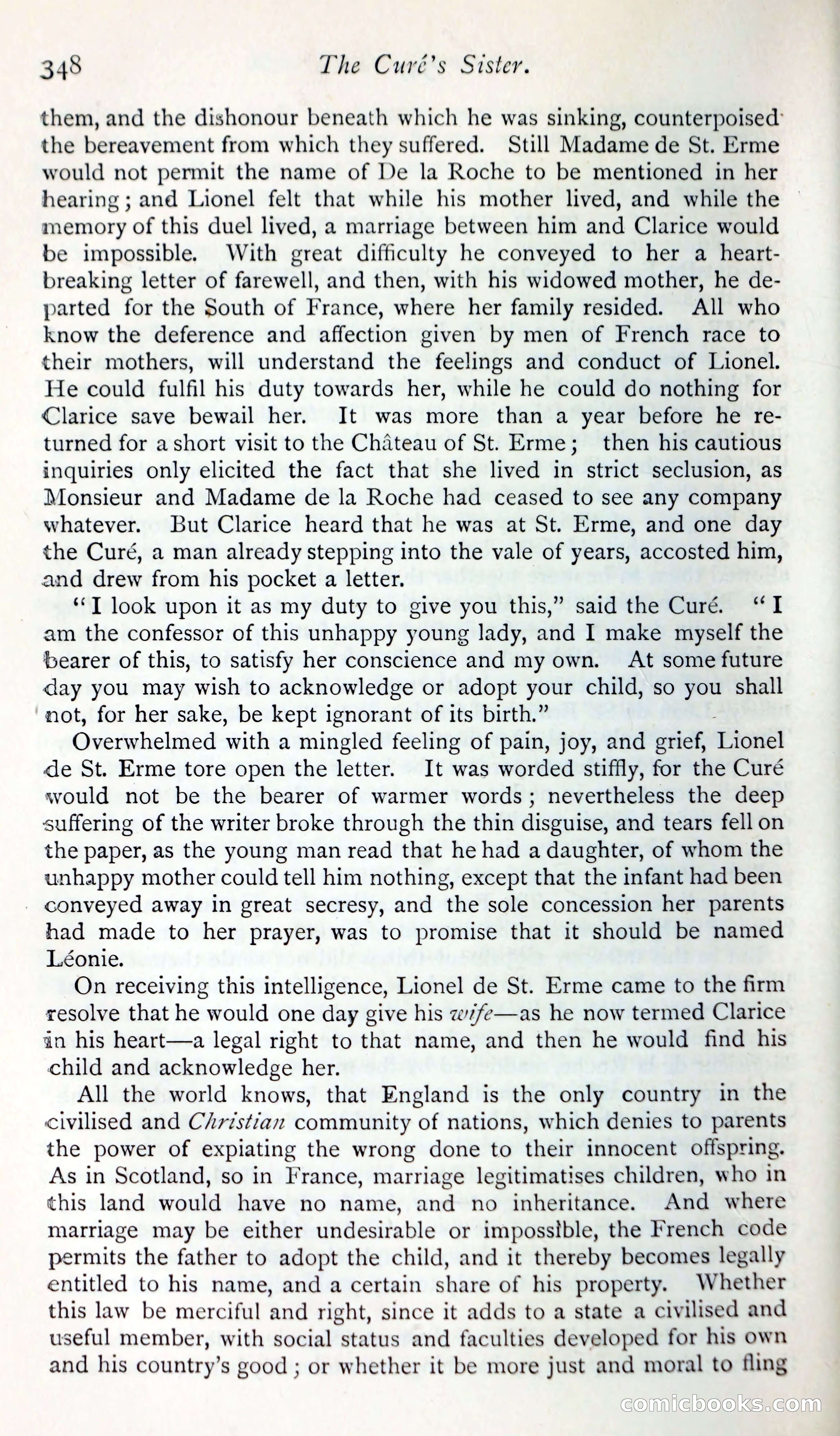
A restored page from Pulp Fiction, 1865. Page through the whole issue in the reader above.
📄 Transcribed text from this page (OCR, searchable)
Machine-transcribed from the original scan — historical spelling and the odd misread are preserved.
348 The Curé’s Sister. them, and the dishonour beneath which he was sinking, counterpoised’ the bereavement from which they suffered. Still Madame de St. Erme would not permit the name of De la Roche to be mentioned in her hearing ; and Lionel felt that while his mother lived, and while the © memory of this duel lived, a marriage between him and Clarice would be impossible. With great difficulty he conveyed to her a heart- breaking letter of farewell, and then, with his widowed mother, he de- parted for the South of France, where her family resided. All who know the deference and affection given by men of French race to their mothers, will understand the feelings and conduct of Lionel. He could fulfil his duty towards her, while he could do nothing for Clarice save bewail her. It was more than a year before he re- turned for ashort visit to the Chateau of St. Erme; then his cautious inquiries only elicited the fact that she lived in strict seclusion, as Monsieur and Madame de la Roche had ceased to see any company whatever. But Clarice heard that he was at St. Erme, and one day the Curé, a man already stepping into the vale of years, accosted him, and drew from his pocket a letter. ‘T look upon it as my duty to give you this,” said the Curé. “TI am the confessor of this unhappy young lady, and I make myself the bearer of this, to satisfy her conscience and my own. At some future day you may wish to acknowledge or adopt your child, so you shall not, for her sake, be kept ignorant of its birth.” Overwhelmed with a mingled feeling of pain, joy, and grief, Lionel de St. Erme tore open the letter. It was worded stiffly, for the Cure would not be the bearer of warmer words; nevertheless the deep suffering of the writer broke through the thin disguise, and tears fell on the paper, as the young man read that he had a daughter, of whom the unhappy mother could tell him nothing, except that the infant had been - conveyed away in great secresy, and the sole concession her parents had made to her prayer, was to promise that it should be named Léonie. On receiving this intelligence, Lionel de St. Erme came to the firm resolve that he would one day give his zwfe—as he now termed Clarice in his heart—a legal right to that name, and then he would find his child and acknowledge her. All the world knows, that England is the only country in the civilised and Christian community of nations, which denies to parents the power of expiating the wrong done to their innocent offspring. As in Scotland, so in France, marriage legitimatises children, who in this land would have no name, and no inheritance. And where marriage may be either undesirable or impossible, the French code permits the father to adopt the child, and it thereby becomes legally entitled to his name, and a certain share of his property. Whether this law be merciful and right, since it adds to a state a civilised and useful member, with social status and faculties developed for his own and his country’s good ; or whether it be more just and moral to fling ECOPMICLIOO; KS, (Eo)