
Pulp Fiction, 1865 · page 370 of 399
The Argosy — page 370: what you’re looking at
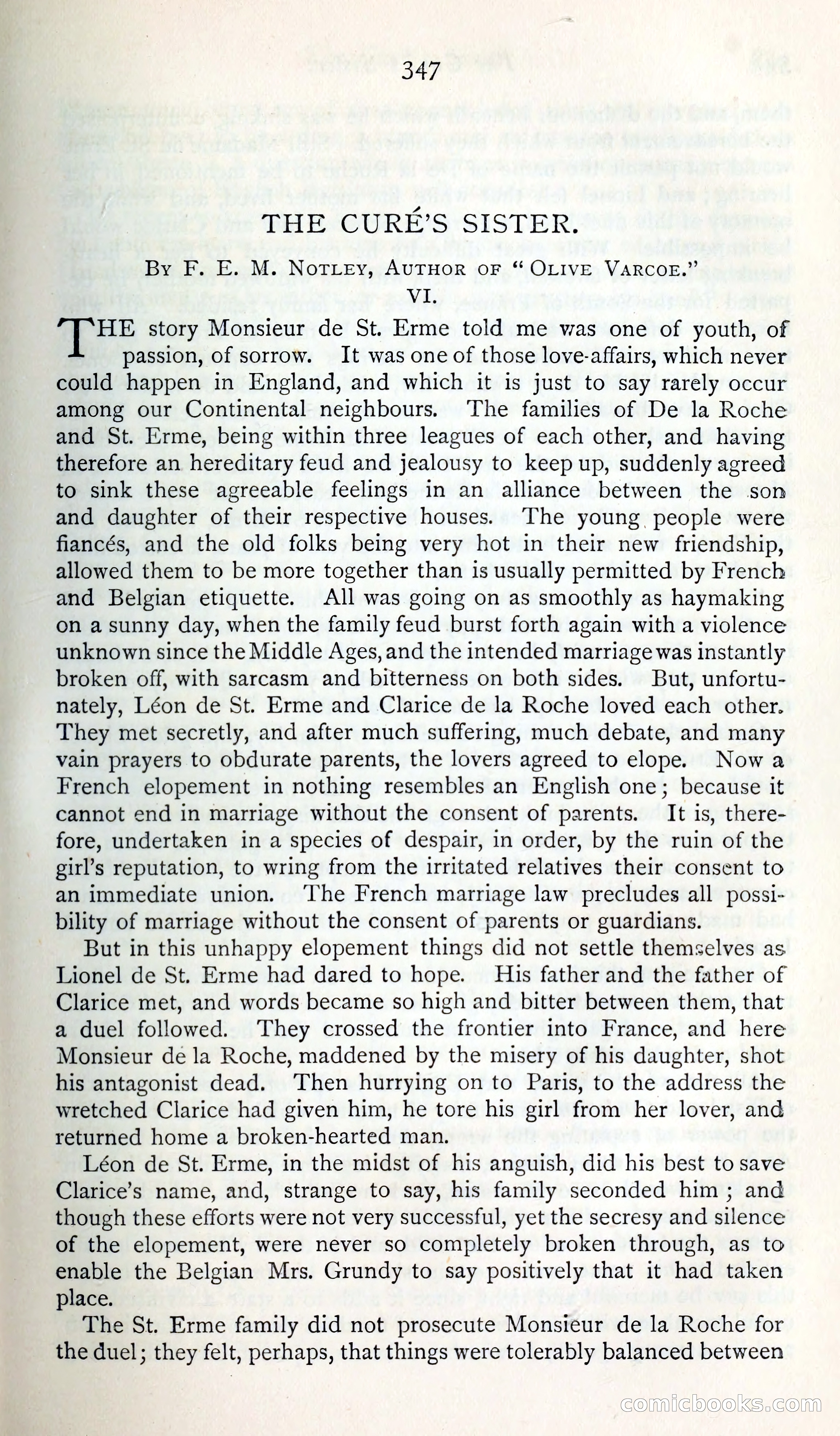
A restored page from Pulp Fiction, 1865. Page through the whole issue in the reader above.
📄 Transcribed text from this page (OCR, searchable)
Machine-transcribed from the original scan — historical spelling and the odd misread are preserved.
Sf THE CURE’S SISTER. By F. E. M. NotTrLey, AUTHOR oF * OLIVE VARCOE.”’ VI. << Wee story Monsieur de St. Erme told me was one of youth, of passion, of sorrow. It was one of those love-affairs, which never could happen in England, and which it is just to say rarely occur among our Continental neighbours. ‘The families of De la Roche and St. Erme, being within three leagues of each other, and having therefore an hereditary feud and jealousy to keep up, suddenly agreed to sink these agreeable feelings in an alliance between the son and daughter of their respective houses. The young people were fiancés, and the old folks being very hot in their new friendship, allowed them to be more together than is usually permitted by French and Belgian etiquette. All was going on as smoothly as haymaking on a sunny day, when the family feud burst forth again with a violence unknown since the Middle Ages, and the intended marriage was instantly broken off, with sarcasm and bitterness on both sides. But, unfortu- nately, Léon de St. Erme and Clarice de la Roche loved each other. They met secretly, and after much suffering, much debate, and many vain prayers to obdurate parents, the lovers agreed to elope. Nowa French elopement in nothing resembles an English one; because it cannot end in marriage without the consent of parents. It is, there- fore, undertaken in a species of despair, in order, by the ruin of the girl’s reputation, to wring from the irritated relatives their consent to an immediate union. ‘The French marriage law precludes all possi- bility of marriage without the consent of parents or guardians. But in this unhappy elopement things did not settle themselves as. Lionel de St. Erme had dared to hope. His father and the father of Clarice met, and words became so high and bitter between them, that a duel followed. ‘They crossed the frontier into France, and here Monsieur de la Roche, maddened by the misery of his daughter, shot his antagonist dead. ‘Then hurrying on to Paris, to the address the wretched Clarice had given him, he tore his girl from her lover, and returned home a broken-hearted man. Léon de St. Erme, in the midst of his anguish, did his best to save Clarice’s name, and, strange to say, his family seconded him ; and though these efforts were not very successful, yet the secresy and silence of the elopement, were never so completely broken through, as to enable the Belgian Mrs. Grundy to say positively that it had taken place. The St. Erme family did not prosecute Monsieur de la Roche for the duel; they felt, perhaps, that things were tolerably balanced between COMMICOAOOKS. CO