
Pulp Fiction, 1865 · page 322 of 399
The Argosy — page 322: what you’re looking at
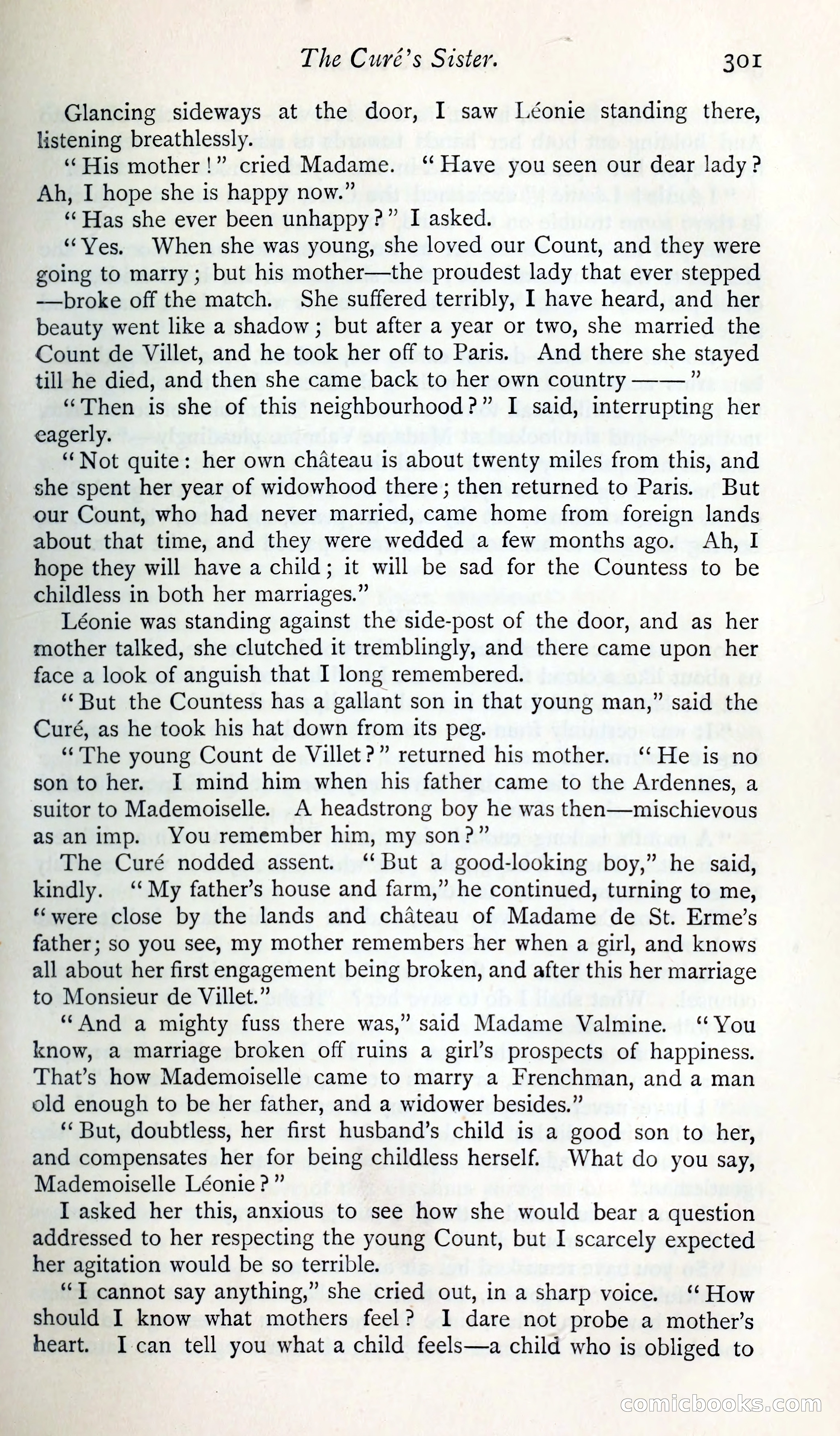
A restored page from Pulp Fiction, 1865. Page through the whole issue in the reader above.
📄 Transcribed text from this page (OCR, searchable)
Machine-transcribed from the original scan — historical spelling and the odd misread are preserved.
The Curé’s Sister. 301 Glancing sideways at the door, I saw Léonie standing there, listening breathlessly. ‘His mother!” cried Madame. ‘“‘ Have you seen our dear lady? Ah, I hope she 1s happy now.” ‘Has she ever been unhappy?” I asked. ‘Ves, When she was young, she loved our Count, and they were going to marry; but his mother—the proudest lady that ever stepped —broke off the match. She suffered terribly, I have heard, and her beauty went like a shadow; but after a year or two, she married the Count de Villet, and he took her off to Paris. And there she stayed till he died, and then she came back to her own country ——” “Then is she of this neighbourhood?” I said, interrupting her eagerly. “Not quite: her own chateau is about twenty miles from this, and she spent her year of widowhood there; then returned to Paris. But our Count, who had never married, came home from foreign lands about that time, and they were wedded a few months ago. Ah, I hope they will have a child; it will be sad for the Countess to be childless in both her marriages.” Léonie was standing against the side-post of the door, and as her mother talked, she clutched it tremblingly, and there came upon her face a look of anguish that I long remembered. ‘‘But the Countess has a gallant son in that young man,” said the Curé, as he took his hat down from its peg. “The young Count de Villet?” returned his mother. ‘‘He is no son to her. I mind him when his father came to the Ardennes, a suitor to Mademoiselle. A headstrong boy he was then—mischievous asanimp. You remember him, my son?” The Curé nodded assent. ‘But a good-looking boy,” he said, kindly. ‘‘ My father’s house and farm,” he continued, turning to me, *‘were close by the lands and chateau of Madame de St. Erme’s father; so you see, my mother remembers her when a girl, and knows all about her first engagement being broken, and after this her marriage to Monsieur de Villet.” “And a mighty fuss there was,” said Madame Valmine. ‘You know, a marriage broken off ruins a girl’s prospects of happiness. That’s how Mademoiselle came to marry a Frenchman, and a man old enough to be her father, and a widower besides.” | ‘But, doubtless, her first husband’s child is a good son to her, and compensates her for being childless herself. What do you say, Mademoiselle Léonie ?” I asked her this, anxious to see how she would bear a question addressed to her respecting the young Count, but I scarcely expected her agitation would be so terrible. ‘“‘T cannot say anything,” she cried out, in a sharp voice. ‘‘ How should I know what mothers feel? I dare not probe a mother’s heart. I-can tell you what a child feels—a child who is obliged to COMmicoooks (C©)