
Pulp Fiction, 1865 · page 321 of 399
The Argosy — page 321: what you’re looking at
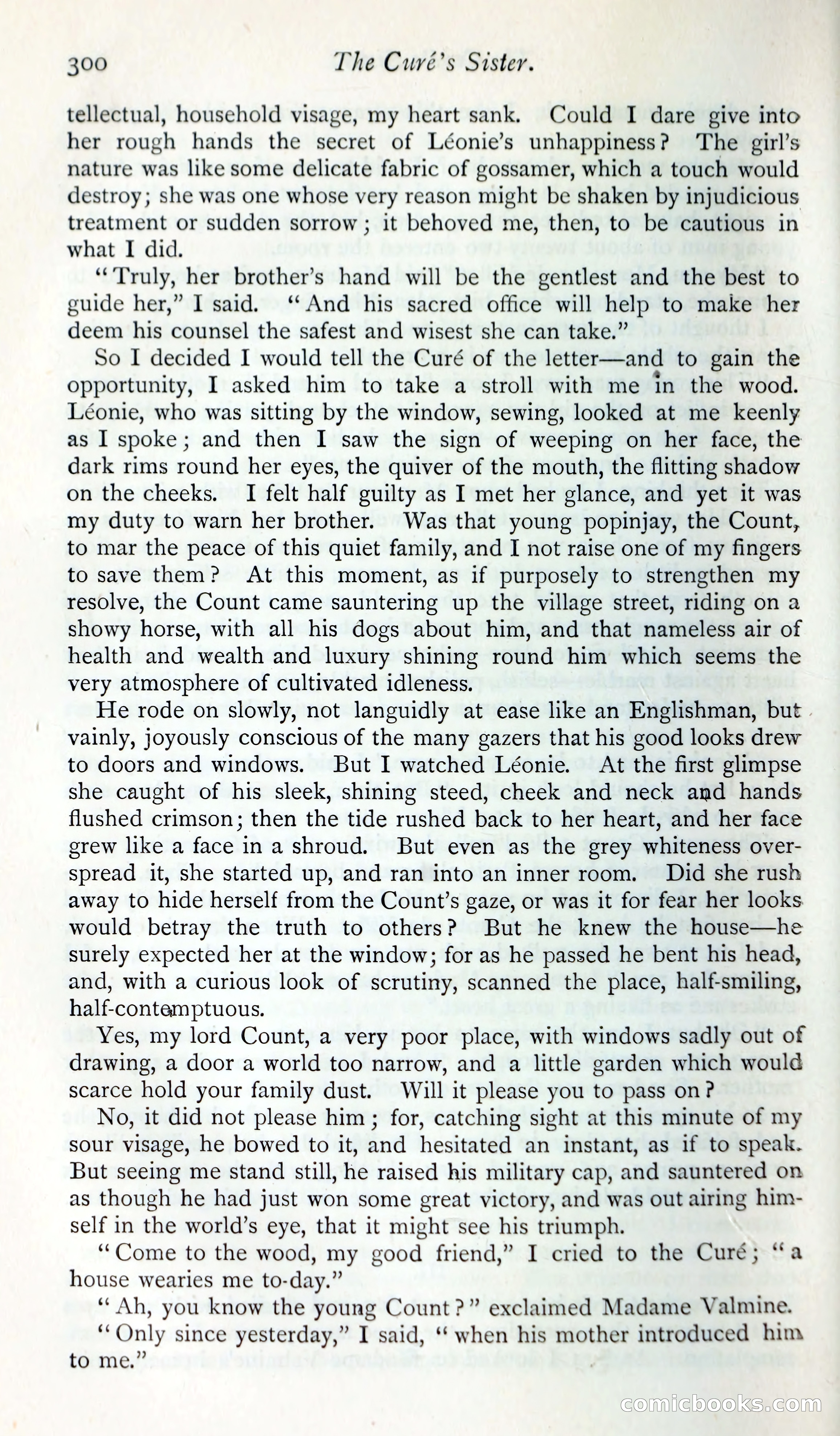
A restored page from Pulp Fiction, 1865. Page through the whole issue in the reader above.
📄 Transcribed text from this page (OCR, searchable)
Machine-transcribed from the original scan — historical spelling and the odd misread are preserved.
300 The Curé’s Sister. tellectual, household visage, my heart sank. Could I dare give into her rough hands the secret of Léonie’s unhappiness? ‘The girl’s nature was like some delicate fabric of gossamer, which a touch would destroy; she was one whose very reason might be shaken by injudicious treatment or sudden sorrow ; it behoved me, then, to be cautious in what I did. “Truly, her brother’s hand will be the gentlest and the best to guide her,” I said. ‘‘And his sacred office will help to make her deem his counsel the safest and wisest she can take.” So I decided I would tell the Curé of the letter—and to gain the opportunity, I asked him to take a stroll with me in the wood. Léonie, who was sitting by the window, sewing, looked at me keenly as I spoke; and then I saw the sign of weeping on her face, the dark rims round her eyes, the quiver of the mouth, the flitting shadow on the cheeks. I felt half guilty as I met her glance, and yet it was my duty to warn her brother. Was that young popinjay, the Count, to mar the peace of this quiet family, and I not raise one of my fingers to save them? At this moment, as if purposely to strengthen my resolve, the Count came sauntering up the village street, riding on a showy horse, with all his dogs about him, and that nameless air of health and wealth and luxury shining round him which seems the very atmosphere of cultivated idleness. He rode on slowly, not languidly at ease like an Englishman, but . vainly, joyously conscious of the many gazers that his good looks drew to doors and windows. But I watched Léonie. At the first glimpse she caught of his sleek, shining steed, cheek and neck and hands flushed crimson; then the tide rushed back to her heart, and her face grew like a face in a shroud. But even as the grey whiteness over- spread it, she started up, and ran into an inner room. Did she rush away to hide herself from the Count’s gaze, or was it for fear her looks would betray the truth to others? But he knew the house—he surely expected her at the window; for as he passed he bent his head, and, with a curious look of scrutiny, scanned the place, half-smiling, half-contemptuous. Yes, my lord Count, a very poor place, with windows sadly out of drawing, a door a world too narrow, and a little garden which would scarce hold your family dust. Will it please you to pass on? No, it did not please him ; for, catching sight at this minute of my sour visage, he bowed to it, and hesitated an instant, as if to speak. But seeing me stand still, he raised his military cap, and sauntered on as though he had just won some great victory, and was out airing him- self in the world’s eye, that it might see his triumph. ‘““Come to the wood, my good friend,” I cried to the Cure; “a house wearies me to-day.” ‘Ah, you know the young Count?” exclaimed Madame Valmine. ‘Only since yesterday,” I said, ‘‘ when his mother introduced him to me.” COPMIECMOOKS Conn