
Pulp Fiction, 1865 · page 323 of 399
The Argosy — page 323: what you’re looking at
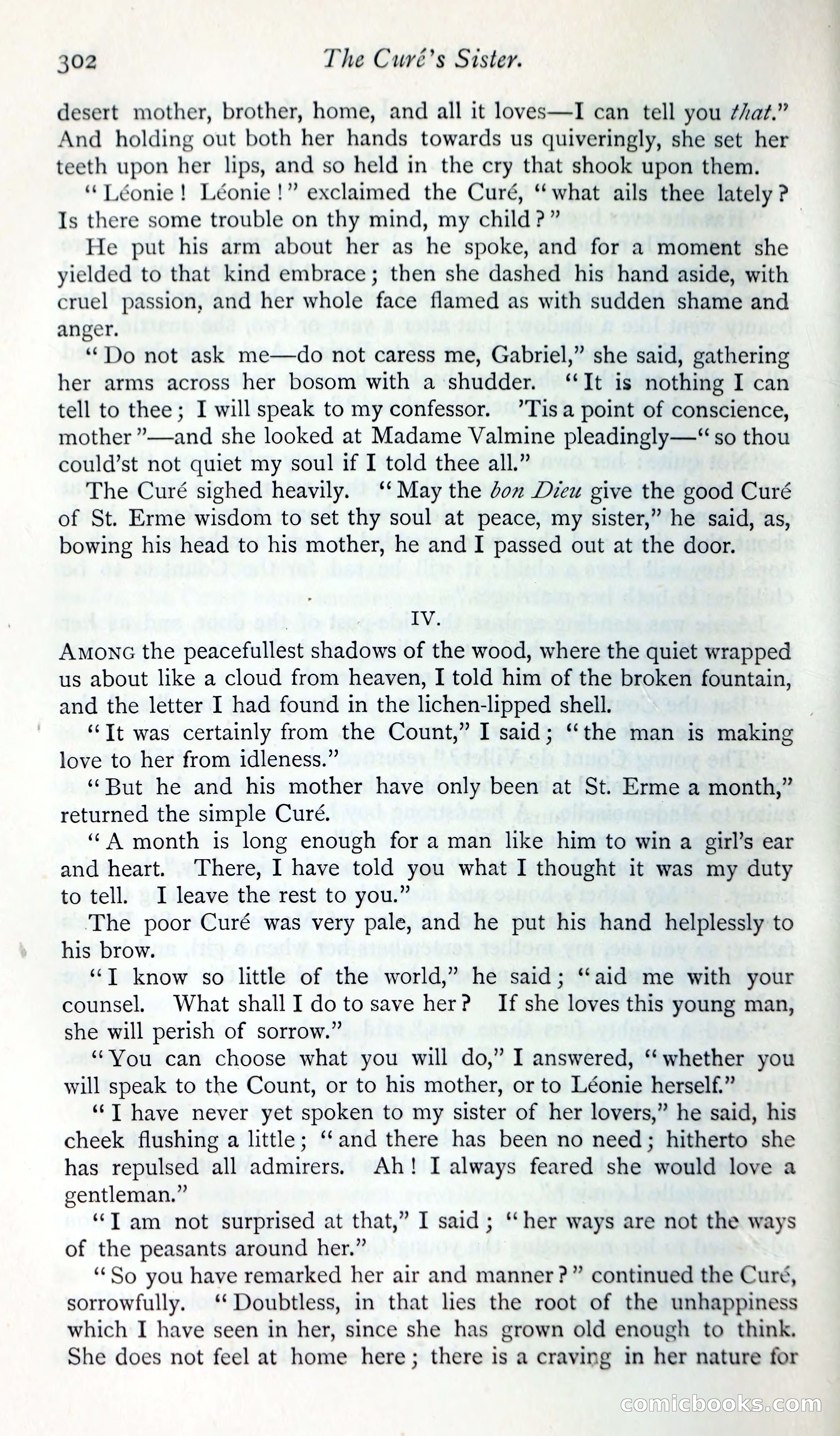
A restored page from Pulp Fiction, 1865. Page through the whole issue in the reader above.
📄 Transcribed text from this page (OCR, searchable)
Machine-transcribed from the original scan — historical spelling and the odd misread are preserved.
302 The Curé’s Sister. desert mother, brother, home, and all it loves—I can tell you ¢hat.” And holding out both her hands towards us quiveringly, she set her teeth upon her lips, and so held in the cry that shook upon them. ‘Léonie! Léonie!” exclaimed the Curé, “what ails thee lately ? Is there some trouble on thy mind, my child?” He put his arm about her as he spoke, and for a moment she yielded to that kind embrace; then she dashed his hand aside, with cruel passion, and her whole face flamed as with sudden shame and anger. ‘Do not ask me—do not caress me, Gabriel,” she said, gathering her arms across her bosom with a shudder. ‘‘It is nothing I can tell to thee; I will speak to my confessor. ’Tisa point of conscience, mother ”—and she looked at Madame Valmine pleadingly—“ so thou could’st not quiet my soul if I told thee all.” The Curé sighed heavily. ‘‘ May the don Dieu give the good Curé of St. Erme wisdom to set thy soul at peace, my sister,” he said, as, bowing his head to his mother, he and I passed out at the door. IV. Amonc the peacefullest shadows of the wood, where the quiet wrapped us about like a cloud from heaven, I told him of the broken fountain, and the letter I had found in the lichen-lipped shell. ‘Tt was certainly from the Count,” I said; “the man is making love to her from idleness.” ‘But he and his mother have only been at St. Erme a month,” returned the simple Curé. ‘“ A month is long enough for a man lke him to win a girl’s ear and heart. There, I have told you what I thought it was my duty to tell. I leave the rest to you.” The poor Curé was very pale, and he put his hand helplessly to his brow. ‘T know so little of the world,” he said; “aid me with your counsel. What shall I doto save her? If she loves this young man, she will perish of sorrow.” ‘You can choose what you will do,” I answered, ‘whether you will speak to the Count, or to his mother, or to Léonie herself.” ‘‘T have never yet spoken to my sister of her lovers,” he said, his cheek flushing a little; “‘and there has been no need; hitherto she has repulsed all admirers. Ah! I always feared she would love a gentleman.” ‘‘T am not surprised at that,” I said; “her ways are not the ways of the peasants around her.” ‘So you have remarked her air and manner?” continued the Curé, sorrowfully. ‘* Doubtless, in that lies the root of the unhappiness which I have seen in her, since she has grown old enough to think. She does not feel at home here; there is a craving in her nature for ECOMICLIOO; KS, (Eo)