
Pulp Fiction, 1865 · page 318 of 399
The Argosy — page 318: what you’re looking at
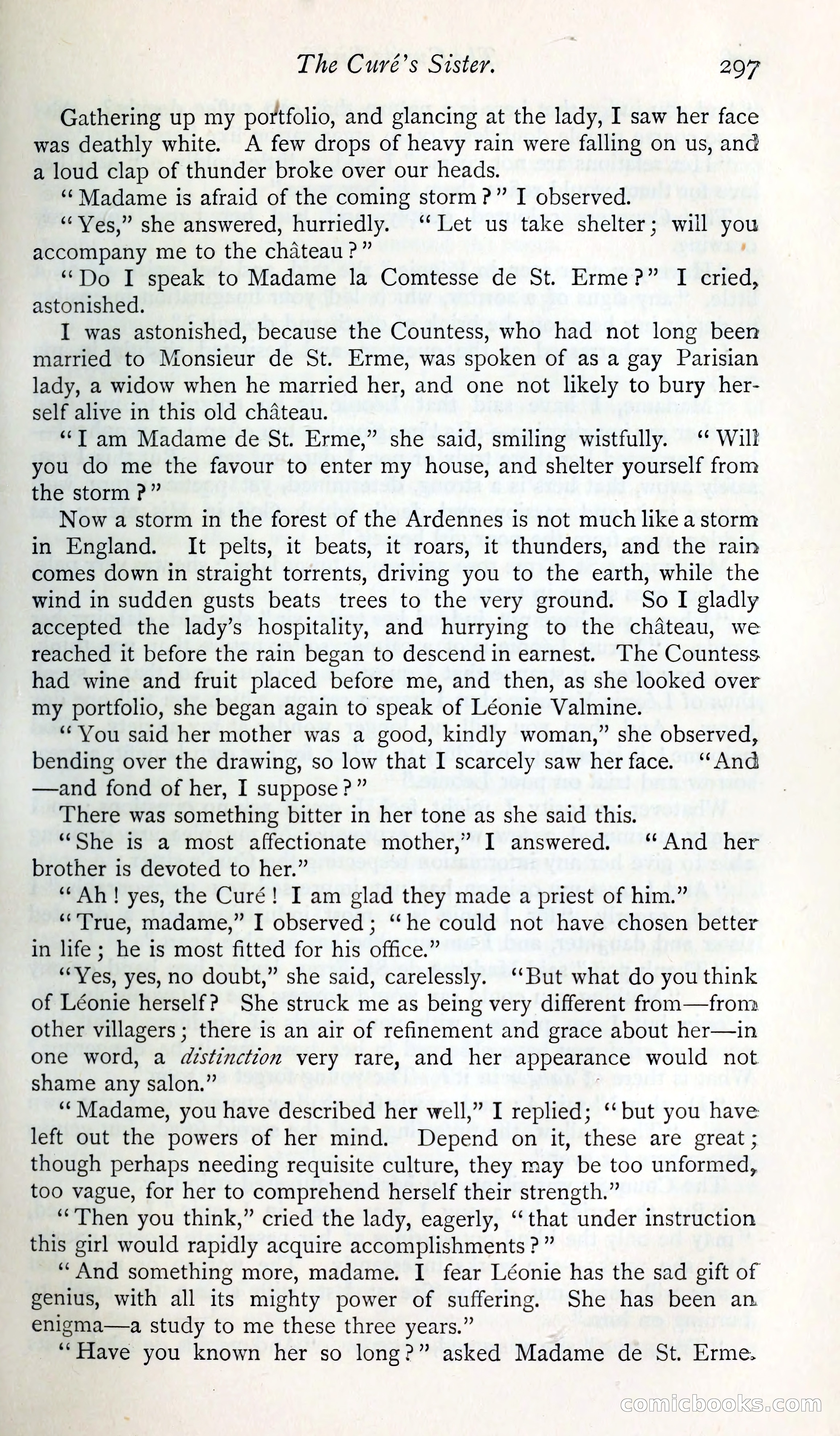
A restored page from Pulp Fiction, 1865. Page through the whole issue in the reader above.
📄 Transcribed text from this page (OCR, searchable)
Machine-transcribed from the original scan — historical spelling and the odd misread are preserved.
The Curé’s Sister. 207 Gathering up my portfolio, and glancing at the lady, I saw her face was deathly white. A few drops of heavy rain were falling on us, and a loud clap of thunder broke over our heads. “Madame is afraid of the coming storm?” I observed. “Ves,” she answered, hurriedly. ‘‘ Let us take shelter; will you accompany me to the chateau ?” “To I speak to Madame la Comtesse de St. Erme?” I cried, astonished. I was astonished, because the Countess, who had not long been married to Monsieur de St. Erme, was spoken of as a gay Parisian lady, a widow when he married her, and one not likely to bury her- self alive in this old chateau. “T am Madame de St. Erme,” she said, smiling wistfully. ‘ Will you do me the favour to enter my house, and shelter yourself from the storm ?” Now a storm in the forest of the Ardennes is not much like a storm in England. It pelts, it beats, it roars, it thunders, and the rain comes down in straight torrents, driving you to the earth, while the wind in sudden gusts beats trees to the very ground. So I gladly accepted the lady’s hospitality, and hurrying to the chateau, we reached it before the rain began to descend in earnest. The Countess. had wine and fruit placed before me, and then, as she looked over my portfolio, she began again to speak of Léonie Valmine. “You said her mother was a good, kindly woman,” she observed, bending over the drawing, so low that I scarcely saw her face. “And —and fond of her, I suppose?” There was something bitter in her tone as she said this. “She is a most affectionate mother,” I answered. “And her brother is devoted to her.” ““Ah! yes, the Curé! I am glad they made a priest of him.” “True, madame,” I observed; “he could not have chosen better in life; he is most fitted for his office.” ““Yes, yes, no doubt,” she said, carelessly. ‘But what do you think of Léonie herself? She struck me as being very different from—from other villagers; there is an air of refinement and grace about her—in one word, a dstinction very rare, and her appearance would not shame any salon.” ; ‘Madame, you have described her well,” I replied; ‘‘ but you have left out the powers of her mind. Depend on it, these are great; though perhaps needing requisite culture, they may be too unformed, too vague, for her to comprehend herself their strength.” ‘Then you think,” cried the lady, eagerly, “that under instruction this girl would rapidly acquire accomplishments ? ” ‘And something more, madame. I fear Léonie has the sad gift of genius, with all its mighty power of suffering. She has been an enigma—a study to me these three years.” ‘Have you known her so long?” asked Madame de St. Erme. ECoOnnicloooks (©) mn