
Pulp Fiction, 1865 · page 319 of 399
The Argosy — page 319: what you’re looking at
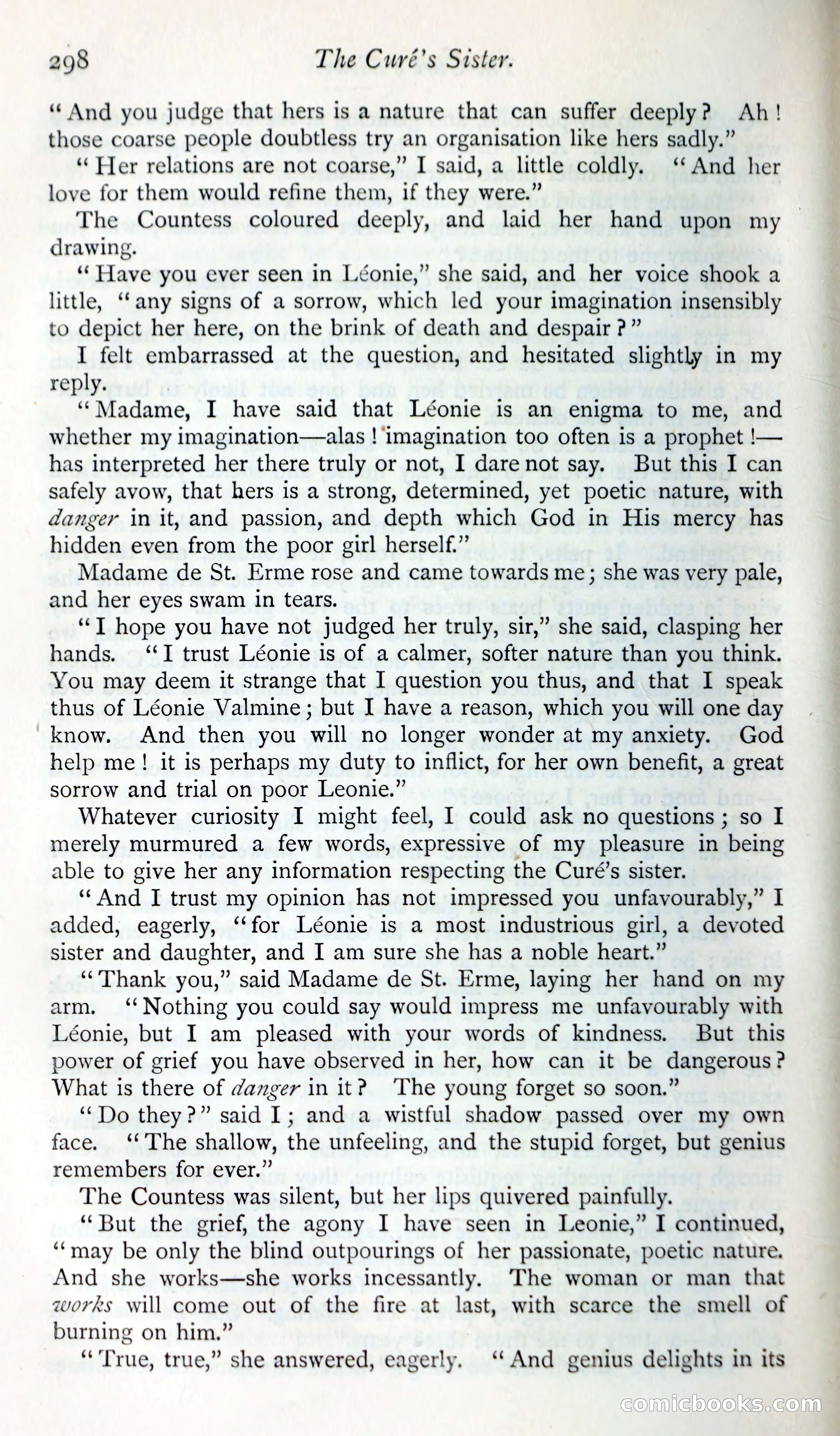
A restored page from Pulp Fiction, 1865. Page through the whole issue in the reader above.
📄 Transcribed text from this page (OCR, searchable)
Machine-transcribed from the original scan — historical spelling and the odd misread are preserved.
298 The Curé’s Sister. ‘And you judge that hers is a nature that can suffer deeply? Ah! those coarse people doubtless try an organisation like hers sadly.” ‘Her relations are not coarse,” I said, a little coldly. ‘And her love for them would refine them, if they were.” The Countess coloured deeply, and laid her hand upon my drawing. ‘‘ Have you ever seen in Léonie,” she said, and her voice shook a little, ‘any signs of a sorrow, which led your imagination insensibly to depict her here, on the brink of death and despair ?” I felt embarrassed at the question, and hesitated slightly in my reply. ‘‘Madame, I have said that Léonie is an enigma to me, and whether my imagination—alas ! imagination too often is a prophet !— has interpreted her there truly or not, I darenot say. But this I can safely avow, that hers is a strong, determined, yet poetic nature, with danger in it, and passion, and depth which God in His mercy has hidden even from the poor girl herself.” Madame de St. Erme rose and came towards me; she was very pale, and her eyes swam In tears. ‘“T hope you have not judged her truly, sir,” she said, clasping her hands. ‘I trust Léonie is of a calmer, softer nature than you think. You may deem it strange that I question you thus, and that I speak thus of Léonie Valmine; but I have a reason, which you will one day know. And then you will no longer wonder at my anxiety. God help me! it is perhaps my duty to inflict, for her own benefit, a great sorrow and trial on poor Leonie.” | Whatever curiosity I might feel, I could ask no questions ; so I merely murmured a few words, expressive of my pleasure in being able to give her any information respecting the Curé’s sister. ‘‘And I trust my opinion has not impressed you unfavourably,” I added, eagerly, ‘‘for Léonie is a most industrious girl, a devoted sister and daughter, and I am sure she has a noble heart.” ‘Thank you,” said Madame de St. Erme, laying her hand on my arm. ‘‘Nothing you could say would impress me unfavourably with Léonie, but I am pleased with your words of kindness. But this power of grief you have observed in her, how can it be dangerous ? What is there of danger in it? ‘The young forget so soon.” “Do they?” said I; and a wistful shadow passed over my own face. ‘The shallow, the unfeeling, and the stupid forget, but genius remembers for ever.” The Countess was silent, but her lips quivered painfully. “But the grief, the agony I have seen in Leonie,” I continued, ‘“‘may be only the blind outpourings of her passionate, poetic nature. And she works—she works incessantly. The woman or man that works will come out of the fire at last, with scarce the smell of burning on him.” “True, true,” she answered, eagerly. ‘And genius delights in its ECOMICLIOO KS, (E00) ita —