
Pulp Fiction, 1865 · page 317 of 399
The Argosy — page 317: what you’re looking at
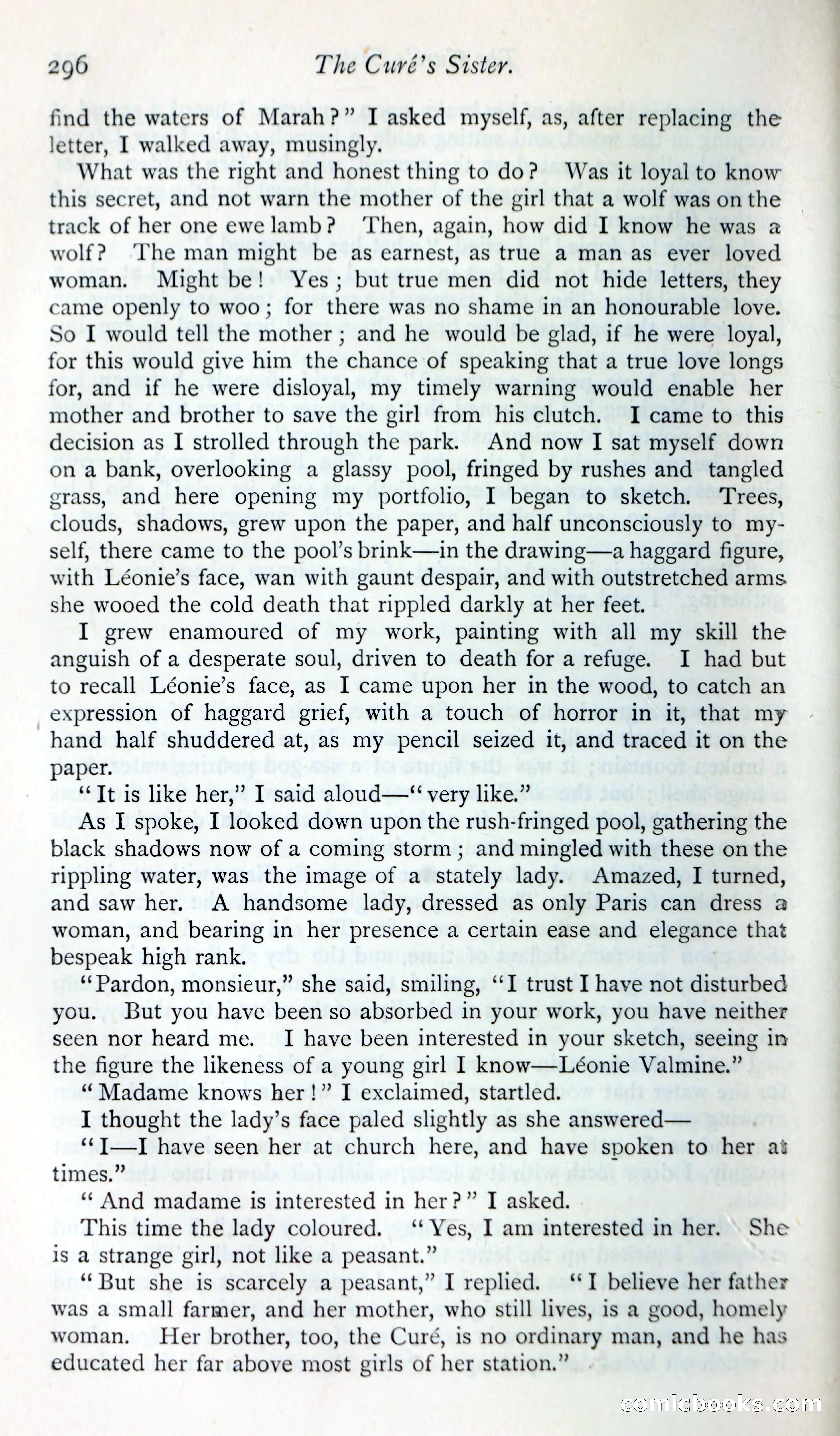
A restored page from Pulp Fiction, 1865. Page through the whole issue in the reader above.
📄 Transcribed text from this page (OCR, searchable)
Machine-transcribed from the original scan — historical spelling and the odd misread are preserved.
296 The Curé’s Sister. find the waters of Marah?” I asked myself, as, after replacing the letter, I walked away, musingly. What was the right and honest thing to do? Was it loyal to know this secret, and not warn the mother of the girl that a wolf was on the track of her one ewelamb? ‘Then, again, how did I know he was a wolf? ‘The man might be as earnest, as true a man as ever loved woman. Might be! Yes; but true men did not hide letters, they came openly to woo; for there was no shame in an honourable love. So I would tell the mother ; and he would be glad, if he were loyal, for this would give him the chance of speaking that a true love longs for, and if he were disloyal, my timely warning would enable her mother and brother to save the girl from his clutch. I came to this decision as I strolled through the park. And now I sat myself down on a bank, overlooking a glassy pool, fringed by rushes and tangled grass, and here opening my portfolio, I began to sketch. ‘Trees, clouds, shadows, grew upon the paper, and half unconsciously to my- self, there came to the pool’s brink—1in the drawing—a haggard figure, with Léonie’s face, wan with gaunt despair, and with outstretched arms she wooed the cold death that rippled darkly at her feet. I grew enamoured of my work, painting with all my skill the anguish of a desperate soul, driven to death for a refuge. I had but to recall Léonie’s face, as I came upon her in the wood, to catch an expression of haggard grief, with a touch of horror in it, that my hand half shuddered at, as my pencil seized it, and traced it on the paper. “Tt is like her,” I said aloud—“ very like.” As I spoke, I looked down upon the rush-fringed pool, cathering the black shadows now of a coming storm ; and mingled with these on the rippling water, was the image of a stately lady. Amazed, I turned, and saw her. A handsome lady, dressed as only Paris can dress a woman, and bearing in her presence a certain ease and elegance that bespeak high rank. ‘Pardon, monsieur,” she said, smiling, “I trust I have not disturbed you. But you have been so absorbed in your work, you have neither seen nor heard me. _ I have been interested in your sketch, seeing in the figure the likeness of a young girl I know—Léonie Valmine.” “Madame knows her!” I exclaimed, startled. I thought the lady’s face paled slightly as she answered— ‘‘]—I have seen her at church here, and have spoken to her at times.” ‘‘ And madame is interested in her?” I asked. This time the lady coloured. ‘‘ Yes, I am interested in her. She is a strange girl, not like a peasant.” “But she is scarcely a peasant,” I replied. ‘‘I believe her father was a small farmer, and her mother, who still lives, is a good, homely woman. Her brother, too, the Curé, is no ordinary man, and he has educated her far above most girls of her station.” ECOPMICMOO;KS, Eo)