
Pulp Fiction, 1865 · page 316 of 399
The Argosy — page 316: what you’re looking at
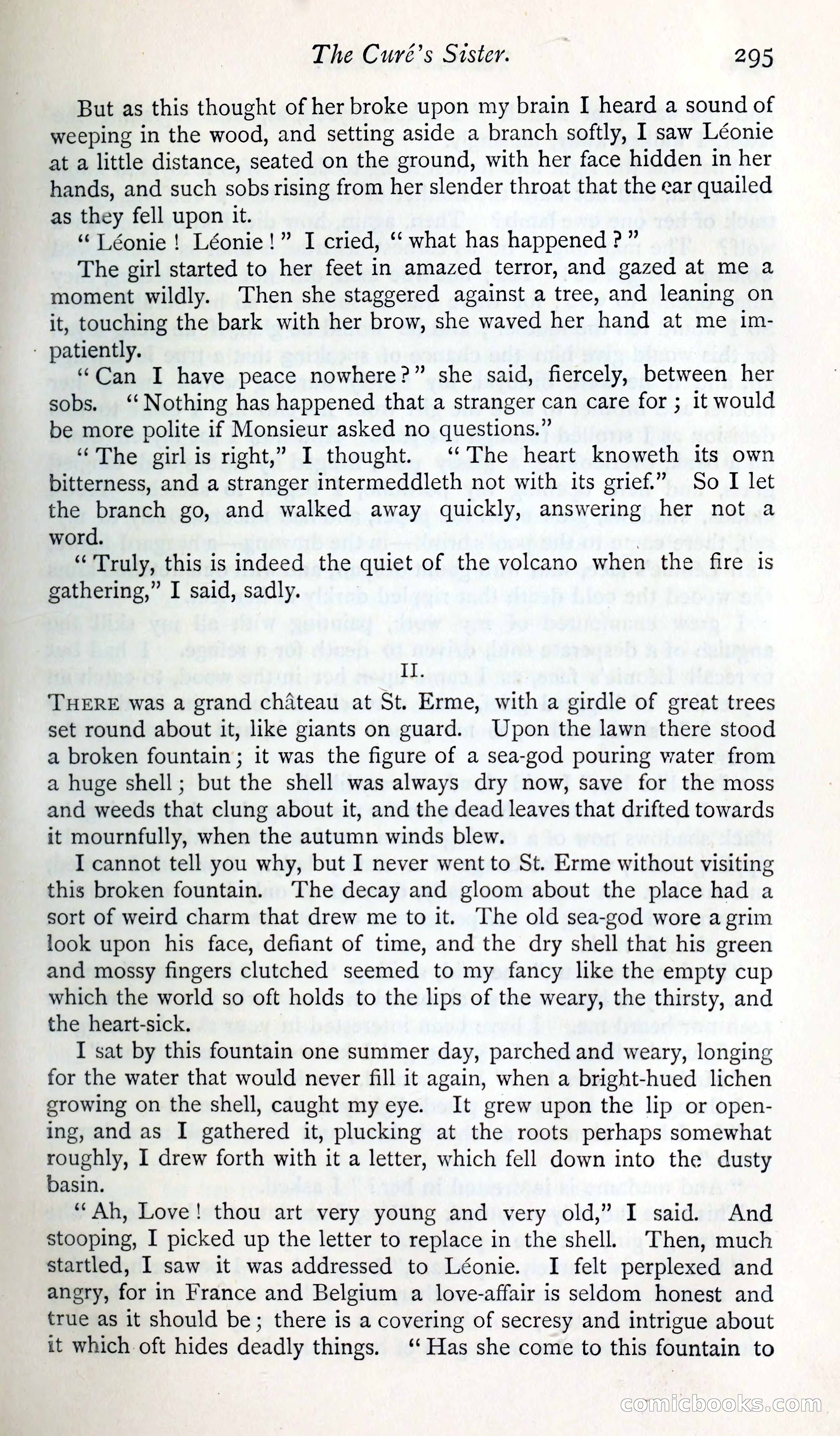
A restored page from Pulp Fiction, 1865. Page through the whole issue in the reader above.
📄 Transcribed text from this page (OCR, searchable)
Machine-transcribed from the original scan — historical spelling and the odd misread are preserved.
The Curé’s Sister. 295 But as this thought of her broke upon my brain I heard a sound of weeping in the wood, and setting aside a branch softly, I saw Léonte at a little distance, seated on the ground, with her face hidden in her hands, and such sobs rising from her slender throat that the ear quailed as they fell upon it. “T éonie! Léonie!” I cried, ‘‘ what has happened ? ” The girl started to her feet in amazed terror, and gazed at me a moment wildly. Then she staggered against a tree, and leaning on it, touching the bark with her brow, she waved her hand at me im- - patiently. “Can I have peace nowhere?” she said, fiercely, between her sobs. ‘‘ Nothing has happened that a stranger can care for ; it would be more polite if Monsieur asked no questions.” “The girl is right,” I thought. ‘The heart knoweth its own bitterness, and a stranger intermeddleth not with its grief.” So I let the branch go, and walked away quickly, answering her not a word. “Truly, this is indeed the quiet of the volcano when the fire is gathering,” I said, sadly. EL, THERE was a grand chateau at St. Erme, with a girdle of great trees set round about it, like giants on guard. Upon the lawn there stood a broken fountain; it was the figure of a sea-god pouring water from a huge shell; but the shell was always dry now, save for the moss and weeds that clung about it, and the dead leaves that drifted towards it mournfully, when the autumn winds blew. I cannot tell you why, but I never went to St. Erme without visiting this broken fountain. ‘The decay and gloom about the place had a sort of weird charm that drew me to it. The old sea-god wore a grim look upon his face, defiant of time, and the dry shell that his green and mossy fingers clutched seemed to my fancy like the empty cup which the world so oft holds to the lips of the weary, the thirsty, and the heart-sick. I sat by this fountain one summer day, parched and weary, longing for the water that would never fill it again, when a bright-hued lichen growing on the shell, caught my eye. It grew upon the lip or open- ing, and as I gathered it, plucking at the roots perhaps somewhat roughly, I drew forth with it a letter, which fell down into the dusty basin. “Ah, Love! thou art very young and very old,” I said. And stooping, I picked up the letter to replace in the shell. Then, much startled, I saw it was addressed to Léonie. I felt perplexed and angry, for in France and Belgium a love-affair is seldom honest and true as it should be; there is a covering of secresy and intrigue about it which oft hides deadly things. ‘Has she come to this fountain to CORNICOOOKS.cO