
Pulp Fiction, 1865 · page 315 of 399
The Argosy — page 315: what you’re looking at
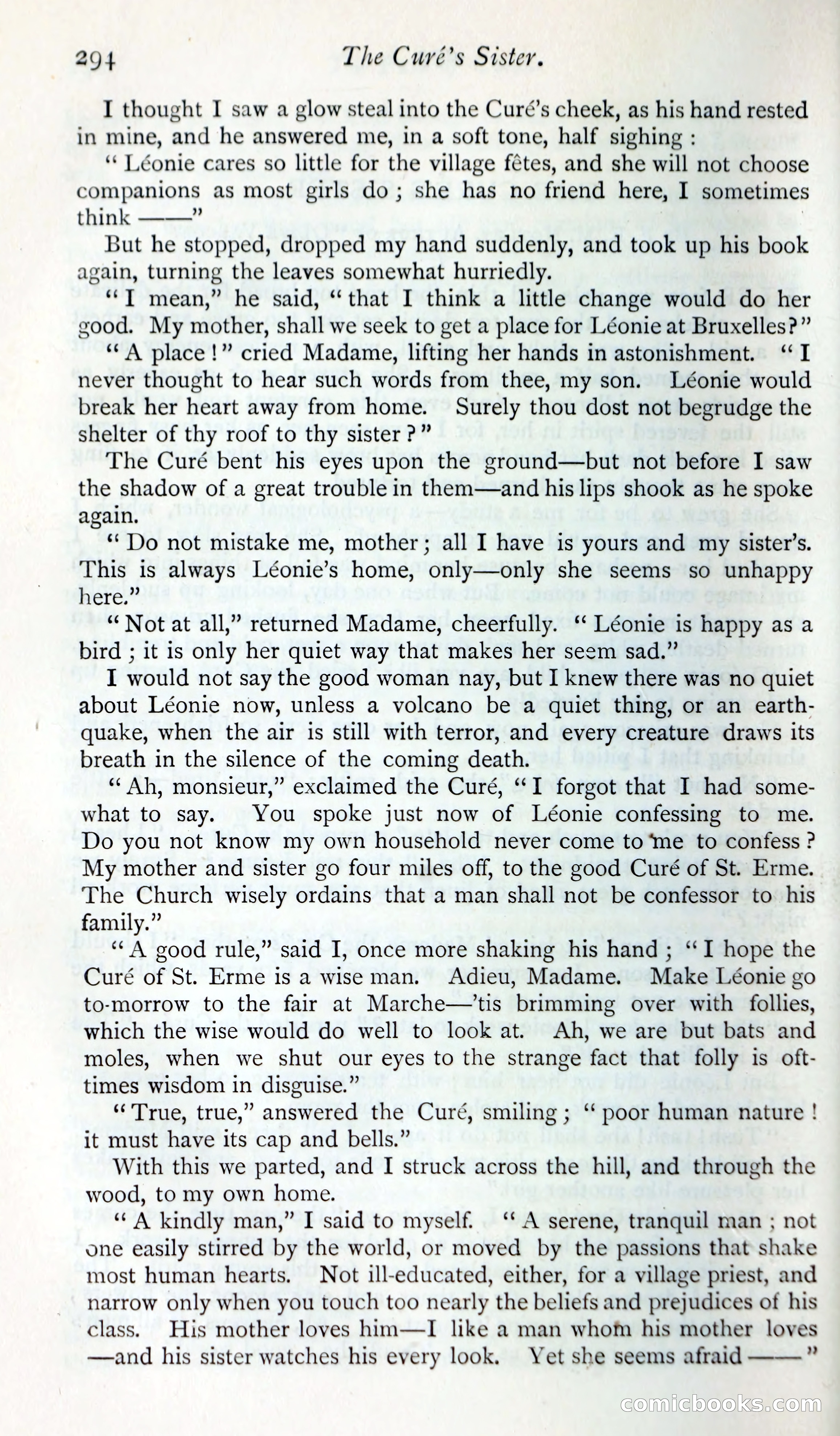
A restored page from Pulp Fiction, 1865. Page through the whole issue in the reader above.
📄 Transcribed text from this page (OCR, searchable)
Machine-transcribed from the original scan — historical spelling and the odd misread are preserved.
294 The Curé’s Sister. I thought I saw a glow steal into the Curé’s cheek, as his hand rested in mine, and he answered me, in a soft tone, half sighing : ‘‘ T.éonie cares so little for the village fétes, and she will not choose companions as most girls do; she has no friend here, I sometimes think ———” But he stopped, dropped my hand suddenly, and took up his book again, turning the leaves somewhat hurriedly. ““T mean,” he said, ‘‘that I think a little change would do her good. My mother, shall we seek to get a place for Léonie at Bruxelles?” ‘A place!” cried Madame, lifting her hands in astonishment. ‘I never thought to hear such words from thee, my son. Léonie would break her heart away from home. Surely thou dost not begrudge the shelter of thy roof to thy sister ?” The Curé bent his eyes upon the ground—but not before I saw the shadow of a great trouble in them—and his lips shook as he spoke again, “To not mistake me, mother; all I have is yours and my sister’s. This is always Léonie’s home, only—only she seems so unhappy here.” | “ Not at all,” returned Madame, cheerfully. ‘‘ Léonie is happy as a bird ; it is only her quiet way that makes her seem sad.” I would not say the good woman nay, but I knew there was no quiet about Léonie now, unless a volcano be a quiet thing, or an earth- quake, when the air is still with terror, and every creature draws its breath in the silence of the coming death. ‘Ah, monsieur,” exclaimed the Curé, “I forgot that I had some- what to say. You spoke just now of Léonie confessing to me. Do you not know my own household never come to‘me to confess ? My mother and sister go four miles off, to the good Curé of St. Erme. The Church wisely ordains that a man shall not be confessor to his family.” ‘A good rule,” said I, once more shaking his hand; ‘‘I hope the Curé of St. Erme is a wise man. Adieu, Madame. Make Léonie go to-morrow to the fair at Marche—’tis brimming over with follies, which the wise would do well to look at. Ah, we are but bats and moles, when we shut our eyes to the strange fact that folly is oft- times wisdom in disguise.” ‘True, true,” answered the Curé, smiling; ‘ poor human nature ! it must have its cap and bells.” With this we parted, and I struck across the hill, and through the wood, to my own home. | ‘¢ A kindly man,” I said to myself. ‘* A serene, tranquil man ; not one easily stirred by the world, or moved by the passions that shake most human hearts. Not ill-educated, either, for a village priest, and narrow only when you touch too nearly the beliefs and prejudices of his class. His mother loves him—I like a man whom his mother loves —and his sister watches his every look. Yet she seems afraid ——” COPMIECMOOOKS Conn