
Pulp Fiction, 1865 · page 305 of 399
The Argosy — page 305: what you’re looking at
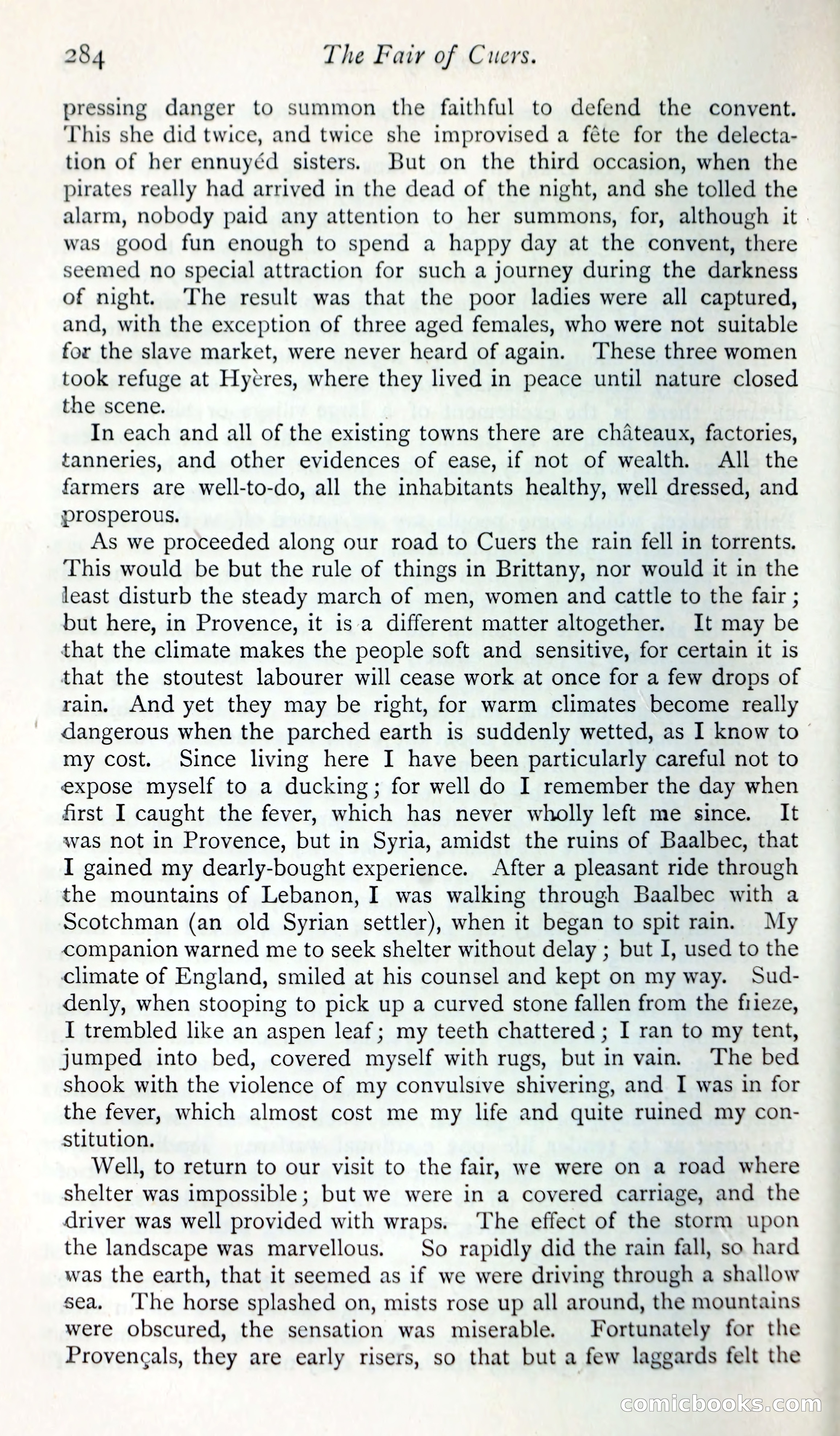
A restored page from Pulp Fiction, 1865. Page through the whole issue in the reader above.
📄 Transcribed text from this page (OCR, searchable)
Machine-transcribed from the original scan — historical spelling and the odd misread are preserved.
284 The Fair of Cuers. pressing danger to summon the faithful to defend the convent. This she did twice, and twice she improvised a féte for the delecta- tion of her ennuyéd sisters. But on the third occasion, when the pirates really had arrived in the dead of the night, and she tolled the alarm, nobody paid any attention to her summons, for, although it. was good fun enough to spend a happy day at the convent, there seemed no special attraction for such a journey during the darkness of night. The result was that the poor ladies were all captured, and, with the exception of three aged females, who were not suitable for the slave market, were never heard of again. ‘These three women took refuge at Hycres, where they lived in peace until nature closed the scene. | In each and all of the existing towns there are chateaux, factories, tanneries, and other evidences of ease, if not of wealth. All the farmers are well-to-do, all the inhabitants healthy, well dressed, and prosperous. As we proceeded along our road to Cuers the rain fell in torrents. This would be but the rule of things in Brittany, nor would it in the least disturb the steady march of men, women and cattle to the fair ; but here, in Provence, it 1s a different matter altogether. It may be that the climate makes the people soft and sensitive, for certain it is that the stoutest labourer will cease work at once for a few drops of rain. And yet they may be right, for warm climates become really dangerous when the parched earth is suddenly wetted, as I know to my cost. Since living here I have been particularly careful not to expose myself to a ducking; for well do I remember the day when first I caught the fever, which has never wholly left me since. It was not in Provence, but in Syria, amidst the ruins of Baalbec, that I gained my dearly-bought experience. After a pleasant ride through the mountains of Lebanon, I was walking through Baalbec with a Scotchman (an old Syrian settler), when it began to spit rain. My companion warned me to seek shelter without delay ; but I, used to the climate of England, smiled at his counsel and kept on my way. Sud- denly, when stooping to pick up a curved stone fallen from the frieze, I trembled like an aspen leaf; my teeth chattered ; I ran to my tent, jumped into bed, covered myself with rugs, but in vain. ‘The bed shook with the violence of my convulsive shivering, and I was in for the fever, which almost cost me my life and quite ruined my con- stitution. Well, to return to our visit to the fair, we were on a road where shelter was impossible; but we were in a covered carriage, and the driver was well provided with wraps. ‘The effect of the storm upon the landscape was marvellous. So rapidly did the rain fall, so hard was the earth, that it seemed as if we were driving through a shallow sea. The horse splashed on, mists rose up all around, the mountains were obscured, the sensation was miserable. Fortunately for the Provencals, they are early risers, so that but a few laggards felt the ECOPMICLIOO KS, EO)