
Pulp Fiction, 1865 · page 304 of 399
The Argosy — page 304: what you’re looking at
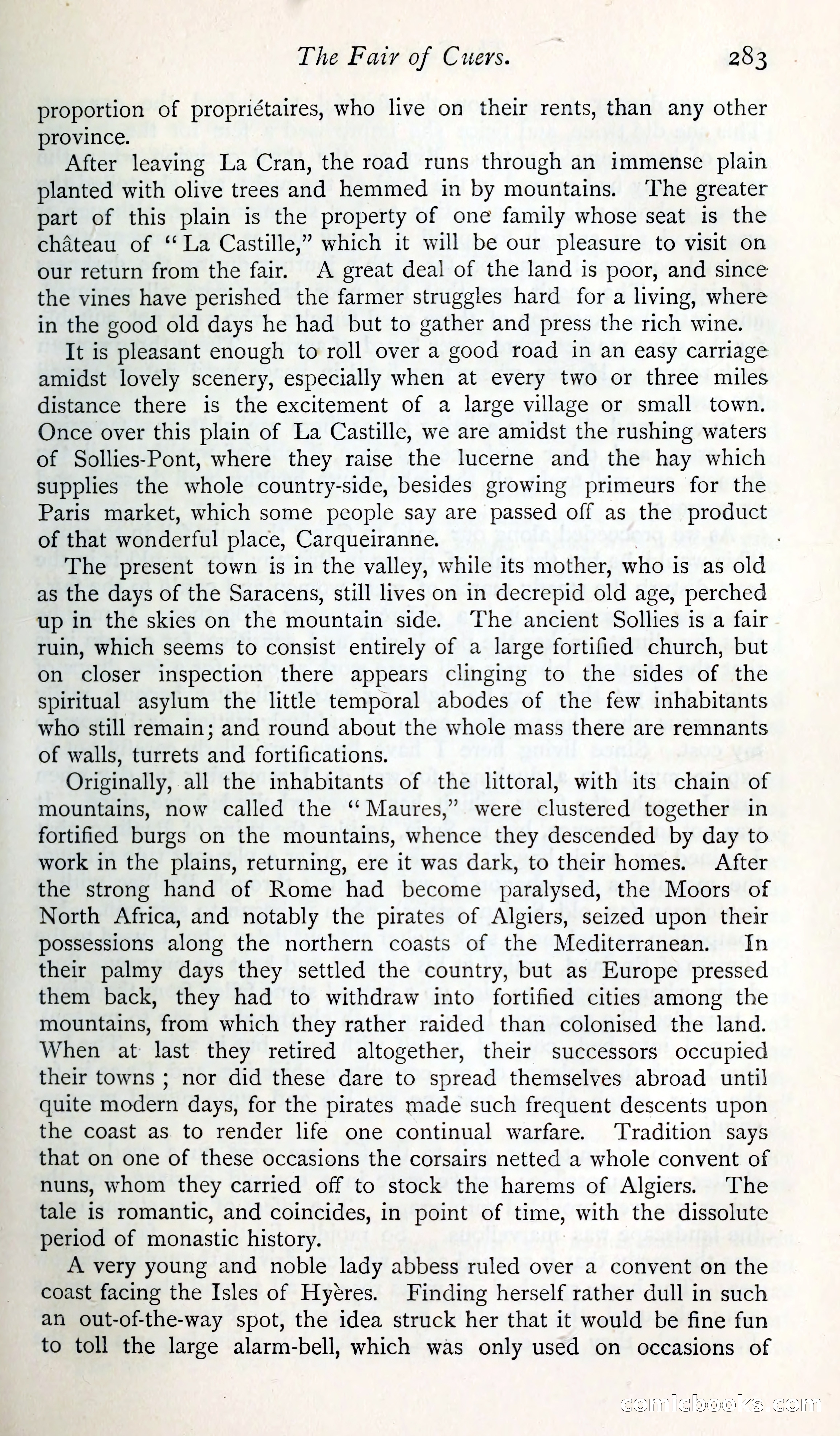
A restored page from Pulp Fiction, 1865. Page through the whole issue in the reader above.
📄 Transcribed text from this page (OCR, searchable)
Machine-transcribed from the original scan — historical spelling and the odd misread are preserved.
The Fair of Cuers. | 283 proportion of propriétaires, who live on their rents, than any other province. After leaving La Cran, the road runs through an immense plain planted with olive trees and hemmed in by mountains. ‘The greater part of this plain is the property of one family whose seat is the chateau of “La Castille,” which it will be our pleasure to visit on our return from the fair. A great deal of the land is poor, and since the vines have perished the farmer struggles hard for a living, where in the good old days he had but to gather and press the rich wine. It is pleasant enough to roll over a good road in an easy carriage amidst lovely scenery, especially when at every two or three miles distance there is the excitement of a large village or small town. Once over this plain of La Castille, we are amidst the rushing waters of Sollies-Pont, where they raise the lucerne and the hay which supplies the whole country-side, besides growing primeurs for the Paris market, which some people say are passed off as the product of that wonderful place, Carqueiranne. The present town is in the valley, while its mother, who is as old as the days of the Saracens, still lives on in decrepid old age, perched up in the skies on the mountain side. The ancient Sollies is a fair ruin, which seems to consist entirely of a large fortified church, but on closer inspection there appears clinging to the sides of the spiritual asylum the little temporal abodes of the few inhabitants who still remain; and round about the whole mass there are remnants of walls, turrets and fortifications. Originally, all the inhabitants of the littoral, with its chain of mountains, now called the ‘‘ Maures,” were clustered together in fortified burgs on the mountains, whence they descended by day to work in the plains, returning, ere it was dark, to their homes. After the strong hand of Rome had become paralysed, the Moors of North Africa, and notably the pirates of Algiers, seized upon their possessions along the northern coasts of the Mediterranean. In their palmy days they settled the country, but as Europe pressed them back, they had to withdraw into fortified cities among the mountains, from which they rather raided than colonised the land. When at last they retired altogether, their successors occupied their towns ; nor did these dare to spread themselves abroad until quite modern days, for the pirates made such frequent descents upon the coast as to render life one continual warfare. ‘Tradition says that on one of these occasions the corsairs netted a whole convent of nuns, whom they carried off to stock the harems of Algiers. The tale is romantic, and coincides, in point of time, with the dissolute period of monastic history. A very young and noble lady abbess ruled over a convent on the coast facing the Isles of Hyéres. Finding herself rather dull in such an out-of-the-way spot, the idea struck her that it would be fine fun to toll the large alarm-bell, which was only used on occasions of ECOnnicloooks (GO