
Pulp Fiction, 1865 · page 306 of 399
The Argosy — page 306: what you’re looking at
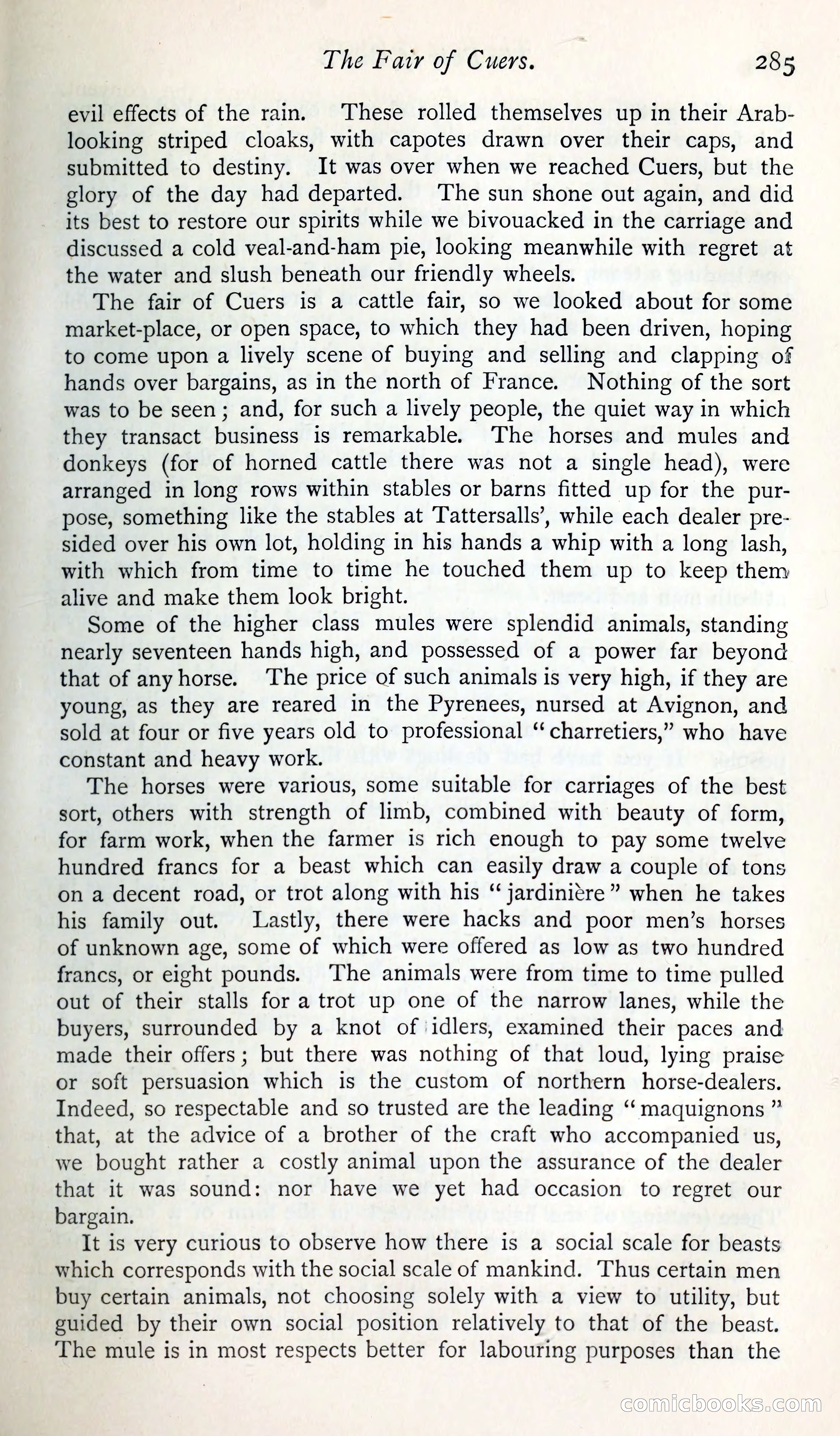
A restored page from Pulp Fiction, 1865. Page through the whole issue in the reader above.
📄 Transcribed text from this page (OCR, searchable)
Machine-transcribed from the original scan — historical spelling and the odd misread are preserved.
The Fair of Cuers. 285 evil effects of the rain. These rolled themselves up in their Arab- looking striped cloaks, with capotes drawn over their caps, and submitted to destiny. It was over when we reached Cuers, but the glory of the day had departed. The sun shone out again, and did its best to restore our spirits while we bivouacked in the carriage and discussed a cold veal-and-ham pie, looking meanwhile with regret at the water and slush beneath our friendly wheels. The fair of Cuers is a cattle fair, so we looked about for some market-place, or open space, to which they had been driven, hoping to come upon a lively scene of buying and selling and clapping of hands over bargains, as in the north of France. Nothing of the sort was to be seen; and, for such a lively people, the quiet way in which they transact business is remarkable. The horses and mules and donkeys (for of horned cattle there was not a single head), were arranged in long rows within stables or barns fitted up for the pur- pose, something like the stables at Tattersalls’, while each dealer pre- sided over his own lot, holding in his hands a whip with a long lash, with which from time to time he touched them up to keep them alive and make them look bright. Some of the higher class mules were splendid animals, standing nearly seventeen hands high, and possessed of a power far beyond that of anyhorse. ‘The price of such animals is very high, if they are young, as they are reared in the Pyrenees, nursed at Avignon, and sold at four or five years old to professional ‘“ charretiers,” who have constant and heavy work. The horses were various, some suitable for carriages of the best sort, others with strength of limb, combined with beauty of form, for farm work, when the farmer is rich enough to pay some twelve hundred francs for a beast which can easily draw a couple of tons on a decent road, or trot along with his “‘ jardiniére” when he takes his family out. Lastly, there were hacks and poor men’s horses of unknown age, some of which were offered as low as two hundred francs, or eight pounds. ‘The animals were from time to time pulled out of their stalls for a trot up one of the narrow lanes, while the buyers, surrounded by a knot of ‘idlers, examined their paces and made their offers; but there was nothing of that loud, lying praise or soft persuasion which is the custom of northern horse-dealers. Indeed, so respectable and so trusted are the leading “ maquignons ” that, at the advice of a brother of the craft who accompanied us, we bought rather a costly animal upon the assurance of the dealer that it was sound: nor have we yet had occasion to regret our bargain. It is very curious to observe how there is a social scale for beasts which corresponds with the social scale of mankind. Thus certain men buy certain animals, not choosing solely with a view to utility, but guided by their own social position relatively to that of the beast. The mule is in most respects better for labouring purposes than the COMMICDAOOKS.€O