
Pulp Fiction, 1865 · page 303 of 399
The Argosy — page 303: what you’re looking at
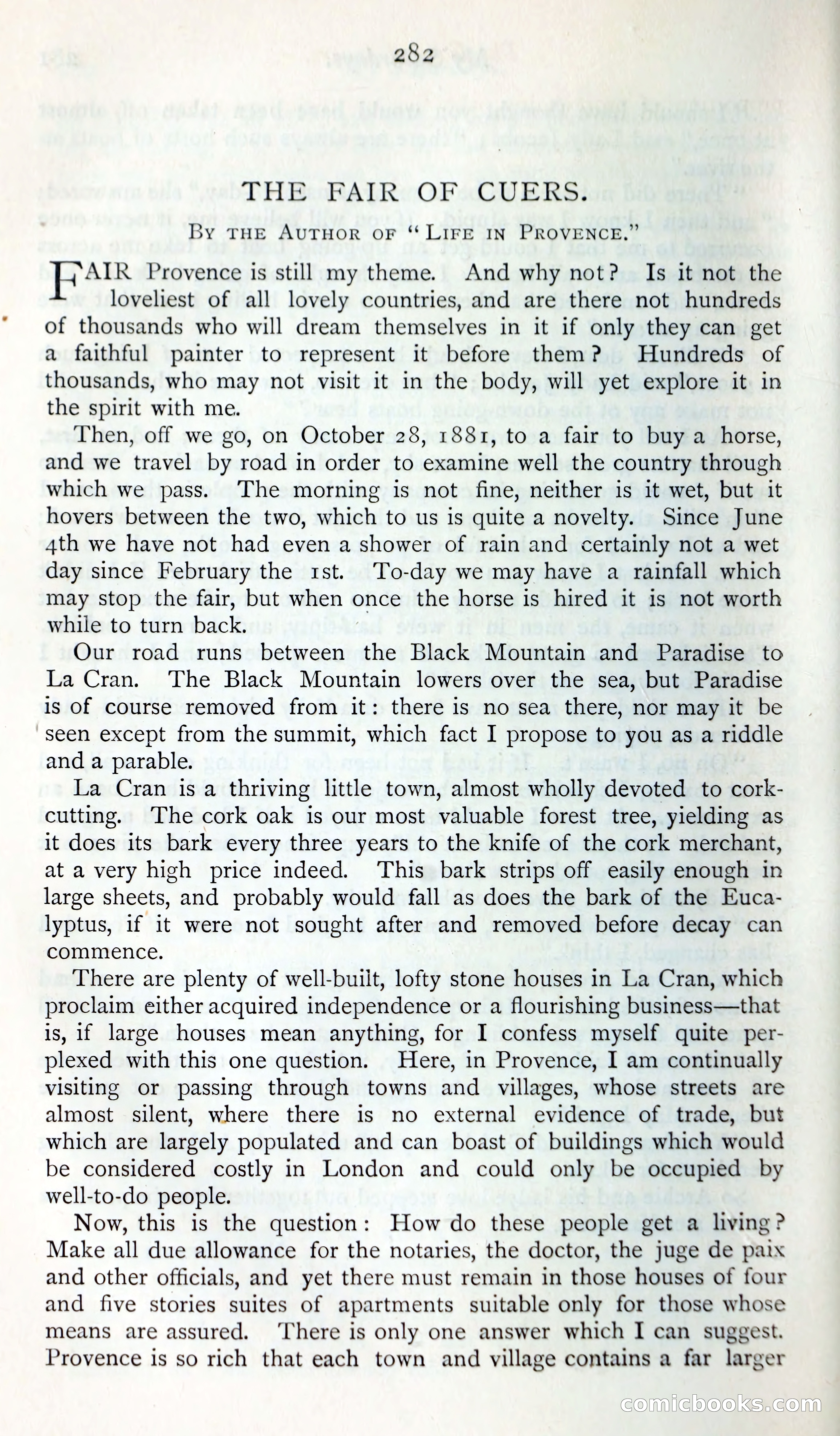
A restored page from Pulp Fiction, 1865. Page through the whole issue in the reader above.
📄 Transcribed text from this page (OCR, searchable)
Machine-transcribed from the original scan — historical spelling and the odd misread are preserved.
282 THE FAIR: OF .CUERSS: By THE AUTHOR OF ‘* LIFE IN PROVENCE,” AIR Provence is still my theme. And why not? Is it not the loveliest of all lovely countries, and are there not hundreds of thousands who will dream themselves in it if only they can get a faithful painter to represent it before them? Hundreds of thousands, who may not visit it in the body, will yet explore it in the spirit with me. Then, off we go, on October 28, 1881, to a fair to buy a horse, and we travel by road in order to examine well the country through which we pass. The morning is not fine, neither is it wet, but it hovers between the two, which to us is quite a novelty. Since June 4th we have not had even a shower of rain and certainly not a wet day since February the 1st. ‘To-day we may have a rainfall which may stop the fair, but when once the horse is hired it is not worth while to turn back. Our road runs between the Black Mountain and Paradise to La Cran. The Black Mountain lowers over the sea, but Paradise is of course removed from it: there is no sea there, nor may it be seen except from the summit, which fact I propose to you as a riddle and a parable. La Cran is a thriving little town, almost wholly devoted to cork- cutting. The cork oak is our most valuable forest tree, yielding as it does its bark every three years to the knife of the cork merchant, at a very high price indeed. This bark strips off easily enough in large sheets, and probably would fall as does the bark of the Euca- lyptus, if it were not sought after and removed before decay can commence. There are plenty of well-built, lofty stone houses in La Cran, which proclaim either acquired independence or a flourishing business—that is, if large houses mean anything, for I confess myself quite per- plexed with this one question. Here, in Provence, I am continually visiting or passing through towns and villages, whose streets are almost silent, where there is no external evidence of trade, but which are largely populated and can boast of buildings which would be considered costly in London and could only be occupied by well-to-do people. Now, this is the question: How do these people get a living? Make all due allowance for the notaries, the doctor, the juge de paix and other officials, and yet there must remain in those houses of four and five stories suites of apartments suitable only for those whose means are assured. ‘There is only one answer which I can suggest. Provence is so rich that each town and village contains a far larger ECOPMICLIOO| KS, (EO)