
Pulp Fiction, 1865 · page 327 of 400
The Argosy — page 327: what you’re looking at
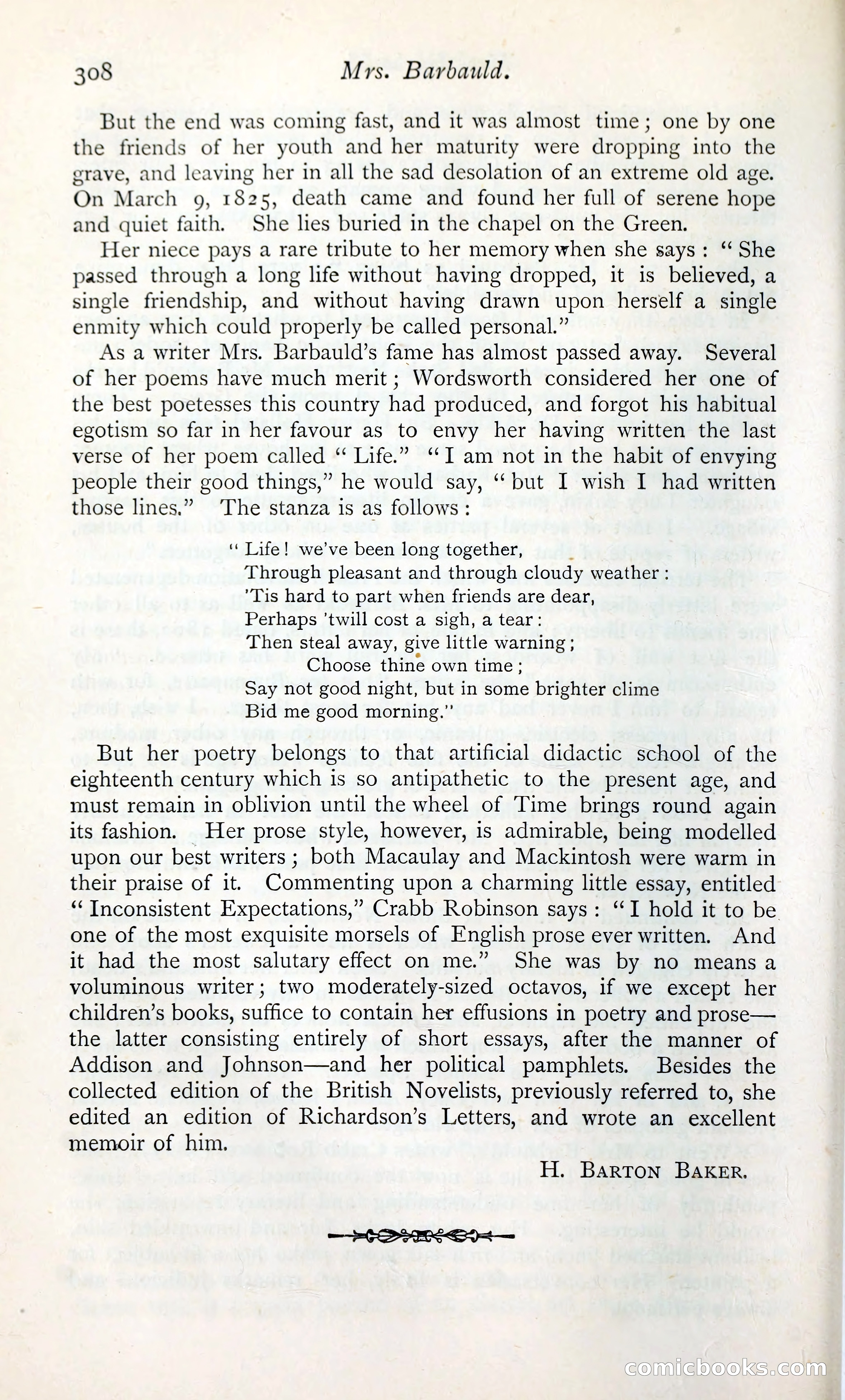
A restored page from Pulp Fiction, 1865. Page through the whole issue in the reader above.
📄 Transcribed text from this page (OCR, searchable)
Machine-transcribed from the original scan — historical spelling and the odd misread are preserved.
308 Mrs. Barbauld. But the end was coming fast, and it was almost time; one by one the friends of her youth and her maturity were dropping into the grave, and leaving her in all the sad desolation of an extreme old age. On March 9g, 1825, death came and found her full of serene hope and quiet faith. She hes buried in the chapel on the Green. Her niece pays a rare tribute to her memory when she says: ‘She passed through a long life without having dropped, it is believed, a single friendship, and without having drawn upon herself a single enmity which could properly be called personal.” As a writer Mrs. Barbauld’s fame has almost passed away. Several of her poems have much merit ; Wordsworth considered her one of the best poetesses this country had produced, and forgot his habitual egotism so far in her favour as to envy her having written the last verse of her poem called “ Life.” ‘I am not in the habit of envying people their good things,” he would say, “ but I wish I had written those lines.” ‘The stanza is as follows : ‘“ Life! we’ve been long together, Through pleasant and through cloudy weather : Tis hard to part when friends are dear, Perhaps ‘twill cost a sigh, a tear: Then steal away, give little warning ; Choose thine own time : Say not good night, but in some brighter clime Bid me good morning.” But her poetry belongs to that artificial didactic school of the eighteenth century which is so antipathetic to the present age, and must remain in oblivion until the wheel of Time brings round again its fashion. Her prose style, however, is admirable, being modelled upon our best writers ; both Macaulay and Mackintosh were warm in their praise of it. Commenting upon a charming little essay, entitled ‘“‘ Inconsistent Expectations,” Crabb Robinson says: ‘I hold it to be one of the most exquisite morsels of English prose ever written. And it had the most salutary effect on me.” She was by no means a voluminous writer; two moderately-sized octavos, if we except her children’s books, suffice to contain her effusions in poetry and prose— the latter consisting entirely of short essays, after the manner of Addison and Johnson—and her political pamphlets. Besides the collected edition of the British Novelists, previously referred to, she edited an edition of Richardson’s Letters, and wrote an excellent memoir of him. H. BARTON BAKER. Gomicbooks (C(O) m