
Pulp Fiction, 1865 · page 326 of 400
The Argosy — page 326: what you’re looking at
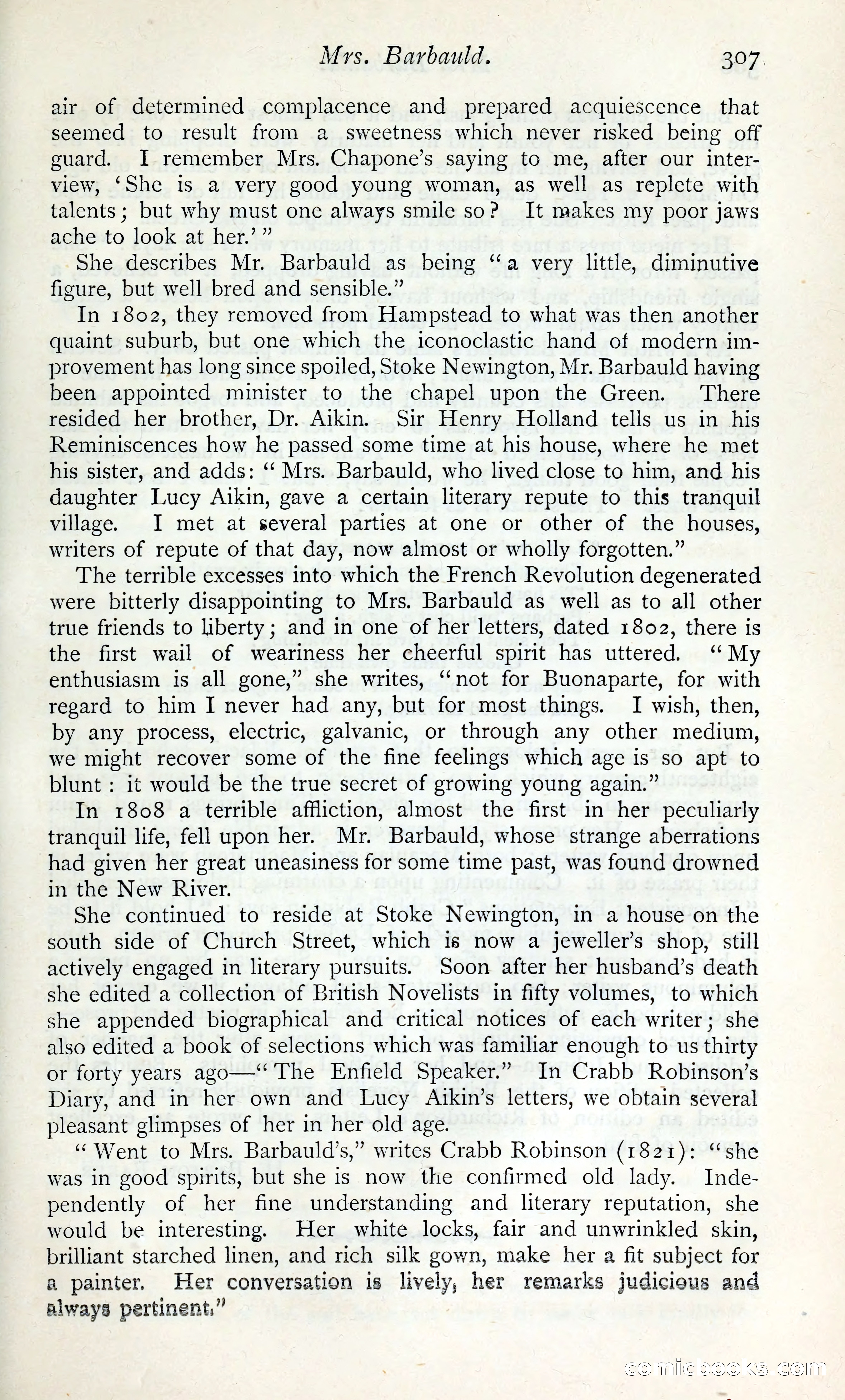
A restored page from Pulp Fiction, 1865. Page through the whole issue in the reader above.
📄 Transcribed text from this page (OCR, searchable)
Machine-transcribed from the original scan — historical spelling and the odd misread are preserved.
Mrs. Barbauld., 307 air of determined complacence and prepared acquiescence that seemed to result from a sweetness which never risked being off guard. I remember Mrs. Chapone’s saying to me, after our inter- view, ‘She is a very good young woman, as well as replete with talents; but why must one always smile so? It makes my poor jaws ache to look at her.’ ” She describes Mr. Barbauld as being ‘a very little, diminutive figure, but well bred and sensible.” In 1802, they removed from Hampstead to what was then another quaint suburb, but one which the iconoclastic hand of modern im- provement has long since spoiled, Stoke Newington, Mr. Barbauld having been appointed minister to the chapel upon the Green. ‘There resided her brother, Dr. Aikin. Sir Henry Holland tells us in his Reminiscences how he passed some time at his house, where he met his sister, and adds: ‘‘ Mrs. Barbauld, who lived close to him, and his daughter Lucy Aikin, gave a certain literary repute to this tranquil village. I met at several parties at one or other of the houses, writers of repute of that day, now almost or wholly forgotten.” The terrible excesses into which the French Revolution degenerated were bitterly disappointing to Mrs. Barbauld as well as to all other true friends to liberty ; and in one of her letters, dated 1802, there is the first wail of weariness her cheerful spirit has uttered. ‘ My enthusiasm is all gone,” she writes, ‘‘not for Buonaparte, for with regard to him J never had any, but for most things. I wish, then, by any process, electric, galvanic, or through any other medium, we might recover some of the fine feelings which age is so apt to blunt : it would be the true secret of growing young again.” In 1808 a terrible affliction, almost the first in her peculiarly tranquil life, fell upon her. Mr. Barbauld, whose strange aberrations had given her great uneasiness for some time past, was found drowned in the New River. She continued to reside at Stoke Newington, in a house on the south side of Church Street, which is now a jeweller’s shop, still actively engaged in literary pursuits. Soon after her husband’s death she edited a collection of British Novelists in fifty volumes, to which she appended biographical and critical notices of each writer; she also edited a book of selections which was familiar enough to us thirty or forty years ago—‘' The Enfield Speaker.” In Crabb Robinson’s Diary, and in her own and Lucy Aikin’s letters, we obtain several pleasant glimpses of her in her old age. “Went to Mrs. Barbauld’s,” writes Crabb Robinson (1821): ‘she was in good spirits, but she is now the confirmed old lady. Inde- pendently of her fine understanding and literary reputation, she would be interesting. Her white locks, fair and unwrinkled skin, brilliant starched linen, and rich silk gown, make her a fit subject for a painter. Her conversation is lively, her remarks judicious and always pertinent,” Conniclooolks (C(O) -