
Pulp Fiction, 1865 · page 324 of 400
The Argosy — page 324: what you’re looking at
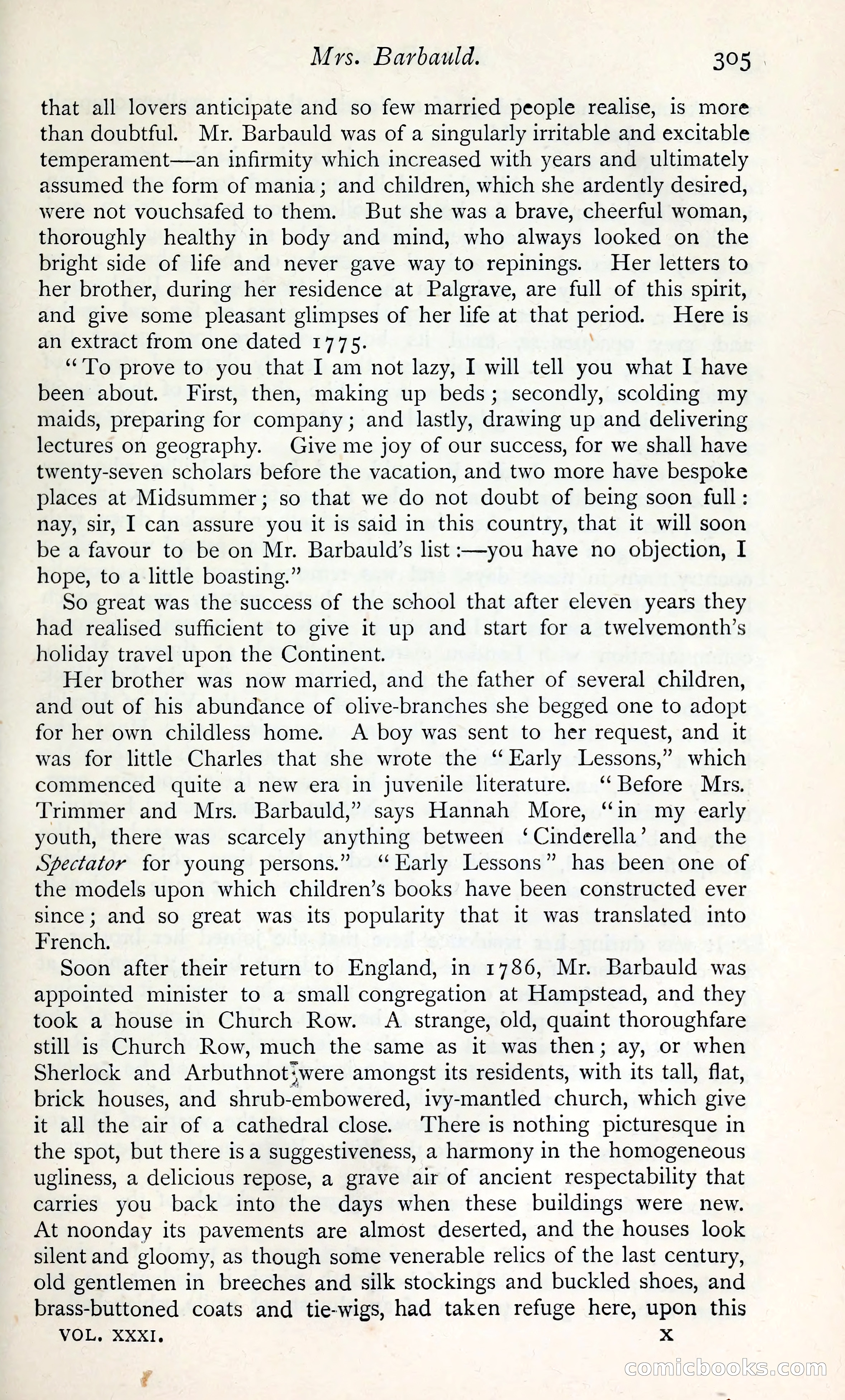
A restored page from Pulp Fiction, 1865. Page through the whole issue in the reader above.
📄 Transcribed text from this page (OCR, searchable)
Machine-transcribed from the original scan — historical spelling and the odd misread are preserved.
Mrs. Barbauld. 305 | that all lovers anticipate and so few married people realise, is more than doubtful. Mr. Barbauld was of a singularly irritable and excitable temperament—an infirmity which increased with years and ultimately assumed the form of mania; and children, which she ardently desired, were not vouchsafed to them. But she was a brave, cheerful woman, thoroughly healthy in body and mind, who always looked on the bright side of life and never gave way to repinings. Her letters to her brother, during her residence at Palgrave, are full of this spirit, and give some pleasant glimpses of her life at that period. Here 1s an extract from one dated 1775. “To prove to you that I am not lazy, I will tell you what I have been about. First, then, making up beds; secondly, scolding my maids, preparing for company; and lastly, drawing up and delivering lectures on geography. Give me joy of our success, for we shall have twenty-seven scholars before the vacation, and two more have bespoke places at Midsummer; so that we do not doubt of being soon full: nay, sir, I can assure you it is said in this country, that it will soon be a favour to be on Mr. Barbauld’s list :—you have no objection, I hope, to a little boasting.” So great was the success of the school that after eleven years they had realised sufficient to give it up and start for a twelvemonth’s holiday travel upon the Continent. Her brother was now married, and the father of several children, and out of his abundance of olive-branches she begged one to adopt for her own childless home. A boy was sent to her request, and it was for little Charles that she wrote the “Early Lessons,” which commenced quite a new era in juvenile literature. ‘Before Mrs. Trimmer and Mrs. Barbauld,” says Hannah More, ‘in my early youth, there was scarcely anything between ‘Cinderella’ and the Spectator for young persons.” ‘Early Lessons” has been one of the models upon which children’s books have been constructed ever since; and so great was its popularity that it was translated into French. Soon after their return to England, in 1786, Mr. Barbauld was appointed minister to a small congregation at Hampstead, and they took a house in Church Row. A strange, old, quaint thoroughfare still is Church Row, much the same as it was then; ay, or when Sherlock and Arbuthnot’ ,were amongst its residents, with its tall, flat, brick houses, and shrub- embowered, ivy-mantled church, which give it all the air of a cathedral close. There is nothing picturesque in the spot, but there isa suggestiveness, a harmony in the homogeneous ugliness, a delicious repose, a grave air of ancient respectability that carries you back into the days when these buildings were new. At noonday its pavements are almost deserted, and the houses look silent and gloomy, as though some venerable relics of the last century, old gentlemen in breeches and silk stockings and buckled shoes, and brass-buttoned coats and tie-wigs, had taken refuge here, upon this VOL. XXXI. x COMICOOO SS (C(O) :