
Pulp Fiction, 1865 · page 323 of 400
The Argosy — page 323: what you’re looking at
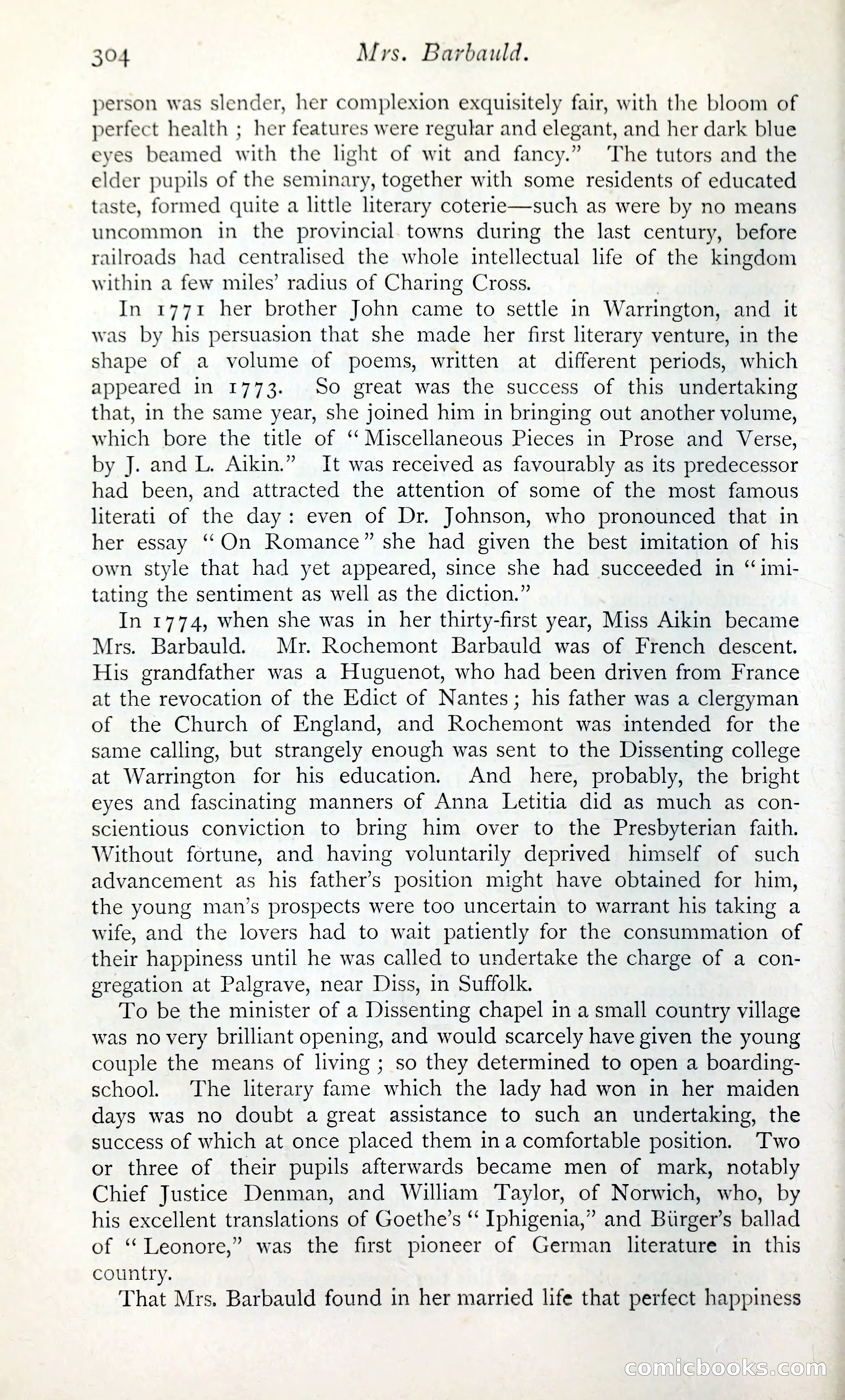
A restored page from Pulp Fiction, 1865. Page through the whole issue in the reader above.
📄 Transcribed text from this page (OCR, searchable)
Machine-transcribed from the original scan — historical spelling and the odd misread are preserved.
304 Mrs. Barbauld. person was slender, her complexion exquisitely fair, with the bloom of perfect health ; her features were regular and elegant, and her dark blue eyes beamed with the light of wit and fancy.” The tutors and the elder pupils of the seminary, together with some residents of educated taste, formed quite a little literary coterile—such as were by no means uncommon in the provincial. towns during the last century, before railroads had centralised the whole intellectual life of the kingdom within a few miles’ radius of Charing Cross. | In 1771 her brother John came to settle in Warrington, and it was by his persuasion that she made her first literary venture, in the shape of a volume of poems, written at different periods, which appeared in 1773. So great was the success of this undertaking that, in the same year, she joined him in bringing out another volume, which bore the title of ‘‘ Miscellaneous Pieces in Prose and Verse, by J. and L. Aikin.” It was received as favourably as its predecessor had been, and attracted the attention of some of the most famous literati of the day: even of Dr. Johnson, who pronounced that in her essay “On Romance” she had given the best imitation of his own style that had yet appeared, since she had succeeded in “imi- tating the sentiment as well as the diction.” In 1774, when she was in her thirty-first year, Miss Aikin became Mrs. Barbauld. Mr. Rochemont Barbauld was of French descent. His grandfather was a Huguenot, who had been driven from France at the revocation of the Edict of Nantes; his father was a clergyman of the Church of England, and Rochemont was intended for the same calling, but strangely enough was sent to the Dissenting college at Warrington for his education. And here, probably, the bright eyes and fascinating manners of Anna Letitia did as much as con- scientious conviction to bring him over to the Presbyterian faith. Without fortune, and having voluntarily deprived himself of such advancement as his father’s position might have obtained for him, the young man’s prospects were too uncertain to warrant his taking a wife, and the lovers had to wait patiently for the consummation of their happiness until he was called to undertake the charge of a con- gregation at Palgrave, near Diss, in Suffolk. To be the minister of a Dissenting chapel in a small country village was no very brilliant opening, and would scarcely have given the young couple the means of living ; so they determined to open a boarding- school. The literary fame which the lady had won in her maiden days was no doubt a great assistance to such an undertaking, the success of which at once placed them ina comfortable position. Two or three of their pupils afterwards became men of mark, notably Chief Justice Denman, and William Taylor, of Norwich, who, by his excellent translations of Goethe’s ‘‘ Iphigenia,” and Biirger’s ballad of ‘“Leonore,” was the first pioneer of German literature in this country. That Mrs. Barbauld found in her married life that perfect happiness EORMIELIOOKS EO)