
Pulp Fiction, 1865 · page 322 of 400
The Argosy — page 322: what you’re looking at
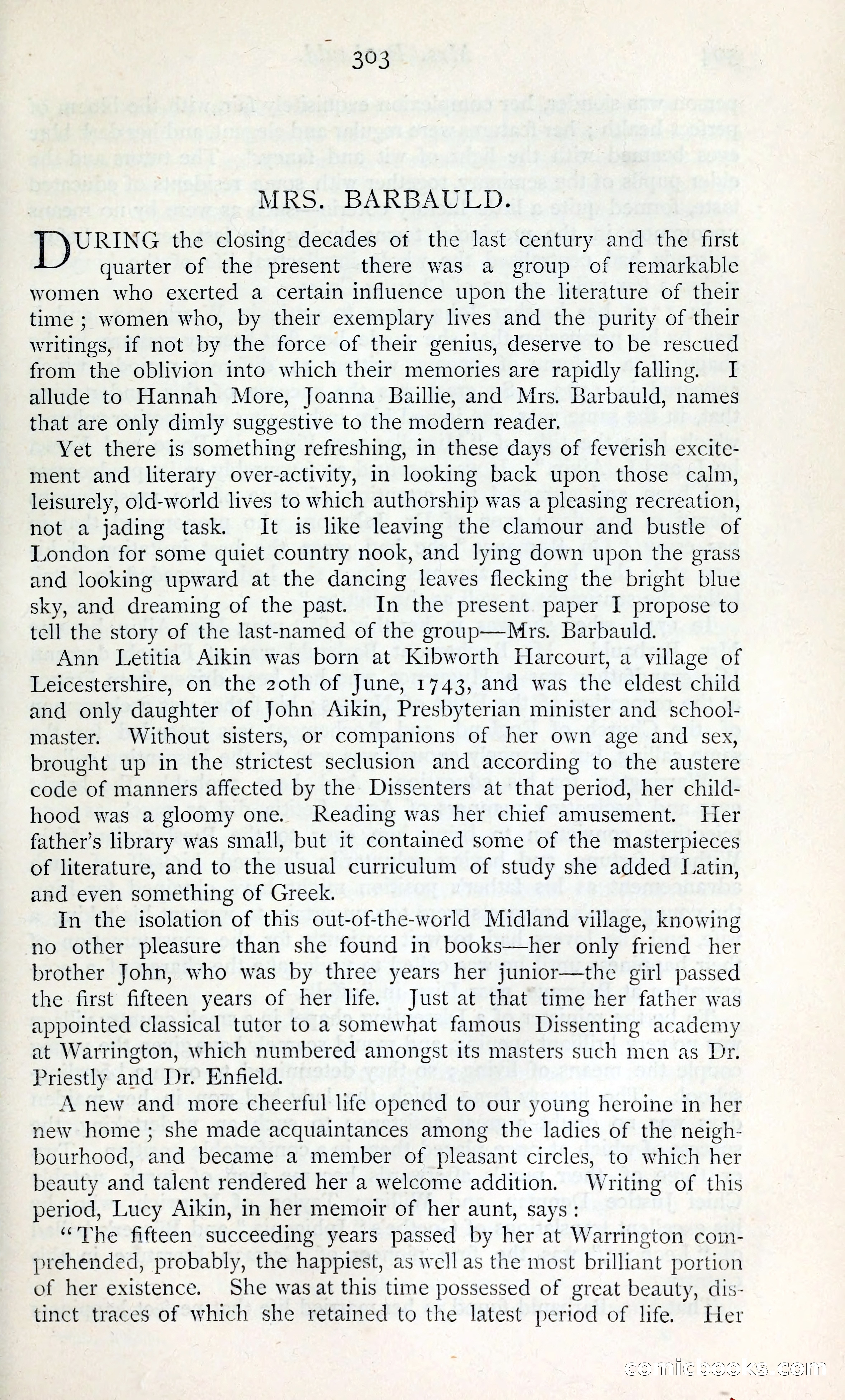
A restored page from Pulp Fiction, 1865. Page through the whole issue in the reader above.
📄 Transcribed text from this page (OCR, searchable)
Machine-transcribed from the original scan — historical spelling and the odd misread are preserved.
as MRS. BARBAULD. se dearaaits the closing decades of the last century and the first quarter of the present there was a group of remarkable women who exerted a certain influence upon the literature of their time ; women who, by their exemplary lives and the purity of their writings, if not by the force of their genius, deserve to be rescued from the oblivion into which their memories are rapidly falling. I allude to Hannah More, Joanna Baillie, and Mrs. Barbauld, names that are only dimly suggestive to the modern reader. Yet there is something refreshing, in these days of feverish excite- ment and literary over-activity, in looking back upon those calm, leisurely, old-world lives to which authorship was a pleasing recreation, not a jading task. It is lke leaving the clamour and bustle of London for some quiet country nook, and lying down upon the grass and looking upward at the dancing leaves flecking the bright blue sky, and dreaming of the past. In the present paper I propose to tell the story of the last-named of the group—Mrs. Barbauld. Ann Letitia Aikin was born at Kibworth Harcourt, a village of Leicestershire, on the 2oth of June, 1743, and was the eldest child and only daughter of John Aikin, Presbyterian minister and school- master. Without sisters, or companions of her own age and sex, brought up in the strictest seclusion and according to the austere code of manners affected by the Dissenters at that period, her child- hood was a gloomy one. Reading was her chief amusement. Her father’s library was small, but it contained some of the masterpieces of literature, and to the usual curriculum of study she added Latin, and even something of Greek. In the isolation of this out-of-the-world Midland village, knowing no other pleasure than she found in books—her only friend her brother John, who was by three years her junior—the girl passed the first fifteen years of her life. Just at that time her father was appointed classical tutor to a somewhat famous Dissenting academy at Warrington, which numbered amongst its masters such men as Dr. Priestly and Dr. Enfield. A new and more cheerful life opened to our young heroine in her new home; she made acquaintances among the ladies of the neigh- bourhood, and became a member of pleasant circles, to which her beauty and talent rendered her a welcome addition. Writing of this period, Lucy Aikin, in her memoir of her aunt, says: “The fifteen succeeding years passed by her at Warrington com- prehended, probably, the happiest, as well as the most brilliant portion of her existence. She was at this time possessed of great beauty, dis- tinct traces of which she retained to the latest period of life. Her COMIC OOO SS (CO) Ln