
Pulp Fiction, 1865 · page 287 of 400
The Argosy — page 287: what you’re looking at
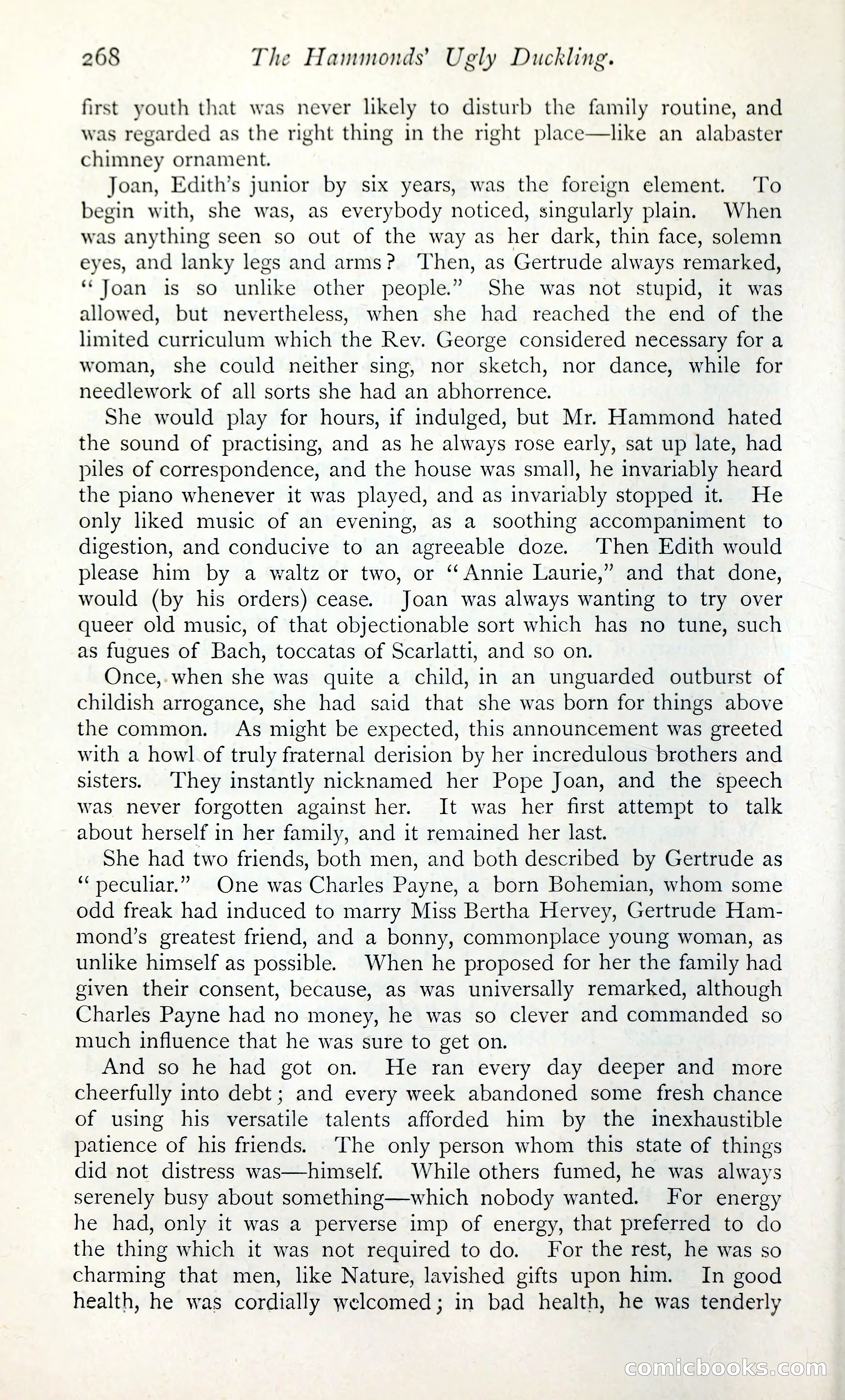
A restored page from Pulp Fiction, 1865. Page through the whole issue in the reader above.
📄 Transcribed text from this page (OCR, searchable)
Machine-transcribed from the original scan — historical spelling and the odd misread are preserved.
268 The Hammonds’ Ugly Duckling. first youth that was never likely to disturb the family routine, and was regarded as the right thing in the nght place—like an alabaster chimney ornament. Joan, Edith’s junior by six years, was the foreign element. To begin with, she was, as everybody noticed, singularly plain. When was anything seen so out of the way as her dark, thin face, solemn eyes, and lanky legs and arms? ‘Then, as Gertrude always remarked, “Joan is so unlike other people.” She was not stupid, it was allowed, but nevertheless, when she had reached the end of the limited curriculum which the Rev. George considered necessary for a woman, she could neither sing, nor sketch, nor dance, while for needlework of all sorts she had an abhorrence. She would play for hours, if indulged, but Mr. Hammond hated the sound of practising, and as he always rose early, sat up late, had piles of correspondence, and the house was small, he invariably heard the piano whenever it was played, and as invariably stopped it. He only liked music of an evening, as a soothing accompaniment to digestion, and conducive to an agreeable doze. Then Edith would please him by a waltz or two, or ‘‘ Annie Laurie,” and that done, would (by his orders) cease. Joan was always wanting to try over queer old music, of that objectionable sort which has no tune, such as fugues of Bach, toccatas of Scarlatti, and so on. Once,-when she was quite a child, in an unguarded outburst of childish arrogance, she had said that she was born for things above the common. As might be expected, this announcement was greeted with a howl of truly fraternal derision by her incredulous brothers and sisters. They instantly nicknamed her Pope Joan, and the speech was never forgotten against her. It was her first attempt to talk about herself in her family, and it remained her last. She had two friends, both men, and both described by Gertrude as “peculiar.” One was Charles Payne, a born Bohemian, whom some odd freak had induced to marry Miss Bertha Hervey, Gertrude Ham- mond’s greatest friend, and a bonny, commonplace young woman, as unlike himself as possible. When he proposed for her the family had given their consent, because, as was universally remarked, although Charles Payne had no money, he was so clever and commanded so much influence that he was sure to get on. And so he had got on. He ran every day deeper and more cheerfully into debt; and every week abandoned some fresh chance of using his versatile talents afforded him by the inexhaustible patience of his friends. The only person whom this state of things did not distress was—himself. While others fumed, he was always serenely busy about something—which nobody wanted. Jor energy he had, only it was a perverse imp of energy, that preferred to do the thing which it was not required to do. For the rest, he was so charming that men, like Nature, lavished gifts upon him. In good health, he was cordially welcomed; in bad health, he was tenderly EORNIELOOOKS.E©