
Pulp Fiction, 1865 · page 286 of 400
The Argosy — page 286: what you’re looking at
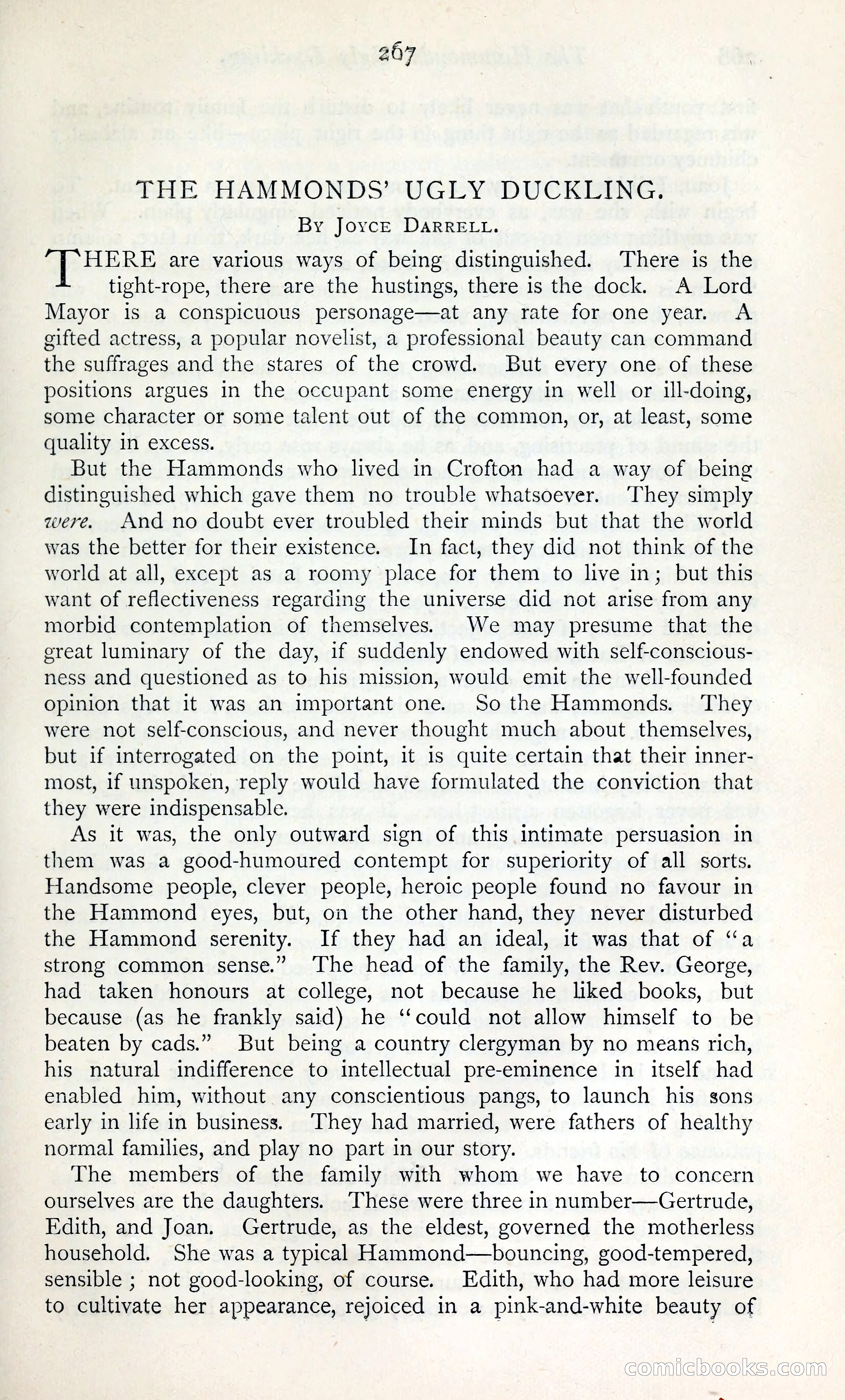
A restored page from Pulp Fiction, 1865. Page through the whole issue in the reader above.
📄 Transcribed text from this page (OCR, searchable)
Machine-transcribed from the original scan — historical spelling and the odd misread are preserved.
THE HAMMONDS’ UGLY DUCKLING. By Joyce DARRELL. HERE are various ways of being distinguished. There is the tight-rope, there are the hustings, there is the dock. A Lord Mayor is a conspicuous personage—at any rate for one year. A gifted actress, a popular novelist, a professional beauty can command the suffrages and the stares of the crowd. But every one of these positions argues in the occupant some energy in well or ill-doing, some character or some talent out of the common, or, at least, some quality in excess. But the Hammonds who lived in Crofton had a way of being distinguished which gave them no trouble whatsoever. ‘They simply were. And no doubt ever troubled their minds but that the world was the better for their existence. In fact, they did not think of the world at all, except as a roomy place for them to live in; but this want of reflectiveness regarding the universe did not arise from any morbid contemplation of themselves. We may presume that the great luminary of the day, if suddenly endowed with self-conscious- ness and questioned as to his mission, would emit the well-founded opinion that it was an important one. So the Hammonds. They were not self-conscious, and never thought much about themselves, but if interrogated on the point, it 1s quite certain that their inner- most, if unspoken, reply would have formulated the conviction that they were indispensable. As it was, the only outward sign of this intimate persuasion in them was a good-humoured contempt for superiority of all sorts. Handsome people, clever people, heroic people found no favour in the Hammond eyes, but, on the other hand, they never disturbed the Hammond serenity. If they had an ideal, it was that of “a strong common sense.” ‘The head of the family, the Rev. George, had taken honours at college, not because he liked books, but because (as he frankly said) he ‘‘could not allow himself to be beaten by cads.” But being a country clergyman by no means rich, his natural indifference to intellectual pre-eminence in itself had enabled him, without any conscientious pangs, to launch his sons early in life in business. They had married, were fathers of healthy normal families, and play no part in our story. The members of the family with whom we have to concern ourselves are the daughters. ‘These were three in number—Gertrude, Edith, and Joan. Gertrude, as the eldest, governed the motherless household. She was a typical Hammond—bouncing, good-tempered, sensible ; not good-looking, of course. Edith, who had more leisure to cultivate her appearance, rejoiced in a pink-and-white beauty of cConniclooolkks (CO) a