
Pulp Fiction, 1865 · page 288 of 400
The Argosy — page 288: what you’re looking at
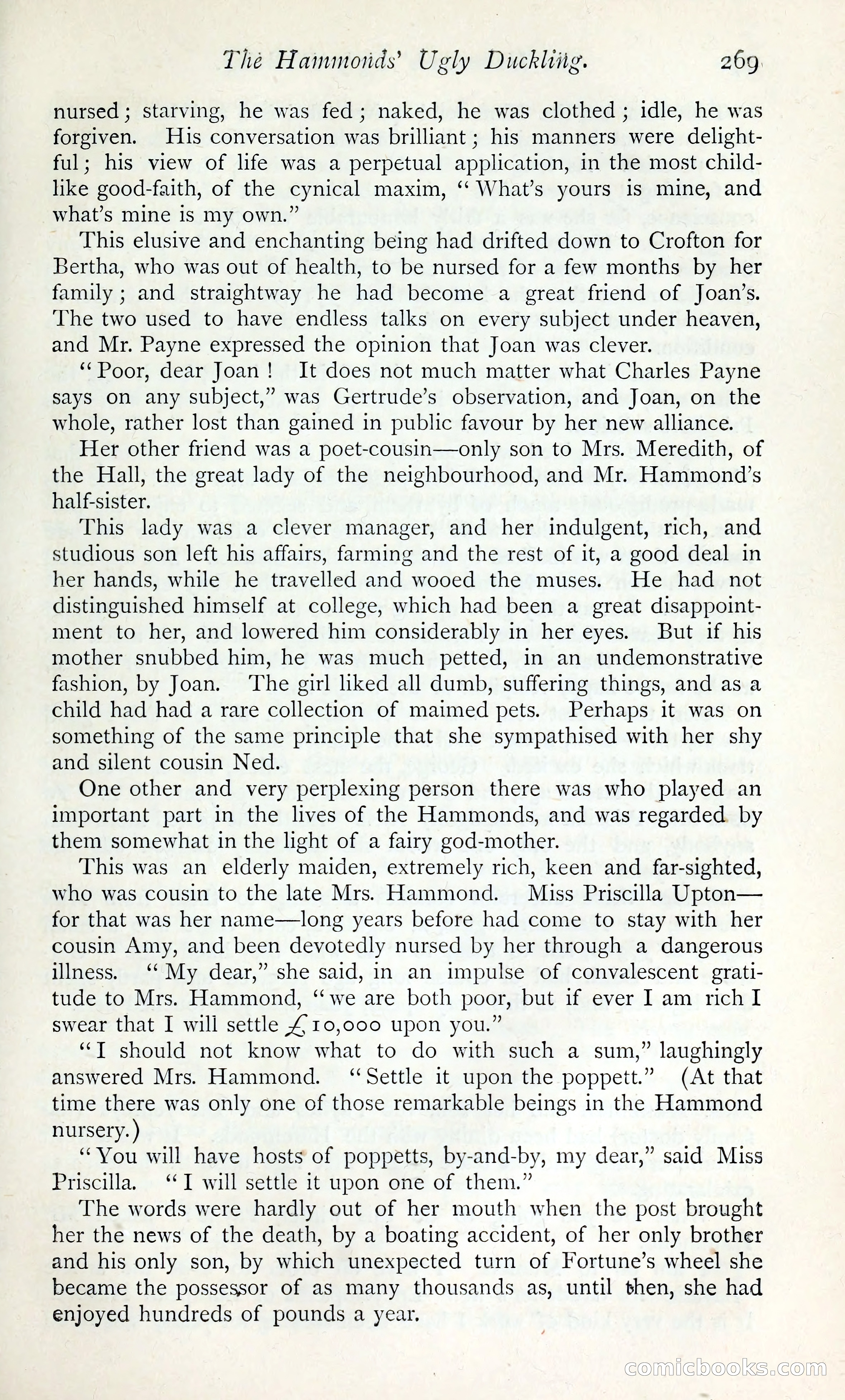
A restored page from Pulp Fiction, 1865. Page through the whole issue in the reader above.
📄 Transcribed text from this page (OCR, searchable)
Machine-transcribed from the original scan — historical spelling and the odd misread are preserved.
Thé Hainmonds’ Ugly Ducklhiig. 269 nursed ; starving, he was fed; naked, he was clothed ; idle, he was forgiven. His conversation was brilliant ; his manners were delight- ful; his view of life was a perpetual application, in the most child- like good-faith, of the cynical maxim, ‘‘ What’s yours 1s mine, and what’s mine 1s my own.” This elusive and enchanting being had drifted down to Crofton for Bertha, who was out of health, to be nursed for a few months by her family ; and straightway he had become a great friend of Joan’s. The two used to have endless talks on every subject under heaven, and Mr. Payne expressed the opinion that Joan was clever. ‘Poor, dear Joan! It does not much matter what Charles Payne says on any subject,” was Gertrude’s observation, and Joan, on the whole, rather lost than gained in public favour by her new alliance. Her other friend was a poet-cousin—only son to Mrs. Meredith, of the Hall, the great lady of the neighbourhood, and Mr. Hammond’s half-sister. This lady was a clever manager, and her indulgent, rich, and studious son left his affairs, farming and the rest of it, a good deal in her hands, while he travelled and wooed the muses. He had not distinguished himself at college, which had been a great disappoint- ment to her, and lowered him considerably in her eyes. But if his mother snubbed him, he was much petted, in an undemonstrative fashion, by Joan. ‘The girl hked all dumb, suffering things, and as a child had had a rare collection of maimed pets. Perhaps it was on something of the same principle that she sympathised with her shy and silent cousin Ned. One other and very perplexing person there was who played an important part in the lives of the Hammonds, and was regarded by them somewhat in the light of a fairy god-mother. This was an elderly maiden, extremely rich, keen and far-sighted, who was cousin to the late Mrs. Hammond. Miss Priscilla Upton— for that was her name—long years before had come to stay with her cousin Amy, and been devotedly nursed by her through a dangerous illness. ‘‘ My dear,” she said, in an impulse of convalescent grati- tude to Mrs. Hammond, ‘‘we are both poor, but if ever I am rich I swear that I will settle 4. 10,000 upon you.” “T should not know what to do with such a sum,” laughingly answered Mrs. Hammond. “Settle it upon the poppett.” (At that time there was only one of those remarkable beings in the Hammond nursery. ) “Vou will have hosts of poppetts, by-and-by, my dear,” said Miss Priscilla. ‘I will settle it upon one of them.” The words were hardly out of her mouth when the post brought her the news of the death, by a boating accident, of her only brother and his only son, by which unexpected turn of Fortune’s wheel she became the possessor of as many thousands as, until then, she had enjoyed hundreds of pounds a year. cConniclooolkks (C(O)